MARCOS (Marine Commandos)
MARCOS, short for Marine Commandos, is the special forces unit of the Indian Navy. Its official name is the Marine Commando Force (MCF). These are small teams of very highly trained soldiers who can fight at sea, under water, from the air and on land. They are used for the hardest missions: freeing hijacked ships, rescuing hostages, fighting terrorists, raiding enemy positions from the sea and guarding against infiltration.
They are often called India's most versatile special forces, because few units in the world are trained for all of sea, air and land.
Why does India need a force like this?
India has a long coastline (about 11,098 km as recalculated in 2024), more than a thousand islands, busy ports, and huge trade passing through the Indian Ocean. Some threats at sea cannot be handled by a big warship alone. If pirates take over a ship with sailors on board, the warship cannot simply fire at it, because the crew would die.
Someone has to get on board quietly and quickly, take control and protect the hostages. Think of a fire in a tall building: fire engines spray water from outside, but specially trained firefighters must go inside to rescue people. MARCOS are those people for the sea.
Where did it come from?
The Indian Navy started planning a maritime special force in April 1986. Three volunteer officers from its diving branch were chosen. They trained with the United States Navy SEALs at Coronado, and later had training exchanges with Britain's Special Boat Service (SBS). In February 1987, the unit was formally created as the Indian Marine Special Force (IMSF), with those three officers as its first members.
In 1991, it was renamed the Marine Commando Force, to give it its own identity. The short name MARCOS came into use after that.
How is it organised?
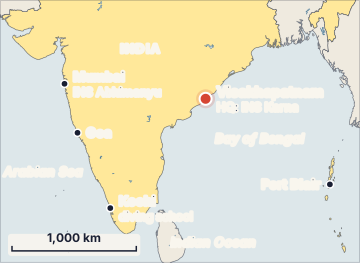
- Headquarters and base: INS Karna at Visakhapatnam, commissioned in 2016 as the force's permanent base.
- Training home: INS Abhimanyu in Mumbai, where the force was first formed and where much of the training takes place.
- Deployment: teams operate from naval bases at Mumbai, Visakhapatnam, Goa, Kochi and Port Blair.
- Smallest team: a group of eight commandos, called a Prahar.
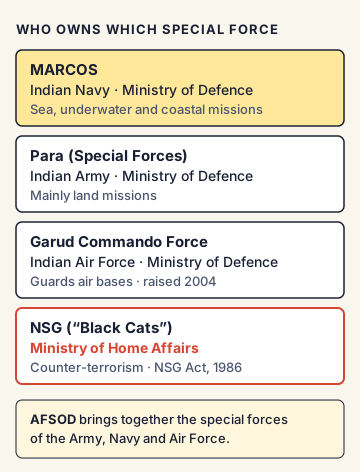
- Joint role: some MARCOS teams also work under the tri-service Armed Forces Special Operations Division (AFSOD), which brings together special forces of the Army, Navy and Air Force.
- Size: the exact number is secret. Estimates range from about 1,200 to 2,000 personnel.
How are MARCOS selected and trained?
Only volunteers from the Navy, usually in their early twenties, can try out. The first step is a tough three-day physical and mental test, which removes about 80% of candidates. Those who pass go through a very hard phase that tests whether they can keep going without sleep, food or rest. Basic training lasts around eight months and covers diving, parachuting (including free-fall jumps), close combat, counter-terrorism and anti-piracy.
Combat diving is taught at the Naval Diving School in Kochi. MARCOS also train with Army special forces, such as the Para (Special Forces). Most volunteers do not make it to the end.
Motto and nicknames
Their motto is "The Few, The Fearless". They are also called "Magarmach" (crocodiles), because they can strike from water as well as land, and "Dadhiwala Fauj" (the bearded army), from their appearance during operations in Jammu and Kashmir.
What have they done? Key operations
- Operation Pawan (1987), Sri Lanka: as part of the Indian Peace Keeping Force, they helped capture the harbours of Jaffna and Trincomalee.
- Operation Cactus (1988), Maldives: they helped defend the Maldives government against a coup attempt.
- Kargil War (1999): they were involved alongside the Indian Army.
- Jammu and Kashmir: they have been posted in the Wular Lake and Jhelum River areas to stop militants from using the water routes.
- 26/11 Mumbai attacks (2008), Operation Black Tornado: they took part in the operation at the Taj and Trident hotels.
- MV Lila Norfolk (January 2024): they boarded a hijacked merchant ship in the Arabian Sea and brought all 21 crew members to safety.
- MV Ruen (March 2024): a Malta-flagged cargo ship that pirates had held since December 2023. MARCOS were air-dropped into the sea from an IAF C-17 aircraft about 2,600 km from India's coast. With the warship INS Kolkata, they freed 17 crew members, and 35 pirates surrendered. The pirates were brought to Mumbai to face Indian law.
Commonly confused concepts
- MARCOS vs Para (Special Forces): MARCOS belong to the Navy and specialise in sea, underwater and coastal missions. Para (SF) belong to the Army and mainly work on land.
- MARCOS vs Garud Commando Force: Garud, raised in 2004, is the special force of the Indian Air Force. It protects air bases and carries out special missions linked to air operations.
- MARCOS vs NSG: the National Security Guard ("Black Cats") is a counter-terrorism force under the Ministry of Home Affairs, made under the NSG Act, 1986. MARCOS are a military force under the Ministry of Defence.
- MARCOS vs Indian Coast Guard: the Coast Guard (made under the Coast Guard Act, 1978) handles coastal policing, search and rescue, and protection of India's sea zones. It is not a special forces unit.
- Special forces vs regular forces: special forces are small, secret, very highly trained teams for high-risk tasks. Regular forces are large units that fight conventional battles.
Issues, criticism and the way forward
- Stretched thin: MARCOS are asked to do many things at once: anti-piracy at sea, counter-terrorism, protection of ports and duty in Jammu and Kashmir. Experts argue that using such a small elite force for routine tasks wears it out.
- Equipment and reach: missions far from India depend on long-range aircraft, fast boats, drones and good intelligence. The MV Ruen airdrop showed what is possible, but such missions need regular investment.
- Joint working: modern operations, like the 2024 and 2026 rescues, use the Navy, the Air Force and surveillance aircraft together. The way forward suggested by experts is stronger joint planning through bodies like AFSOD and the proposed theatre commands.
- Legal follow-up: catching pirates is only half the job. Without a law to try them, they may be set free. India's Maritime Anti-Piracy Act, 2022 now fills this gap.
Concepts to Know
- Special forces: small military units trained for difficult, high-risk missions such as hostage rescue, raids and secret operations.
- Non-kinetic measures: actions that put pressure on an opponent without firing weapons, such as blocking a boat's path, warning calls, close following and showing overwhelming force. "Kinetic" action means using weapons.
- Hostage: a person held by force, whose safety is used to make demands.
- Infiltration: secretly entering an area, for example militants crossing a border or coming in by water.
- Tri-service: involving all three armed services: Army, Navy and Air Force.
- Mother ship: a larger boat used by pirates as a floating base, from which small fast boats are sent out to attack ships far from the coast.
- Planning began April 1986; officers trained with US Navy SEALs and later with Britain's SBS
- Raised February 1987 as the Indian Marine Special Force (IMSF); renamed Marine Commando Force in 1991
- Motto: "The Few, The Fearless"; nicknames Magarmach and Dadhiwala Fauj
- Base: INS Karna, Visakhapatnam (2016); training: INS Abhimanyu, Mumbai; combat diving at Kochi
- Operations: Pawan (1987), Cactus (1988), Kargil (1999), Black Tornado (2008), MV Lila Norfolk (January 2024, 21 crew), MV Ruen (March 2024, 17 crew rescued, 35 pirates surrendered)
- Part of the tri-service Armed Forces Special Operations Division (AFSOD)
● Tracked since November 03, 2026 · last seen November 03, 2026 · updates as the daily brief publishes