Maize Cultivation in India
Crop, Regions and Uses
Maize (also called corn; scientific name Zea mays) is a cereal grain, like rice and wheat. In India it is the third most important cereal after rice and wheat. It is used as food for people, as feed for poultry and cattle, and as a raw material for industry, especially for starch and, more and more, for ethanol fuel. Because it gives high yields and has so many uses, maize is often called the "queen of cereals".
Why does maize matter so much?
Most crops have one main use. Maize has many. The same grain can end up as chicken feed, cornflakes, starch for medicines and paper, cooking oil from the germ, or ethanol for vehicles. So when any one of these industries grows, the demand for maize grows. Maize also needs much less water than paddy (rice). For farmers in areas where groundwater is falling, such as Punjab and Haryana, maize is one of the main crops suggested to replace water-hungry paddy.
Where did maize come from?
Maize was first domesticated (turned from a wild grass into a farm crop) in Mexico, in Central America, several thousand years ago. It spread to Europe after the voyages of Columbus, and is believed to have reached India around the 16th to 17th century through Portuguese traders. Today the United States, China and Brazil are the world's three largest producers. India is among the top producers by quantity, but its yield (output per hectare) is far below that of these leaders.
What does the crop need?
- Temperature: It grows best between about 21°C and 27°C. It does not tolerate frost.
- Soil: It grows well in old alluvial soil and other well-drained, fertile soils. It cannot stand waterlogging (water standing in the field), which damages its roots.
- Water: It needs moderate rainfall or irrigation, much less than paddy. It is sensitive to dry spells at the time of flowering.
- A C4 plant: Maize uses a special way of photosynthesis (C4) that lets it make food efficiently in heat and bright sunlight. This is one reason why it gives high yields.
When is it grown?
Maize is mainly a kharif crop, sown with the start of the southwest monsoon in June–July and harvested around September–October. Around 70% of its area is in kharif. In some states, such as Bihar, Andhra Pradesh, Telangana, Karnataka and Tamil Nadu, maize is also grown in rabi (winter), and rabi maize often gives higher yields because of irrigation, more sunlight and fewer pests. In Punjab and western Uttar Pradesh, some farmers also grow spring maize.
Where is it grown in India?
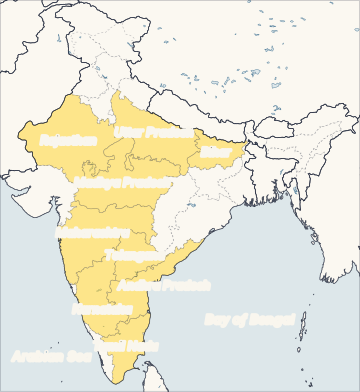
Maize is grown in almost every state, but the main producers are Karnataka, Madhya Pradesh, Maharashtra, Bihar, Tamil Nadu, Telangana, Andhra Pradesh, Rajasthan and Uttar Pradesh. The exact ranking changes from year to year. A lot of kharif maize in Rajasthan, Madhya Pradesh and Maharashtra is rain-fed (it depends only on rain), so its output rises and falls with the monsoon.
What is maize used for in India?
The shares change each year, but a 2025-26 market outlook estimated:
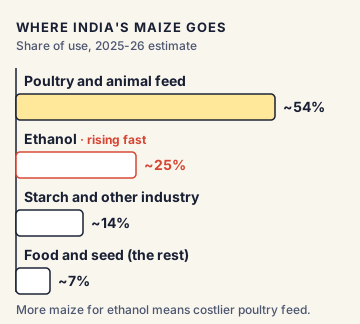
- Poultry and animal feed: about 54%. Maize is the main energy source in chicken feed, so the growth of the poultry industry has been the biggest driver of demand.
- Ethanol: about 25%, up sharply in the last few years.
- Starch and other industrial uses: about 14%. Starch is used in food processing, textiles, paper and medicines.
- The rest goes to human food (such as roti, corn flour, popcorn, sweet corn, baby corn) and seed.
How does the government support maize?
- Minimum Support Price (MSP): The Union Cabinet fixes it each season, based on the recommendation of the Commission for Agricultural Costs and Prices (CACP). For kharif 2026-27, the MSP of maize is ₹2,410 per quintal, just ₹10 more than the previous year's ₹2,400. In practice, government buying of maize at MSP is small, so market prices matter more.
- Research: The ICAR–Indian Institute of Maize Research (IIMR), Ludhiana leads maize research. In 2024, the government gave it about ₹15.46 crore for a project to raise maize production in the catchment areas of ethanol plants (the districts around these plants), covering 78 districts. Under this project, the institute also promotes growing maize between rows of sugarcane (intercropping).
- Better seeds: Most of the jump in yield has come from hybrid seeds, especially single-cross hybrids (made by crossing two pure parent lines), which give much higher and more uniform yields than ordinary seeds.
What about imports and GM maize?
India allows imports of up to 5 lakh tonnes of maize a year at a low 15% duty under a tariff-rate quota (TRQ). Imports above this limit face about 50% duty. India does not allow genetically modified (GM) maize: the only GM crop approved for farming in India is Bt cotton. Since most maize grown in the United States is GM, this rule limits which countries India can import maize from.
Commonly confused concepts
- Maize vs millets: Maize is a cereal but is not a millet. Millets (such as jowar, bajra and ragi) are small-grained, hardy crops; the "Shree Anna" campaign and the International Year of Millets 2023 were about millets, not maize.
- Normal maize vs Quality Protein Maize (QPM): Normal maize protein is low in two essential amino acids, lysine and tryptophan. QPM varieties are bred to contain more of them, making the grain more nutritious. QPM is a biofortified crop, not a GM crop.
- Hybrid vs GM: A hybrid is made by crossing two parent plants of the same crop in the normal way. A GM crop has a gene from another organism inserted in a laboratory. Hybrid maize is widely grown in India; GM maize is not allowed.
- Grain ethanol vs molasses ethanol: Molasses ethanol is made from a by-product of sugar mills. Grain ethanol is made from the starch in maize or rice, which is first turned into sugar and then fermented.
- Kharif maize vs rabi maize: Kharif maize is rain-fed and has a large area but lower yields; rabi maize has a smaller area but usually higher yields because it is irrigated and faces fewer pests.
Issues, criticism and the way forward
- Low yields: India's average yield is about 3.5 to 4 tonnes per hectare, compared with around 11 tonnes in the United States. Experts suggest wider use of good hybrids, better seed supply, mechanisation and better soil and water management.
- Food, feed and fuel competition: When more maize goes to ethanol, maize prices rise. This raises costs for poultry farmers and feed makers, who have asked for easier imports. This is part of the wider food vs fuel debate.
- Price swings for farmers: Maize prices can fall below MSP at harvest time, because government buying is limited. Farmers need assured buyers, such as contracts with ethanol plants, to make a long-term switch.
- Pests and climate: The fall armyworm, an invasive pest first found in India in Karnataka in 2018, damages maize across the country. Dry spells at flowering and heat waves also cut yields. Experts call for integrated pest management and climate-resilient varieties.
- Water and crop diversification: Moving land from paddy to maize can save groundwater. But maize must give farmers a similar income, otherwise they will not switch.
- Drying and storage: Freshly harvested maize has high moisture. Without proper drying and storage, it can develop aflatoxins (poisons made by fungi), which make it unfit for feed or food. Better drying and storage facilities near farms are needed.
Concepts to Know
- Feedstock: The raw material used to make a product. For ethanol, the feedstocks include sugarcane juice, molasses, maize and broken rice.
- Yield: How much crop is harvested from one hectare of land, usually in tonnes per hectare.
- Tariff-rate quota (TRQ): A system where a fixed quantity of a product can be imported at a low duty, and anything above it pays a much higher duty.
- Intercropping: Growing two crops in the same field at the same time, for example maize planted in the gaps between sugarcane rows.
- Biofortification: Breeding crops so that the grain naturally has more nutrients, such as protein, iron or zinc.
- Aflatoxin: A poisonous substance made by certain fungi that grow on damp grain. It is harmful to humans and animals.
- Scientific name: Zea mays; a C4 plant; India's third most important cereal after rice and wheat
- Grows best at about 21°C to 27°C in well-drained, fertile soil such as old alluvial soil; cannot stand waterlogging
- Mainly a kharif crop (about 70% of area); also grown in rabi (Bihar, Andhra Pradesh, Telangana, Karnataka, Tamil Nadu) and spring seasons
- Major states: Karnataka, Madhya Pradesh, Maharashtra, Bihar, Tamil Nadu, Telangana, Andhra Pradesh, Rajasthan, Uttar Pradesh
- Uses (2025-26 estimate): feed about 54%, ethanol about 25%, starch about 14%
- MSP: ₹2,400 per quintal (2025-26), ₹2,410 per quintal (kharif 2026-27)
- ICAR–Indian Institute of Maize Research: Ludhiana; ₹15.46 crore project for maize in ethanol catchment areas (78 districts)
- Import TRQ: 5 lakh tonnes at 15% duty; about 50% duty beyond; GM maize not approved in India (only Bt cotton is approved for cultivation)
- World's top producers: United States, China, Brazil
- Fall armyworm first reported in India in Karnataka in 2018
● Tracked since November 01, 2026 · last seen November 01, 2026 · updates as the daily brief publishes