Legislative Procedure for an Ordinary Bill
An ordinary bill is any proposed law that is not a Money Bill, a Financial Bill or a Constitution Amendment Bill. Most laws in India, such as a new criminal law or an amendment to the FCRA, are passed this way. To become an Act, an ordinary bill must be passed by both Houses of Parliament (the Lok Sabha and the Rajya Sabha) and then get the President's assent (approval). Each House reads and debates the bill in three stages, called the first, second and third readings.
Why such a long process?
A law affects crores of people and can stay for decades. A careful process gives time to find mistakes, hear different views and improve the text before it becomes binding. Having two Houses also adds a second check: the Rajya Sabha, which represents the states, can review what the Lok Sabha has passed. Think of it like a building plan that must be checked by two separate engineers and then signed by the owner before work starts.
Where does it come from?
The Constitution lays down the basic rules, and each House fills in the details through its own Rules of Procedure.
- Article 107: How bills are introduced and passed, and when they lapse.
- Article 108: Joint sitting of both Houses to settle a deadlock.
- Article 111: The President's assent to bills.
- Article 118: Each House can make its own rules of procedure.
- (For comparison: Articles 109 and 110 cover Money Bills, Article 117 covers Financial Bills, and Article 368 covers Constitution Amendment Bills.)
Under Article 107(1), an ordinary bill can be introduced in either House. It can be a government bill (moved by a minister) or a private member's bill (moved by an MP who is not a minister).
First reading: introduction
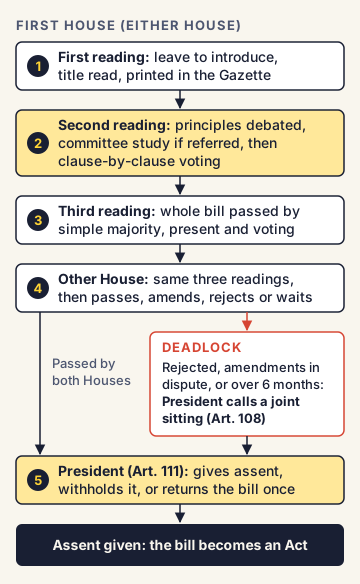
The minister or member asks the House for leave (permission) to introduce the bill. Once the House agrees, the bill is introduced and its title and objectives are read out. There is usually no debate on the bill's details at this stage. The bill is then published in the Gazette of India (the government's official journal). If the bill was already published in the Gazette with the presiding officer's permission before introduction, leave to introduce is not needed.
Second reading: the most important stage
This is where the bill gets its detailed examination. It has three parts.
- General discussion stage: Copies of the bill are given to members and the main principles are debated. The member in charge can then move one of four motions:
- to take the bill into consideration at once,
- to refer it to a Select Committee of that House,
- to refer it to a Joint Committee of both Houses (this needs the other House to agree),
- to circulate it to get public opinion.
Separately, the presiding officer (the Lok Sabha Speaker or the Rajya Sabha Chairman) can send a bill to the relevant Department-related Standing Committee for study.
- Committee stage: If referred, the committee studies the bill clause by clause (section by section). It can hear experts, officials and affected groups, and can suggest amendments. It cannot change the basic principle the House approved. It then sends its report to the House.
- Consideration stage: The House goes through the bill clause by clause. Members move amendments, and each clause, with or without amendments, is put to vote.
Third reading: final vote
The House debates whether to accept or reject the bill as a whole. Only formal, verbal or consequential amendments (small wording changes) are allowed now. If a simple majority of members present and voting agrees, the bill is passed. Example: if 400 members are present and all vote, at least 201 must vote "yes". The presiding officer then certifies the bill and sends it to the other House.
In the second House
The bill again goes through all three readings. The second House has four options:
- pass the bill as sent;
- pass it with amendments and send it back to the first House;
- reject it completely;
- take no action and keep it pending.
If the first House accepts the amendments, the bill is passed by both Houses.
What if the two Houses disagree? The joint sitting (Article 108)
A deadlock arises if, after one House passes a bill, the other House:
- rejects it, or
- disagrees on the amendments to be made, or
- does not pass it for more than six months from the date it receives the bill.
While counting the six months, any period when that House is prorogued (its session formally ended) or adjourned for more than four days in a row is not counted. In a deadlock, the President may call a joint sitting of both Houses.
- It is chaired by the Lok Sabha Speaker (in his absence, the Deputy Speaker; if both are absent, the Deputy Chairman of the Rajya Sabha).
- The bill is passed by a majority of the total members of both Houses present and voting. Since the Lok Sabha has more than twice as many members as the Rajya Sabha, it usually prevails.
- No new amendments can be proposed, except those made necessary by the delay or those on which the Houses disagreed.
- A joint sitting is not possible for Money Bills (the Lok Sabha has the final say on them anyway) or Constitution Amendment Bills (each House must pass them separately by special majority).
Joint sittings have been held only three times: the Dowry Prohibition Bill (1961), the Banking Service Commission (Repeal) Bill (1978) and the Prevention of Terrorism Bill (2002).
President's assent (Article 111)
After both Houses pass the bill, it goes to the President, who can:
- give assent, and the bill becomes an Act;
- withhold assent, and the bill ends (this is called the absolute veto);
- return the bill for reconsideration (the suspensive veto). If both Houses pass it again, with or without amendments, the President must give assent. A Money Bill cannot be returned.
The Constitution sets no time limit for the President to decide. Sitting on a bill indefinitely is called the pocket veto. President Zail Singh used it in 1986 on the Indian Post Office (Amendment) Bill.
When does a bill lapse (die)? Article 107
Sessions end (prorogation) and the Lok Sabha is dissolved every five years, or earlier. The rules are:
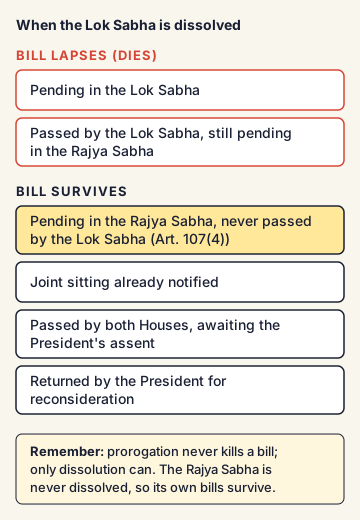
- Prorogation of a House does not kill a pending bill (Article 107(3)).
- On dissolution of the Lok Sabha:
- a bill pending in the Lok Sabha lapses;
- a bill passed by the Lok Sabha but pending in the Rajya Sabha lapses;
- a bill pending in the Rajya Sabha but not passed by the Lok Sabha does not lapse (Article 107(4));
- a bill for which the President has notified a joint sitting before dissolution does not lapse;
- a bill passed by both Houses and pending the President's assent, or returned by the President for reconsideration, does not lapse.
A simple way to remember: the Rajya Sabha is a permanent House and is never dissolved, so bills that belong only to it survive. Bills "carried" by the dissolved Lok Sabha die with it.
How committees fit in: India's experience
India has 24 Department-related Standing Committees (DRSCs), each with 31 members (21 from the Lok Sabha and 10 from the Rajya Sabha). The first 17 were set up in 1993, and the number was raised to 24 in 2004. Sending a bill to a committee is not compulsory. According to PRS Legislative Research, the share of bills referred to committees fell from about 71% in the 15th Lok Sabha (2009-14) to about 25% in the 16th (2014-19) and 16% in the 17th (2019-24). For major or disputed bills, Parliament sometimes uses a JPC, as with the FCRA Amendment Bill, 2026.
India's other related tools
- Pre-Legislative Consultation Policy (2014): Ministries are expected to publish draft bills for public comment for at least 30 days before sending them to the Cabinet.
- Ordinances (Article 123): When Parliament is not in session, the President can make a temporary law on the advice of the government. It must be approved by Parliament within six weeks of the Houses reassembling, or it ends.
Commonly confused concepts
- Ordinary Bill vs Money Bill: An ordinary bill can start in either House, needs both Houses' approval and can go to a joint sitting. A Money Bill (Article 110) can start only in the Lok Sabha, on the President's recommendation; the Rajya Sabha can only make recommendations within 14 days; there is no joint sitting.
- Select Committee vs Joint Committee vs DRSC: A Select Committee has members of one House. A Joint Committee has members of both Houses and is formed for one bill or matter. A DRSC is permanent and covers a group of ministries.
- Prorogation vs adjournment vs dissolution: Adjournment pauses a sitting for hours or days. Prorogation ends a session. Dissolution ends the life of the Lok Sabha itself. Only dissolution can make bills lapse.
- Joint sitting vs joint address: A joint sitting (Article 108) settles a deadlock on a bill. The President's address to both Houses (Article 87) happens at the start of the first session each year and after each general election. It is not a joint sitting under Article 108.
- Simple majority vs special majority: Ordinary bills need a simple majority of members present and voting. Constitution Amendment Bills under Article 368(2) need a special majority: a majority of the total membership of the House and two-thirds of members present and voting.
Issues, criticism and the way forward
- Fewer bills sent to committees: The fall in committee referrals means many laws are passed without detailed, expert scrutiny. Critics say this leads to poorly drafted laws that later need amendments or are challenged in court.
- Little time for debate: PRS data shows many bills are passed after short debates, sometimes in a single sitting, often amid disruptions.
- Rushed consultations: As seen in committee hearings, stakeholders often complain that they get too little time to give views.
- Use of shortcuts: Critics point to frequent ordinances and the use of the Money Bill route to avoid the Rajya Sabha. The government's view is that some laws are urgent and that Parliament still has the final say.
- Way forward: Experts and bodies like the National Commission to Review the Working of the Constitution (NCRWC, 2002) have suggested stronger committees. Common suggestions include making committee scrutiny the default for important bills, giving committees research staff, following the pre-legislative consultation policy, and fixing a minimum number of sitting days for Parliament.
Concepts to Know
- Bill vs Act: A bill is a draft law. It becomes an Act only after both Houses pass it and the President gives assent.
- Clause: A single numbered section of a bill. After the bill becomes an Act, clauses become sections.
- Gazette of India: The government's official publication where laws, rules and notices are printed. Publishing in it makes a document official.
- Stakeholder: Any person or group affected by a law, such as NGOs, businesses, workers, or religious and educational institutions.
- Presiding officer: The person who runs a House: the Speaker in the Lok Sabha and the Chairman (the Vice-President of India) in the Rajya Sabha.
- Veto: The power to stop or delay a decision. "Veto" is a Latin word meaning "I forbid".
- Ordinary bill: Article 107 (introduction, passing, lapse); can start in either House
- Three readings in each House; detailed clause-by-clause examination in the second reading
- Passed by a simple majority of members present and voting
- Deadlock: rejection, disagreement on amendments, or more than 6 months without passing
- Joint sitting: Article 108; called by the President; chaired by the Speaker; not for Money Bills or Constitution Amendment Bills
- Joint sittings held 3 times: 1961 (Dowry Prohibition), 1978 (Banking Service Commission Repeal), 2002 (Prevention of Terrorism)
- President's assent: Article 111; returned bill re-passed must get assent; pocket veto used by Zail Singh, 1986 (Indian Post Office (Amendment) Bill)
- Lapse on dissolution: bills pending in or passed by the Lok Sabha lapse; bills pending only in the Rajya Sabha (never passed by the Lok Sabha) do not
- DRSCs: 24, each 31 members (21 LS + 10 RS); first 17 set up in 1993
- Bills referred to committees (PRS): 71% (15th LS), 25% (16th LS), 16% (17th LS)
● Tracked since July 27, 2026 · last seen November 20, 2026 · updates as the daily brief publishes