Judges (Protection) Act, 1985
Legal Shield for Judicial Acts
The Judges (Protection) Act, 1985 is a short law made by Parliament that protects judges from being sued or prosecuted for the work they do as judges. It says no court can hear a civil case (like a claim for money) or a criminal case against a current or former judge for any act done or word spoken while doing judicial work.
But the law also keeps a door open: the government, the Supreme Court, the High Courts and other lawful authorities can still take action against a judge. So it protects judges from harassment by private parties, without placing them above the law.
Why does it exist?
Every court case has a loser. If the losing side could file a case against the judge personally, judges would spend their lives defending themselves. A judge who fears being sued would hesitate to give a bold or unpopular decision. Think of a cricket umpire: if every batsman given out could sue the umpire, no umpire would raise a finger. Protection lets judges decide cases freely and honestly, which is the core of judicial independence.
Where did it come from?
India had such protection long before 1985.
- The Judicial Officers' Protection Act, 1850 protected judicial officers from civil cases for acts done in their judicial role, but only if they acted in good faith (honestly).
- Section 77 of the Indian Penal Code, 1860 said nothing is an offence if a judge does it while acting judicially, using a power given by law, or one the judge in good faith believes the law gives. This is now Section 15 of the Bharatiya Nyaya Sanhita (BNS), 2023, which came into force on 1 July 2024.
- Parliament then passed the Judges (Protection) Act, 1985 (Act No. 59 of 1985). It received assent and came into force on 6 September 1985. Its long title says it is "for securing additional protection for Judges and others acting judicially". The word "additional" matters: it adds to the older protections and does not replace them.
Who counts as a "Judge"? (Section 2)
The law uses a wide meaning. A "Judge" includes not only people officially called judges, but also:
- anyone the law empowers to give a definitive judgment (a final decision) in a legal proceeding, or a judgment that becomes final if nobody appeals or if a higher authority confirms it; and
- any member of a body of persons (like a tribunal bench) that the law empowers to give such a judgment.
So magistrates, tribunal members and other officers who decide cases can also be covered.
What does Section 3 say?
This is the heart of the Act. It has two parts that must be read together.
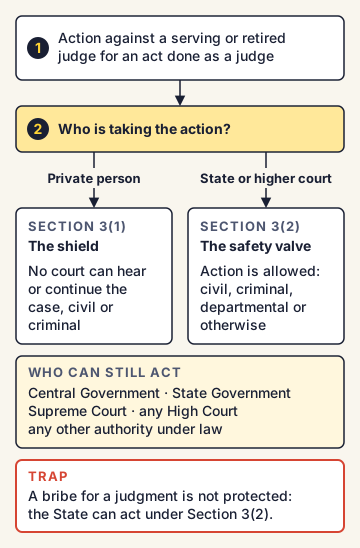
- Section 3(1), the shield: No court shall entertain or continue any civil or criminal proceeding against any person who is or was a Judge, for any act, thing or word committed, done or spoken while acting or purporting to act in the discharge of official or judicial duty or function. "Is or was" means the protection continues even after the judge retires. "Purporting to act" means the judge believed or claimed to be acting officially, even if the act later turns out to be outside the judge's power.
- Section 3(2), the safety valve: Nothing in Section 3(1) stops the Central Government, a State Government, the Supreme Court, any High Court or any other authority under any law from taking action (civil, criminal, departmental or otherwise) against a current or former judge.
You can picture it like this. Section 3(1) locks the door against private persons. Section 3(2) gives the State and the higher judiciary a key.
Section 4, the saving clause
The Act is "in addition to, and not in derogation of" any other law protecting judges. In plain words, it adds protection and does not take away any older protection.
How does it work in practice?
Suppose a litigant who lost a property case files a criminal complaint saying the judge "cheated" him by deciding against him. Under Section 3(1), the court must refuse to hear it, because the act was a judicial one. But suppose an investigating agency finds material that the judge took a bribe to give that judgment.
Courts have held that in such a case the State can act under Section 3(2), and the shield of Section 3(1) does not protect the judge. The protection is for honest judicial work, not for corruption.
How do courts deal with corruption by higher judges?
In K. Veeraswami v. Union of India (1991), a Constitution Bench of the Supreme Court held that judges of the High Courts and the Supreme Court are public servants under the anti-corruption law. But to protect judicial independence, it said no criminal case should be registered against such a judge without first consulting the Chief Justice of India. So even for top judges, there is a path to prosecution, with a safeguard.
India's position and other forms of immunity
Indian law gives different kinds of protection to different offices, each with limits:
- President and Governors (Article 361): not answerable to any court for the exercise of their official powers; no criminal case and no arrest during the term of office; civil cases about personal acts need two months' notice. The criminal protection ends when the term ends.
- Members of Parliament and state legislatures (Articles 105 and 194): freedom of speech and voting inside the House. In Sita Soren v. Union of India (2024), a seven-judge bench held that this does not protect a legislator who takes a bribe to vote or speak.
- Public servants in general: protected not by a bar but by the need for prior sanction (government permission) before prosecution, under Section 218 of the Bharatiya Nagarik Suraksha Sanhita (BNSS), 2023 (earlier Section 197 of the CrPC).
Commonly confused concepts
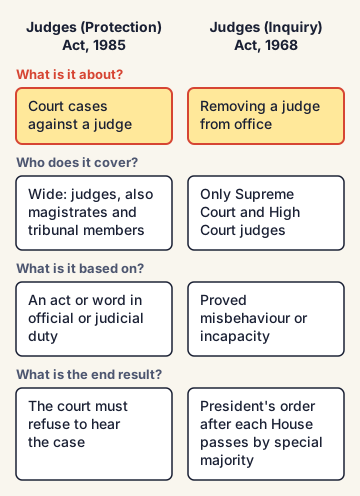
- Judges (Protection) Act, 1985 vs Judges (Inquiry) Act, 1968: The 1985 Act protects judges from court cases. The 1968 Act lays down how a complaint against a Supreme Court or High Court judge is investigated for removal by Parliament. One is about lawsuits; the other is about removal.
- Protection from lawsuits vs removal: A judge of the Supreme Court can be removed only under Article 124(4), by an order of the President after each House of Parliament passes an address by a special majority: a majority of the total membership of the House and two-thirds of members present and voting. Example: in a House of 545, at least 273 must vote yes, and if 450 are present and voting, at least 300 must vote yes. The 1985 Act does not touch this process.
- Immunity vs sanction: Immunity is a bar, so no court can hear the case at all. Sanction is a gate: the case can go ahead once the competent authority gives permission.
- Section 77 IPC / Section 15 BNS vs the 1985 Act: Section 15 BNS says a judge's judicial act is not an offence at all. The 1985 Act goes further and stops courts from even hearing civil or criminal cases about such acts.
Issues, criticism and the way forward
- Accountability gap: Critics argue that broad immunity, combined with rare removals, makes it hard to hold judges accountable. Since 1950 no Supreme Court or High Court judge has been removed by Parliament.
- Who decides what is "judicial"? The line between a judicial act and personal misconduct is not always clear, so courts have to decide case by case.
- Copying the model to other offices: When this protection is copied into laws for non-judicial offices without the Section 3(2) safety valve, the balance between independence and accountability changes. This is the main legal debate around Section 16 of the 2023 election commissioners' law.
- Way forward suggested by experts: keep strong protection for honest judicial work, but keep clear and time-bound routes for the State and higher courts to act on evidence of corruption, and consider a transparent complaints mechanism for judicial misconduct.
Concepts to Know
- Civil proceeding: A court case between private parties, usually for money or property, like a claim for compensation.
- Criminal proceeding: A case where the State prosecutes someone for a crime that can lead to jail or a fine.
- Immunity: Legal protection that stops a person from being taken to court for certain acts.
- Judicial independence: The idea that judges should be free to decide cases without fear of the government, powerful people or lawsuits.
- Departmental proceedings: Action taken inside an organisation (like suspension or a disciplinary inquiry), not in a criminal court.
- Read down: When a court keeps a law but interprets it narrowly so that it does not break the Constitution.
- Judges (Protection) Act, 1985: Act No. 59 of 1985, in force from 6 September 1985
- Section 2: wide definition of "Judge" (anyone empowered to give a definitive judgment, including members of a deciding body)
- Section 3(1): no civil or criminal proceeding against a person who "is or was" a Judge for official or judicial acts or words
- Section 3(2): Central Government, State Government, Supreme Court, High Courts and other authorities can still act against a current or former judge
- Section 4: Act is in addition to, not in derogation of, other laws protecting judges
- Older protections: Judicial Officers' Protection Act, 1850 (good faith); Section 77 IPC, now Section 15 BNS, 2023
- K. Veeraswami v. Union of India (1991): higher judges are public servants under anti-corruption law; consult the CJI before registering a case
- Removal of Supreme Court judges: Article 124(4), special majority in each House; procedure under the Judges (Inquiry) Act, 1968
● Tracked since November 04, 2026 · last seen November 04, 2026 · updates as the daily brief publishes