Joint Forest Management (JFM)
Joint Forest Management, or JFM, is a system in which the State Forest Department and the people of a nearby village protect and manage a forest together, and share what the forest produces. The villagers form a JFM Committee (JFMC). In return for protecting the forest from fire, illegal cutting and over-grazing, they get free access to items like fuelwood, fodder and minor forest produce, and a share of the money from timber. It is a partnership: the forest stays government land, but the people living next to it become its guardians.
Why was it needed?
For about a hundred years, forests in India were managed only by the Forest Department. Local people were treated as a problem to be kept out, not as partners. But the people who lived next to the forest needed it every day for fuel, fodder and food. With nothing to gain from protecting it, and no say in how it was run, many cut what they needed.
Forest staff were too few to guard huge areas. By the 1970s and 1980s, large areas of forest were badly degraded. JFM tried a simple idea: if people get a fair share of the benefits, they will protect the forest themselves.
Where did it come from?
The idea grew out of local experiments, before it became national policy.
- Arabari, West Bengal (1972): In Midnapore district, a forest officer, Ajit Kumar Banerjee, asked villagers to protect a degraded sal forest. In return they got free non-timber produce, first preference in forest work and a 25% share of the money from selling sal poles. The forest grew back. This is seen as the birthplace of JFM.
- Sukhomajri, Haryana (1970s): Villagers protected a hill catchment from grazing in return for water from a small dam and grass from the hills. It is another early model of people-led protection.
- National Forest Policy, 1988: It made people's participation a national goal. It said the needs of tribal and other poor people living in and near forests for fuelwood, fodder, minor forest produce and small timber should be the "first charge" on forest produce, and called for a "massive people's movement" to protect forests.
- 1 June 1990: The Union Ministry of Environment and Forests sent a circular to all states. It asked them to involve village communities and voluntary agencies in regenerating degraded forests. This circular is the official start of JFM. States then issued their own JFM resolutions.
How does JFM work?
It runs step by step at the village level.
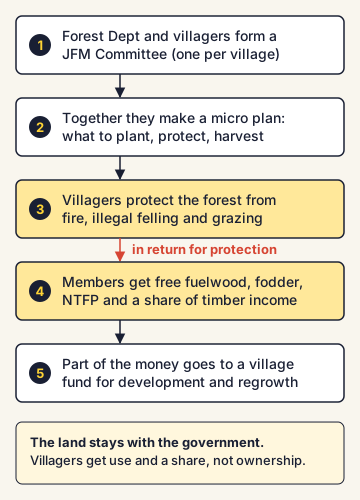
- The Forest Department and villagers form a JFM Committee for a patch of forest, usually one committee per revenue village.
- The committee and forest staff prepare a micro plan: a small local plan for what to plant, protect and harvest, and how to share the produce.
- Members protect the forest: they watch for fires, illegal felling, encroachment and grazing.
- In return, members collect fuelwood, fodder and non-timber produce for their own use, and get an agreed share of timber income when trees are harvested.
- A part of the money goes into a village fund for development work and for regenerating the forest.
Think of it like a housing society and a builder. The builder (Forest Department) still owns the land, but the residents (villagers) look after the garden and keep a share of the fruit.
The key guidelines
The Centre has issued three main sets of JFM guidelines:
- 1 June 1990: started JFM, with a focus on degraded forests.
- 21 February 2000: strengthened JFM. It asked states to give JFMCs legal backing by registering them under the Societies Registration Act, 1860, to use one common name (JFM Committees) and to sign an agreement with each committee. It set rules for women's participation: at least 50% women in the general body, at least 33% women in the executive committee, and at least one of the posts of President, Vice-President or Secretary for a woman. It allowed JFM in good forests on a pilot basis, with revenue sharing capped at 20% and only after at least 10 years of protection. It also asked that 25% of the village's share be put back into the forest.
- 24 December 2002: asked for a Memorandum of Understanding (MoU) between the Forest Department and each JFMC, set out a relationship with panchayats (JFMCs keep their separate, non-political identity as "guardians of forests"), and stressed capacity building for managing non-timber forest produce.
How big is JFM?
As of 1 January 2000, about 36,075 committees were managing about 10.24 million hectares of forest. By 2011, Ministry figures put the number at more than 1,18,000 committees managing about 22.94 million hectares of recorded forest. Near protected areas (national parks and sanctuaries), similar village bodies are called Eco-Development Committees (EDCs).
How is it funded?
Under the National Afforestation Programme (NAP), the Centre funds forest restoration through a two-tier system: a Forest Development Agency (FDA) at the forest division level, and JFMCs at the village level. The FDA is a federation of the JFMCs in its division. Later programmes such as the Green India Mission also use village institutions, with a larger role for gram sabhas.
Commonly confused concepts
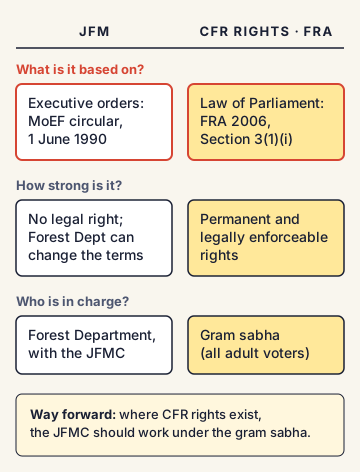
- JFM vs Community Forest Resource (CFR) rights under FRA: JFM rests on government orders and circulars; it gives no legal right to the forest, and the Forest Department can change the terms. CFR rights come from a law passed by Parliament (Section 3(1)(i) of the FRA, 2006); they are permanent, legally enforceable rights, and the gram sabha is the authority, not the Forest Department.
- JFMC vs gram sabha: A JFMC is a committee formed under Forest Department rules, with its forest officer as a member. The gram sabha is the assembly of all adult voters of the village, recognised by Article 243A of the Constitution and given special powers by the FRA and the PESA Act, 1996.
- JFM vs social forestry: Social forestry (mainly 1970s and 1980s) meant planting trees on non-forest land (roadsides, village commons, farm boundaries) to meet local needs. JFM is about protecting and regenerating existing forest land together with villagers.
- JFMC vs Van Panchayat: Van Panchayats of Uttarakhand are older (rules from 1931) village forest councils that manage village forests on their own, under their own rules. JFMCs are newer and work jointly with the Forest Department.
Issues, criticism and the way forward
- Weak legal status: In many states JFMCs are not registered bodies. The Forest Department can dissolve them or change the sharing terms, so villagers feel like junior partners.
- Forest Department control: The forest officer often acts as the committee's secretary and controls funds and decisions. Critics say JFM gave people duties but not real power.
- Benefits delayed or unpaid: Timber income comes only after many years, and in some places the promised share was paid late or not at all.
- Overlap with FRA: After 2006, JFMCs and FRA gram sabhas sometimes claim the same forest. The Ministry of Tribal Affairs has objected when states gave forest rights to JFMCs instead of gram sabhas, because the FRA makes the gram sabha the authority.
- Equity: Better-off households and men often dominate meetings; women and the poorest, who depend most on the forest, may have less voice despite the quotas.
- Way forward: Experts suggest that where CFR rights exist, JFMCs should work under the gram sabha, with the Forest Department as a technical adviser; that JFM micro plans and CFR management plans be merged into one plan; that benefit-sharing be paid on time and openly; and that results be judged by forest health and income, not just by the number of committees formed.
Concepts to Know
- Degraded forest: Forest land where most trees have been cut or damaged, so the canopy (the tree cover seen from above) is thin and the land produces little.
- Non-Timber Forest Produce (NTFP) / Minor Forest Produce: Things taken from the forest other than timber, such as tendu leaves, bamboo, honey, lac, mahua flowers, medicinal plants and fodder.
- Working plan: A ten-year (or similar) official plan made by the Forest Department for each forest division, saying what can be cut, planted and protected.
- Usufruct: The right to use and enjoy the products of a property (like fruits or leaves) without owning the property itself.
- Societies Registration Act, 1860: An old law under which groups like clubs and charities register so they become legal bodies that can open bank accounts and sign agreements.
- Revenue village: A village as recorded in the land-revenue records of the government; it may include several smaller hamlets.
- Basis: National Forest Policy, 1988; first central JFM circular: 1 June 1990 (Ministry of Environment and Forests)
- Origin: Arabari, Midnapore district, West Bengal (1972), led by forest officer Ajit Kumar Banerjee; villagers got a 25% share of sal pole income
- 21 February 2000 guidelines: register JFMCs under the Societies Registration Act, 1860; 50% women in general body, 33% in executive committee; JFM in good forests on pilot basis, revenue share up to 20% after 10 years of protection; 25% of village share ploughed back
- 24 December 2002 guidelines: MoU with each JFMC; link with panchayats; NTFP capacity building
- Scale: about 36,075 JFMCs over 10.24 million ha (1 January 2000); more than 1,18,000 JFMCs over 22.94 million ha (2011 figures)
- Funding channel: National Afforestation Programme, two-tier: Forest Development Agency (division) and JFMC (village)
- JFM is based on executive orders; CFR rights are statutory, under Section 3(1)(i), FRA 2006
● Tracked since October 15, 2026 · last seen October 15, 2026 · updates as the daily brief publishes