Japan's Pacifist Constitution
Article 9 and the Self-Defense Forces
Article 9 of Japan's Constitution says Japan gives up war forever as a way to settle quarrels with other countries. It also says Japan will not keep "land, sea and air forces" or other "war potential". This is why Japan is called a "pacifist" country. Yet Japan today has one of the world's best-equipped militaries, called the Japan Self-Defense Forces (JSDF). The story of how both can be true, and how the rules keep changing, explains much of Japan's security policy.
Why does Article 9 exist?
Japan fought a long war across Asia and the Pacific, which ended with its defeat in 1945 after the atomic bombings of Hiroshima and Nagasaki. The Allied occupation (led by the USA under General Douglas MacArthur) wanted to make sure Japan could never again start a war. So a ban on war was written into the new Constitution. Many Japanese people, tired of war, also strongly supported it.
Where did it come from?
The new Constitution was promulgated (formally announced) on 3 November 1946 and came into force on 3 May 1947. It has never been amended since then. Article 9 has two paragraphs:
- Paragraph 1: The Japanese people forever renounce war as a sovereign right of the nation, and the threat or use of force as a means of settling international disputes.
- Paragraph 2: To achieve this, land, sea and air forces, as well as other war potential, will never be maintained, and the "right of belligerency" (the legal rights a country has when at war) will not be recognised.
How did Japan get armed forces anyway?
The world changed fast. When the Korean War began in 1950, US troops in Japan left for Korea. With the occupation's approval, Japan created a National Police Reserve in 1950. It became the National Safety Force in 1952. On 1 July 1954, Japan set up the Self-Defense Forces, with three branches: Ground, Maritime and Air.
The government's argument was simple: every country has an inherent right to defend itself, and Article 9 only bans forces for war, not the minimum force needed for self-defence. Japan's Supreme Court, in the Sunagawa case (1959), said Article 9 does not deny Japan's inherent right of self-defence.
The old limits on Japan's military
For decades, Japan kept tight self-made rules:
- Exclusively defence-oriented policy: Use force only after being attacked, and only the minimum needed.
- No collective self-defence: Japan would not fight to defend an ally that was attacked, if Japan itself was not attacked.
- Defence spending capped at 1% of GNP: In 1976 the cabinet decided that defence spending should not go above 1% of GNP (gross national product, the measure of the economy used then). The cabinet formally dropped this cap in 1987, but spending stayed close to 1% of the economy in practice for many years after.
- Arms export limits: In 1967, Japan's "Three Principles on Arms Exports" banned weapon exports to communist countries, to countries under UN arms embargoes, and to countries in or likely to enter a conflict. In 1976 the cabinet widened this into a near-total ban on weapon exports to every country.
- Three Non-Nuclear Principles (1967): Japan will not possess, produce or permit the entry of nuclear weapons.
How has the meaning changed? (step by step)
Without changing a single word of Article 9, Japan has changed how it reads the article:
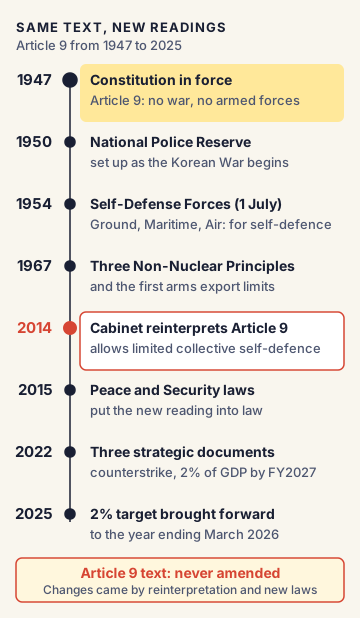
- April 2014: The arms export ban was replaced by the Three Principles on Transfer of Defense Equipment and Technology. Exports became possible under conditions. In December 2023 the rules were relaxed further, allowing some finished equipment to be exported.
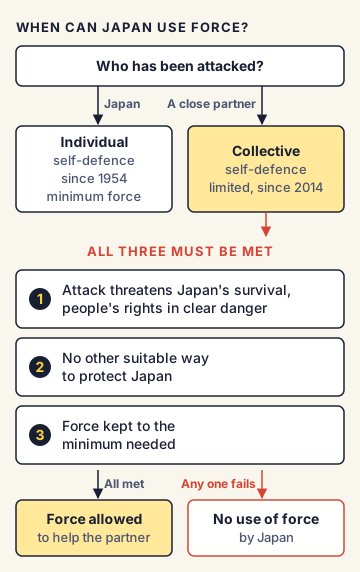
- 1 July 2014: The cabinet reinterpreted Article 9 to allow limited collective self-defence. Japan may now use force to help a country with close ties to Japan (such as the USA) when that country is attacked, even if Japan itself is not attacked. All three conditions must be met. First, the attack on that country threatens Japan's very survival and puts the Japanese people's basic rights (life, liberty and the pursuit of happiness) in clear danger. Second, there is no other suitable way to protect Japan. Third, the force used is kept to the minimum needed.
- September 2015: The Diet (Japan's parliament) passed the Legislation for Peace and Security, which put this reinterpretation into law. It came into force in March 2016.
- December 2022: Japan adopted three new documents: the National Security Strategy, the National Defense Strategy and the Defense Buildup Program. They allowed Japan to build "counterstrike capability" (the ability to hit an enemy's missile launch sites or bases, in self-defence, once an attack has begun). They also set a goal that defence spending, together with related spending such as the Japan Coast Guard, would reach 2% of GDP by financial year 2027. About ¥43 trillion was planned for the defence buildup over the five financial years 2023-2027.
- April 2023: Japan started Official Security Assistance (OSA) to give defence equipment, like coastal radars, to friendly countries.
- 2025-2026: Japan's government said in October 2025 that it would reach the 2% level early, in the financial year ending March 2026, using a supplementary budget. In 2026 it began revising all three strategic documents again.
How is the Constitution amended?
Article 96 of Japan's Constitution says an amendment needs a vote of two-thirds or more of all members of each House of the Diet, and then the approval of a majority of votes cast in a national referendum. Because this bar is high and public opinion is divided, Japan has changed policy by reinterpretation and new laws instead of a formal amendment.
India's position and Indian examples
India sees a stronger, more active Japan as good for a balanced Asia and a free, open Indo-Pacific. Japan's looser export rules made new India-Japan defence projects possible:
- 2015: Agreement on Transfer of Defence Equipment and Technology.
- 2020: Acquisition and Cross-Servicing Agreement (ACSA) for sharing supplies.
- November 2024: Japan's ATLA (Acquisition, Technology and Logistics Agency) and India signed a memorandum on transferring the UNICORN stealth antenna system, which would be Japan's first defence equipment export to India.
- India and Japan take part together in exercises like Malabar, JIMEX/JAIMEX (navies), Dharma Guardian (armies) and Veer Guardian (air forces).
Commonly confused concepts
- Individual vs collective self-defence: Individual self-defence means defending yourself when you are attacked. Collective self-defence means helping defend an ally that is attacked. Japan has claimed the first since it set up the Self-Defense Forces in 1954; it accepted a limited form of the second only in 2014-2015.
- Reinterpretation vs amendment: Japan's Article 9 text has never been amended. The 2014 change was a cabinet reinterpretation, followed by laws in 2015.
- JSDF vs "army": Officially, the JSDF are not called an army, navy or air force. In practice, they are a modern military with destroyers, submarines and fighter jets.
- Japan Coast Guard vs Maritime Self-Defense Force: The Coast Guard is a law-enforcement body under the transport ministry. The Maritime Self-Defense Force is the military navy under the defence ministry.
- Article 9 (Japan) vs Article 51 (UN Charter): Article 51 of the UN Charter recognises every country's inherent right of individual or collective self-defence. Japan used this right as part of its argument for limited collective self-defence.
Issues, criticism and the way forward
- Constitutional debate: Critics in Japan argue that changing the meaning of Article 9 by cabinet decision bypasses the amendment process in Article 96. Supporters argue the security situation around Japan has changed and the law must keep up.
- Regional concerns: China and some neighbours view Japan's build-up with suspicion, citing wartime history. Japan says its actions are defensive and transparent.
- Cost: Higher defence spending puts pressure on Japan's budget, which already carries very high public debt.
- Alliance dependence: Japan still relies on the US-Japan Security Treaty (1960); US demands for higher spending shape Japan's choices.
- Way forward: Experts suggest clear public debate on any amendment, close coordination with partners like the USA, Australia and India, and confidence-building with neighbours to avoid an arms race.
Concepts to Know
- Pacifism: The belief that war and violence should not be used to settle disputes.
- Promulgation: The formal public announcement of a new law or constitution.
- Belligerency: The legal status of a country that is at war, with rights such as attacking enemy forces or blockading ports.
- Diet: Japan's parliament. It has two Houses: the House of Representatives and the House of Councillors.
- Counterstrike capability: The ability to hit an enemy's missile launch sites or bases, in self-defence, once an attack has begun.
- Supplementary budget: An extra budget passed in the middle of a financial year to add money for new needs.
- Surface-to-ship missile: A missile fired from land (the "surface") at an enemy ship at sea.
- Constitution promulgated 3 November 1946; in force 3 May 1947; never amended
- Article 9: renounces war; land, sea and air forces and other war potential "will never be maintained"
- National Police Reserve 1950 → National Safety Force 1952 → Self-Defense Forces, 1 July 1954
- Sunagawa case (1959): Japan's Supreme Court said Article 9 does not deny the inherent right of self-defence
- Three Principles on Arms Exports 1967 (widened to a near-total ban in 1976) → Three Principles on Transfer of Defense Equipment and Technology April 2014 → relaxed December 2023
- Cabinet reinterpretation for limited collective self-defence: 1 July 2014; Legislation for Peace and Security passed September 2015, in force March 2016
- Three strategic documents: December 2022; goal of 2% of GDP (defence plus related spending) by FY2027, about ¥43 trillion for the buildup over FY2023-27; government said in October 2025 it would reach 2% early
- Article 96: amendment needs two-thirds or more of all members of each House, then a majority of votes cast in a national referendum
- Official Security Assistance (OSA): April 2023
● Tracked since March 20, 2026 · last seen November 20, 2026 · updates as the daily brief publishes