Invoice Management System (IMS) under GST
The Invoice Management System, or IMS, is a facility on the GST portal where a business can see every bill (invoice) that its suppliers have uploaded against its name. For each bill, the buyer can accept it, reject it, or keep it pending. Only accepted bills count towards the buyer's input tax credit for that month. In simple words, IMS lets the buyer say "yes, I really bought this" or "no, this is not mine" before tax credit is calculated.
Why does it exist?
Under GST, a buyer can reduce its own tax by claiming credit for the GST it paid on purchases. This is called input tax credit (ITC). The credit depends on what the supplier uploads. Before IMS, the buyer had no easy way to object to a wrong bill. Wrong amounts, duplicate bills or even fake bills from shell firms would show up in the buyer's credit statement.
This led to mismatches, notices from tax officers and fake invoice frauds. IMS gives the buyer a simple tool to check and correct this every month.
Where did it come from?
GST came into force on 1 July 2017. Its IT system is run by the Goods and Services Tax Network (GSTN). Matching purchase and sale bills has been a problem since the start. IMS was introduced on the GST portal from October 2024 as an optional facility. The GST Council expected it to reduce notices about ITC mismatches.
Later, the Finance Act, 2025 amended Section 38 of the CGST Act to give IMS a legal basis, so that the buyer's monthly credit statement (GSTR-2B) is prepared from the buyer's IMS actions.
How does IMS work, step by step?
Imagine a shop owner, Ravi, who buys goods from three suppliers in May.
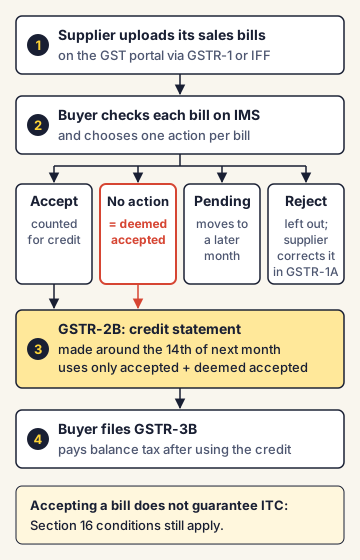
- Each supplier uploads its sales bills on the GST portal through its sales return (GSTR-1) or a quicker facility for small taxpayers (IFF, Invoice Furnishing Facility).
- These bills appear on Ravi's IMS dashboard.
- Ravi checks each one against his own records. He accepts the two correct bills, rejects one bill for goods he never bought, and keeps a bill pending because the goods have not yet arrived.
- If Ravi takes no action on a bill, it is treated as deemed accepted.
- The portal prepares Ravi's credit statement, GSTR-2B, around the 14th of the next month, using only accepted (and deemed accepted) bills. Rejected bills are left out. Pending bills move to later months.
- Ravi then files his monthly summary return, GSTR-3B, and pays the balance tax after using the credit.
What happens to a rejected bill?
The supplier can see that the buyer has rejected it. The supplier can then correct or cancel the bill through an amendment facility (GSTR-1A) or in a later return. This pushes both sides to fix mistakes quickly, instead of fighting about them years later in a tax notice.
Key rules and limits
- Accepting a bill does not guarantee credit. All the normal conditions for ITC under Section 16 still apply, such as actually receiving the goods and the supplier actually paying the tax.
- Some documents cannot stay pending for ever. The law limits how long certain items, such as credit notes, can be kept pending.
- The 57th GST Council (October 2026) recommended a system to let businesses correct the credit shown in GSTR-3B so that it matches GSTR-2B, with a circular to explain how these facilities work together, from the April 2027 return period.
- As planned, IMS will become mandatory from 1 April 2027, and CBIC is upgrading it to make invoice matching fully digital.
Commonly confused concepts
- IMS vs e-invoicing: E-invoicing means a seller must register each business bill on a government portal (the Invoice Registration Portal) and get a unique number (IRN, Invoice Reference Number) before issuing it. It is about the seller creating a valid bill. IMS is about the buyer accepting or rejecting bills it has received.
- GSTR-2A vs GSTR-2B: GSTR-2A is a live statement that keeps changing as suppliers upload bills. GSTR-2B is a fixed monthly statement, and it is the one used to claim credit. IMS actions feed GSTR-2B.
- GSTR-1 vs GSTR-3B: GSTR-1 is the detailed sales return (bill by bill). GSTR-3B is the monthly summary return where tax is actually paid.
- IMS vs e-way bill: An e-way bill tracks the movement of goods worth over ₹50,000. IMS tracks bills, not trucks.
Issues, criticism and the way forward
- Extra work for small businesses: Checking every bill each month takes time and some digital skill. Small traders may simply let bills be deemed accepted, which reduces the benefit.
- Supplier's fault, buyer's loss: Even after accepting a bill, the buyer can lose credit if the supplier does not pay the tax. Industry wants this risk removed for honest buyers.
- Disputes between buyer and supplier: Rejecting bills can strain business relations, especially for small suppliers who depend on big buyers.
- Benefits: Supporters say IMS catches fake invoices early, reduces mismatch notices, and builds a more automatic, trust-based system.
- Way forward: Experts suggest simple screens, clear deadlines, help for small taxpayers, and linking IMS fully with e-invoicing so most matching happens automatically.
Concepts to Know
- Invoice: A bill given by a seller to a buyer showing what was sold, the price and the tax charged.
- Input tax credit (ITC): The GST a business paid on its purchases, which it can subtract from the GST it must pay on its sales.
- Shell firm: A company that exists only on paper and does no real business. It is often used to issue fake bills.
- GSTN (Goods and Services Tax Network): The not-for-profit company that runs the GST portal and its IT system.
- Deemed accepted: Treated as accepted automatically because the buyer did not act on it in time.
- Circular: An official letter from the tax department explaining how a law or rule should be applied.
- IMS introduced on the GST portal from October 2024 as an optional facility
- Buyer actions: accept, reject, pending; no action = deemed accepted
- Accepted bills flow into GSTR-2B (generated around the 14th of the next month); rejected bills are excluded
- Legal basis: Section 38 of the CGST Act, amended by the Finance Act, 2025
- Accepting a bill does not override the Section 16 conditions for ITC
- Planned to be mandatory from 1 April 2027
● Tracked since October 12, 2026 · last seen October 12, 2026 · updates as the daily brief publishes