International Fund for Agricultural Development (IFAD)
The International Fund for Agricultural Development, or IFAD, is a United Nations agency that gives money to improve farming and life in poor rural areas. It is both a specialised agency of the UN and an international financial institution, which means it works like a bank for development. It lends money on very soft terms, and sometimes gives grants, to governments of developing countries for projects that help small farmers, herders, fishers and rural women. Its headquarters is in Rome, Italy.
Why does IFAD exist?
Most of the world's poorest and hungriest people live in villages and depend on farming. Yet small farmers often cannot get good seeds, fertiliser, loans, insurance or a fair market for their crops. Big banks rarely lend to them because the loans are small and risky. IFAD was created to fill this gap. Its idea is simple: if you invest in small farmers, they grow more food, earn more money and become less hungry. This is different from just sending food aid after a disaster.
Where did it come from?
In the early 1970s, the world faced a serious food crisis. Droughts hit the Sahel region of Africa (the dry belt just south of the Sahara desert) very hard, and food prices rose. To respond, the UN held the World Food Conference in 1974. One of its main decisions was to create a fund to pay for farming development in poor countries.
That fund became IFAD. The agreement setting up IFAD came into force on 30 November 1977, and the UN General Assembly recognised it as a specialised agency in December 1977 (Resolution 32/107).
Who are its members?
Any member of the UN, of its specialised agencies or of the International Atomic Energy Agency can join. As of 2026, IFAD has about 180 member states. They are grouped into three lists:
- List A: mainly rich countries (largely members of the OECD, the club of developed economies).
- List B: mainly oil-exporting countries (largely OPEC members), which were major early donors.
- List C: developing countries. It is split into C1 (Africa), C2 (Europe, Asia and the Pacific) and C3 (Latin America and the Caribbean). India is in Sub-list C2.
How is IFAD run?
IFAD has three main parts:
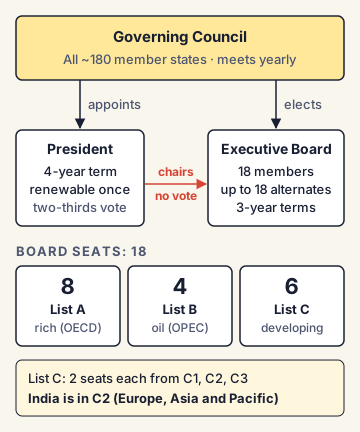
- Governing Council: the highest body. Every member state is in it. It meets once a year.
- Executive Board: handles day-to-day decisions, such as approving loans. It has 18 members and up to 18 alternate members, elected by the Governing Council for three-year terms. The seats are shared as 8 from List A, 4 from List B and 6 from List C (two from each sub-list).
- President: the head of IFAD. The Governing Council appoints the President by a two-thirds vote for a four-year term, which can be renewed once. The President also chairs the Executive Board but does not vote there. As of November 2026, the President is Álvaro Lario of Spain, who took office on 1 October 2022.
Where does IFAD get its money?
Every three years, member countries pledge fresh money to IFAD. This is called a replenishment (like topping up a water tank). The 13th replenishment (IFAD13) covers 2025–2027, and pledges crossed US$1.5 billion. Under IFAD13, all core resources go to low-income and lower-middle-income countries, and at least 30% go to countries in fragile situations (places hit by conflict or weak governance). Talks for the next cycle, IFAD14, began in February 2026. IFAD also borrows from markets and partners to lend more than its donors give.
How does an IFAD project work?
Here is a simple step-by-step picture:
- A government and IFAD agree on a country strategy, called a COSOP (Country Strategic Opportunities Programme).
- Under it, they design a project, for example to help hill farmers in one state grow and sell spices.
- IFAD gives a low-interest, long-term loan (and sometimes a grant). The government adds its own money, and other partners may co-finance.
- The state government runs the project on the ground, often through farmer groups and women's self-help groups.
- IFAD checks progress and results, and its Independent Office of Evaluation reviews whether the money worked.
India and IFAD
IFAD has worked in India since 1979, and India is one of its largest borrowers. By IFAD's count (May 2026), it has supported 35 rural projects in India worth a total of about US$4.2 billion (including the government's and partners' shares). In May 2026, IFAD and the Government of India launched a new eight-year country strategy, COSOP 2026–2033, aligned with the Viksit Bharat@2047 vision.
Its focus areas include climate resilience and women's empowerment. In April 2026, India and IFAD signed a US$45.78 million deal to scale up climate-resilient, market-oriented farming in Mizoram.
IFAD's recent climate work
IFAD argues that small farmers are the first to suffer from climate shocks, yet they get very little climate finance. At COP31 it launched a US$70 million private placement bond, described as the first global adaptation bond focused on rural communities. Its 2026 El Niño report says support works best when inputs, markets and finance come together, not one at a time.
Commonly confused concepts
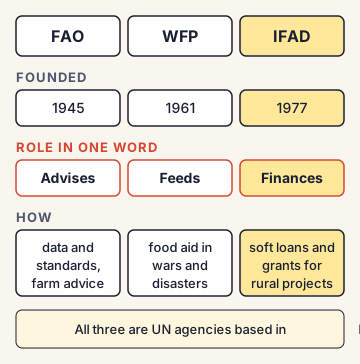
- IFAD vs FAO vs WFP (the three Rome-based UN food agencies):
- FAO (Food and Agriculture Organization, 1945): the knowledge agency. It collects data, sets standards and gives technical advice on farming, forests and fisheries.
- WFP (World Food Programme, 1961): the emergency agency. It delivers food to people in crises such as wars and disasters.
- IFAD (1977): the money agency. It invests in long-term rural development through loans and grants.
- A simple way to remember: FAO advises, WFP feeds, IFAD finances.
- IFAD vs World Bank: Both lend for development. The World Bank lends for all sectors (roads, power, health, education). IFAD lends only for rural and farm development, and focuses on the poorest rural people.
- IFAD vs NABARD: NABARD (National Bank for Agriculture and Rural Development) is an Indian bank set up by an Act of Parliament in 1982. IFAD is an international UN agency. NABARD works only in India.
Issues, criticism and the way forward
- Small size: IFAD's yearly lending is small compared with the scale of rural poverty and climate damage. Climate finance reaching small farmers remains a tiny share of global climate money.
- Debt worries: Many poor countries are already heavily in debt. Even soft loans add to that burden, so IFAD must balance loans with grants.
- Dependence on donors: Replenishments depend on rich countries' budgets, which can shrink when they face their own economic problems.
- Slow delivery: Evaluations of IFAD's India work have rated its results on natural resources and climate only "moderately satisfactory", while income gains were rated better.
- Way forward: Experts suggest more grant money for the most indebted countries, more private investment (such as adaptation bonds), and "bundled" support (seeds, markets, insurance and credit together), which IFAD's own modelling shows works best.
Concepts to Know
- Specialised agency: An independent international body linked to the UN by a special agreement. It has its own members, budget and rules. Examples: WHO, FAO, IFAD.
- International financial institution: A body owned by many countries that lends money for development. Examples: World Bank, Asian Development Bank, IFAD.
- Concessional loan: A "soft" loan with a very low interest rate and a long time to repay. It is much cheaper than a normal bank loan.
- Replenishment: A regular round, every three years at IFAD, in which member countries promise new money to the fund.
- Acute food insecurity: When people's lack of food is so serious that their lives or livelihoods are in immediate danger.
- Resilience: The ability of a farmer or community to survive a shock (like a drought) and recover quickly.
- Created after the 1974 World Food Conference; agreement entered into force 30 November 1977; UNGA Resolution 32/107 (December 1977)
- Headquarters: Rome, Italy; one of three Rome-based UN food agencies (with FAO and WFP)
- About 180 member states, in Lists A, B and C (C1 Africa, C2 Europe-Asia-Pacific, C3 Latin America-Caribbean); India is in C2
- Executive Board: 18 members + up to 18 alternates; 3-year terms; 8 (List A) + 4 (List B) + 6 (List C)
- President: 4-year term, renewable once; Álvaro Lario (Spain) since 1 October 2022
- IFAD13 replenishment: 2025–2027; IFAD14 talks launched February 2026
- In India since 1979; COSOP 2026–2033 launched May 2026
● Tracked since May 12, 2026 · last seen November 11, 2026 · updates as the daily brief publishes