Intergovernmental Panel on Climate Change (IPCC)
The Intergovernmental Panel on Climate Change, or IPCC, is the United Nations body that assesses the science of climate change. It does not do its own experiments or collect its own data. Instead, thousands of scientists read the research already published around the world and summarise what is known, how sure we are, and what the options are. Governments then use these reports to make climate policy and to negotiate climate treaties.
Why does it exist?
Climate change is a global problem, and every country needs to agree on the basic facts before it can agree on action. Without a common, trusted source, each country could pick the studies that suit it. The IPCC solves this by giving all governments one shared summary of the science. You can think of it like a panel of senior doctors who read all the medical reports of a patient and write one agreed diagnosis, so that the family can decide on treatment.
Where did it come from?
By the 1980s, scientists were warning that greenhouse gases were warming the planet. In 1988, two UN bodies, the World Meteorological Organization (WMO) and the United Nations Environment Programme (UNEP), set up the IPCC. The UN General Assembly endorsed it the same year through Resolution 43/53 of 6 December 1988. The IPCC's first report in 1990 helped lead to the United Nations Framework Convention on Climate Change (UNFCCC) in 1992. In 2007, the IPCC shared the Nobel Peace Prize with former US Vice President Al Gore.
Who are its members and where is it based?
The IPCC has 195 member countries. Its secretariat (office) is in Geneva, Switzerland, and is hosted by the WMO. India is a member. The scientists who write the reports are not paid by the IPCC. They are volunteers nominated by governments and organisations.
How is the IPCC organised?
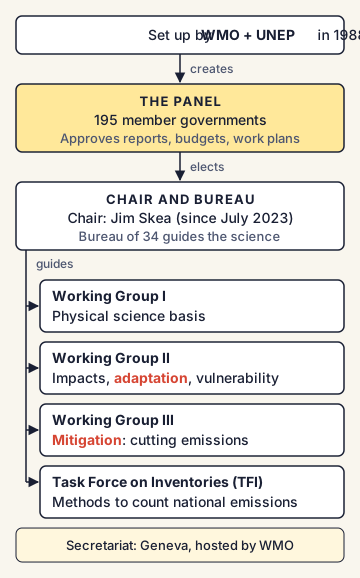
- The Panel: representatives of all member governments. It meets in plenary sessions, usually about twice a year, and takes the main decisions, including approving reports, budgets and work plans.
- The Chair and the Bureau: an elected Chair leads the IPCC. The Bureau (34 members) guides the scientific work. Professor Jim Skea of the United Kingdom was elected Chair on 26 July 2023 at the 59th session in Nairobi.
- Working Group I: the physical science basis (how and why the climate is changing).
- Working Group II: impacts, adaptation and vulnerability (how climate change affects people and nature, and how to cope).
- Working Group III: mitigation (how to reduce greenhouse gas emissions).
- Task Force on National Greenhouse Gas Inventories (TFI): creates the methods countries use to count their own emissions.
- Secretariat and Technical Support Units: the staff who organise meetings and help authors.
Past chairs
Bert Bolin (Sweden, 1988), Robert Watson (1997), Rajendra K. Pachauri of India (2002 to 2015), Hoesung Lee (2015 to 2023) and Jim Skea (since 2023).
What does the IPCC produce?
- Assessment Reports (AR): big reports every 6 to 7 years. Each has three Working Group reports plus a Synthesis Report that joins them.
- AR1: 1990
- AR2: 1995
- AR3: 2001
- AR4: 2007
- AR5: 2013 to 2014
- AR6: 2021 to 2023 (Synthesis Report in March 2023)
- Special Reports: on specific topics. Examples: Global Warming of 1.5°C (2018), Climate Change and Land (2019), and the Ocean and Cryosphere in a Changing Climate (2019).
- Methodology Reports: guidelines for counting emissions, such as the 2006 IPCC Guidelines for National Greenhouse Gas Inventories and their 2019 Refinement.
How is a report made and approved?
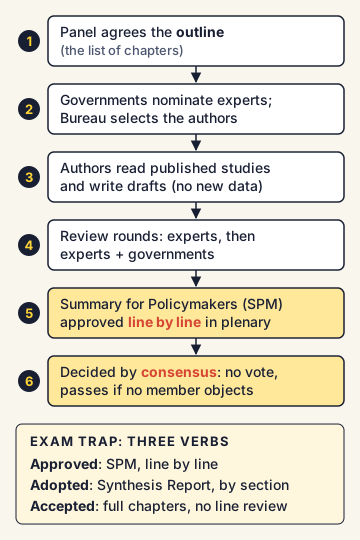
- The Panel agrees on the outline (the chapter list) of a report.
- Governments and organisations nominate experts. The Bureau selects the authors, trying to balance regions, gender and fields.
- Authors read thousands of published studies and write drafts.
- Drafts go through several rounds of review: first by experts, then by experts and governments together. Every comment must get a written answer.
- The most important part, the Summary for Policymakers (SPM), is approved by governments line by line in a plenary session, with authors present to make sure the science is not changed.
- Decisions are taken by consensus. This means no vote: everyone must at least not object. This is why one or a few countries can slow down a decision.
This process makes IPCC reports both scientifically strong and politically accepted. Governments cannot later say "we never agreed to this".
What has the IPCC found?
The AR6 Synthesis Report (2023) said that human activity has clearly warmed the planet, by about 1.1°C above the 1850 to 1900 level. To limit warming to 1.5°C, global greenhouse gas emissions would need to fall by about 43% by 2030 compared with 2019. It also said that warming is likely to exceed 1.5°C during this century on current paths. IPCC findings shaped key climate deals: the 1.5°C goal in the 2015 Paris Agreement drew directly on IPCC science.
What is the seventh assessment cycle (AR7)?
The current cycle began with Jim Skea's election in July 2023. At its 60th session in Istanbul (16 to 19 January 2024), the IPCC agreed on the set of products:
- Three Working Group reports and a Synthesis Report
- A Special Report on Climate Change and Cities (the only special report of this cycle, planned for March 2027)
- A Methodology Report on carbon dioxide removal technologies, carbon capture, use and storage (targeted for 2027)
- A Methodology Report on inventories for short-lived climate forcers (pollutants like methane and black carbon that stay in the air only a short time)
The UNFCCC invited the IPCC to time its reports so they can feed into the second Global Stocktake. But the delivery dates of the Working Group reports have not been agreed across several sessions (Sofia, Hangzhou, Lima, Bangkok).
India's position and Indian connections
- India has been an active member since the start. An Indian scientist, R.K. Pachauri, led the IPCC for 13 years, including when it won the Nobel Peace Prize.
- Many Indian scientists serve as IPCC authors, nominated through the Union Ministry of Environment, Forest and Climate Change.
- In the AR7 timeline debate, India argues that developing country scientists and governments need enough time to take part and review drafts. India also stresses equity: countries that grew rich by burning fossil fuels should cut emissions the most.
- India uses IPCC methods to prepare its own greenhouse gas inventory reports to the UNFCCC.
Commonly confused concepts
- IPCC vs UNFCCC: The IPCC is a science body that assesses research. It does not make rules. The UNFCCC is a treaty where countries negotiate and agree on actions. The IPCC informs; the UNFCCC decides.
- IPCC vs WMO and UNEP: WMO and UNEP are the parent UN agencies that created the IPCC in 1988. The IPCC is a separate panel.
- IPCC vs IPBES: IPBES (the Intergovernmental Science-Policy Platform on Biodiversity and Ecosystem Services, set up in 2012) does for nature and biodiversity what the IPCC does for climate.
- Assessment Report vs Special Report: An Assessment Report covers all of climate science. A Special Report focuses on one theme, such as 1.5°C warming or cities.
- "Approved" vs "adopted" vs "accepted": The SPM is approved line by line. The Synthesis Report is adopted section by section. The full underlying chapters are accepted without line-by-line discussion.
- Working Group I vs II vs III: I = the science of the change itself; II = impacts and adaptation; III = mitigation (cutting emissions).
Issues, criticism and the way forward
- Consensus means delay: Because all decisions need consensus, a small group can block a decision. The AR7 timeline deadlock is an example. Supporters say consensus is what gives reports their authority with every government.
- Science vs politics: Some observers point out that major oil-producing countries are among those asking for delay, and see this as stalling. The countries concerned reject this, saying their concern is fairness and quality. Others say the IPCC's work should be timed by science, not by the UN negotiation calendar.
- Inclusivity gap: Scientists from developing countries face less funding, fewer journals in their languages, and visa and travel problems. Just over half of the AR7 lead authors and editors come from developing or transition economies, but much of the research they assess is still written in rich countries.
- Money troubles: The IPCC runs on voluntary contributions to a trust fund set up in 1989. UNEP has warned that spending has been higher than income in recent years. The US withdrawal in January 2026 removed the largest funder.
- Errors and trust: AR4 (2007) wrongly said Himalayan glaciers could disappear by 2035. The claim came from a non-peer-reviewed source. A 2010 review by the InterAcademy Council found that the IPCC's review steps had not been followed properly, and procedures were tightened.
- Way forward: Suggestions include more funding for developing country authors, more translated and regional literature, more flexible timelines, and clearer rules so that procedural disputes do not block scientific work.
Concepts to Know
- Greenhouse gases: Gases such as carbon dioxide, methane and nitrous oxide that trap heat in the atmosphere, like a blanket around the Earth.
- Mitigation vs adaptation: Mitigation means reducing the causes of climate change (cutting emissions). Adaptation means adjusting to its effects (building flood walls, growing heat-tolerant crops).
- Consensus: A way of deciding where there is no vote and the decision passes only if no member formally objects.
- Plenary session: A full meeting where all members are present and take decisions together.
- Peer review: Checking of a scientific study by other independent experts before it is published.
- Transition economies: Countries moving from a state-controlled economy to a market economy, such as many former Soviet countries.
- Set up in 1988 by WMO and UNEP; endorsed by UN General Assembly Resolution 43/53 (6 December 1988)
- 195 member countries; secretariat in Geneva, hosted by WMO
- Three Working Groups (I: physical science; II: impacts, adaptation, vulnerability; III: mitigation) plus a Task Force on National Greenhouse Gas Inventories
- Chairs: Bert Bolin, Robert Watson, R.K. Pachauri (India, 2002 to 2015), Hoesung Lee, Jim Skea (since July 2023)
- Nobel Peace Prize 2007, shared with Al Gore
- Assessment Reports: 1990, 1995, 2001, 2007, 2013 to 2014, 2021 to 2023
- AR6 Synthesis (March 2023): about 1.1°C warming; emissions must fall about 43% by 2030 (vs 2019) for 1.5°C
- AR7 work programme agreed at IPCC-60, Istanbul, January 2024; Special Report on Cities planned for March 2027
- SPM approved line by line; decisions by consensus
- Bureau: 34 members
● Tracked since October 12, 2026 · last seen October 12, 2026 · updates as the daily brief publishes