Innovations for Defence Excellence (iDEX)
Innovations for Defence Excellence (iDEX) is the Ministry of Defence's scheme to get startups, MSMEs (micro, small and medium enterprises), individual innovators, research labs and universities to solve problems faced by the armed forces. It gives them grants (money that does not have to be repaid), mentoring and a path to sell their product to the forces. It was launched on 12 April 2018 at DefExpo 2018 at Mahabalipuram, Tamil Nadu.
Why does it exist?
India's defence research was mostly done by big government bodies like DRDO and DPSUs. Meanwhile, India had a huge and fast-growing startup ecosystem working on drones, artificial intelligence, robotics and communication. These young firms had ideas but found it almost impossible to sell to the military: tenders demanded years of experience, big turnover and long trials. iDEX is a bridge between the soldier with a problem and the startup with a solution. Without it, many good ideas would never reach the armed forces, and India would keep importing such technology.
Who runs it?
iDEX is run by the Defence Innovation Organisation (DIO). DIO is a not-for-profit company under Section 8 of the Companies Act, 2013. Its two founding members are Hindustan Aeronautics Limited (HAL) and Bharat Electronics Limited (BEL), two DPSUs that gave its initial funding. The structure has two levels:
- DIO gives high-level policy direction.
- iDEX works as the executive arm that runs challenges, gives grants and tracks projects.
It works under the Department of Defence Production (DDP), Ministry of Defence. iDEX also works with Partner Incubators: incubation centres in institutions like IITs that guide startups on business and technology.
How does it work, step by step?
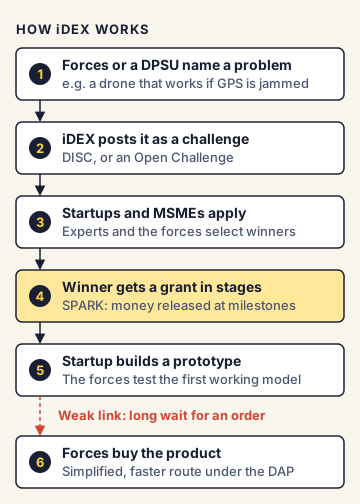
- The Army, Navy, Air Force, Coast Guard or a DPSU names a real problem, for example "a drone that can work where GPS is jammed".
- iDEX publishes it as a challenge, mainly through the Defence India Startup Challenge (DISC), or through an Open Challenge where innovators can propose their own ideas.
- Startups and MSMEs apply. Experts and users from the forces shortlist and select winners.
- Winners sign an agreement and get a grant, released in stages as they reach milestones. This is the SPARK (Support for Prototype and Research Kickstart) framework.
- The startup builds a prototype (a first working model), which the forces test.
- If the product works, the forces can buy it through a simplified, faster procurement route provided under the Defence Acquisition Procedure.
The funding levels
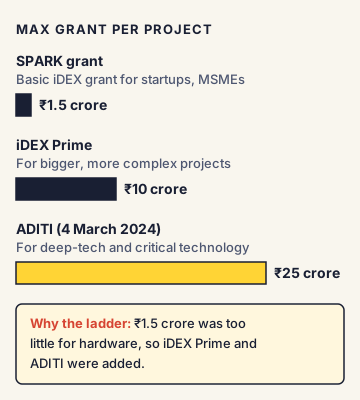
- iDEX (SPARK) grant: up to ₹1.5 crore per project.
- iDEX Prime: up to ₹10 crore, for bigger and more complex projects.
- ADITI (Acing Development of Innovative Technologies with iDEX): launched on 4 March 2024, for deep-tech and critical technologies, with grants of up to ₹25 crore per project. Its outlay was ₹750 crore for 2023-24 to 2025-26.
- The main iDEX scheme had budget support of ₹498.78 crore for 2021-22 to 2025-26.
Other parts of iDEX
- iDEX4Fauji: launched on 29 September 2020, it supports innovations by soldiers themselves, who often find clever fixes in the field.
- Results: As of October 2024, procurement orders worth more than ₹1,000 crore had been placed for 26 products developed under iDEX.
- Recognition: iDEX won the Prime Minister's Award for Excellence in Public Administration 2021 in the innovation category.
India's position and Indian examples
iDEX projects cover areas like anti-drone systems, secure communication, AI-based surveillance, underwater drones, and night-vision and sensor technology. iDEX is part of a wider set of reforms to build a home-grown defence industry:
- Positive Indigenisation Lists, which ban imports of listed items after set dates
- Buy (Indian-IDDM) as the top buying category in the Defence Acquisition Procedure
- The SRIJAN portal (2020), where DPSUs and the forces list imported items for Indian firms to make
- A set share of the defence R&D budget earmarked for private industry, startups and academia
Commonly confused concepts
- iDEX vs Technology Development Fund (TDF): iDEX is run by DIO under the Department of Defence Production and focuses on startups and quick prototypes for user problems. TDF is run by DRDO and funds Indian industry, especially MSMEs, to develop technologies that DRDO and the forces need.
- iDEX vs "Make" category of DAP: The Make procedure in the Defence Acquisition Procedure is for developing larger systems. Make-I is government-funded (up to 70% of prototype cost). Make-II is industry-funded. iDEX is a separate, lighter scheme for startups and small firms.
- DIO vs DRDO: DRDO is the government's own defence research body, with its own labs and scientists. DIO is a not-for-profit company that does not do research itself; it funds and guides outside innovators.
- iDEX vs Startup India: Startup India (2016) is a general scheme for all startups. iDEX is only for defence and aerospace problems, with the armed forces as the end user.
Issues, criticism and the way forward
- Prototype to order gap: Many startups build a working prototype but wait a long time for a purchase order, or never get one. Small firms can run out of money while waiting.
- Slow trials: Testing by the forces can take a long time, and requirements may change midway.
- Small grant size: ₹1.5 crore is too little for hardware-heavy products, which is why iDEX Prime and ADITI were added.
- Scale-up: Moving from a few prototypes to mass production needs factories, certification and working capital that startups often lack.
- Way forward: Assured purchase orders for successful prototypes, faster trials, more deep-tech funding, links with DPSUs and big private firms for mass production, and a bigger role for iDEX products in exports.
Concepts to Know
- Startup: A young company, usually a few years old, built around a new product or technology, that aims to grow fast.
- Section 8 company: A company set up under the Companies Act for a charitable or public purpose. It cannot share profits with its owners and must use any income for its goals.
- Prototype: The first working model of a product, built to test whether the idea works before making it in large numbers.
- Deep-tech: Technology based on serious science or engineering breakthroughs, such as AI, quantum, semiconductors or advanced materials. It takes longer and costs more to develop.
- Incubator: An organisation, often at a university, that helps young startups with mentoring, office space, networks and sometimes funding.
- Launched: 12 April 2018, DefExpo 2018, Mahabalipuram (Tamil Nadu)
- Run by Defence Innovation Organisation (DIO): Section 8 not-for-profit company; founding members HAL and BEL
- Works under the Department of Defence Production, Ministry of Defence
- Grants: up to ₹1.5 crore (SPARK); iDEX Prime up to ₹10 crore; ADITI up to ₹25 crore
- ADITI launched 4 March 2024; outlay ₹750 crore (2023-24 to 2025-26)
- iDEX budget: ₹498.78 crore for 2021-22 to 2025-26
- iDEX4Fauji launched 29 September 2020
- PM's Award for Excellence in Public Administration 2021 (innovation category)
● Tracked since October 09, 2026 · last seen October 09, 2026 · updates as the daily brief publishes