India's Defence Exports
Defence exports are the weapons, equipment, parts and services that Indian companies sell to the armed forces of other countries. They include missiles, radars, guns, helicopters, patrol boats, body armour, ammunition and software. For most of its history, India mainly bought weapons from abroad. Since the mid-2010s, it has been trying to become a seller too, and exports have grown many times over.
Why do defence exports matter?
There are four big reasons:
- Scale and lower cost: A factory that makes weapons only for the Indian Army may run half-empty in peacetime. Export orders keep production lines busy, lower the cost of each unit and keep skilled workers employed. This also helps in wartime, when the line can be quickly scaled up.
- Money for R&D: Export earnings help companies pay for research on the next generation of products.
- Strategic influence: When a friendly country uses Indian weapons, it depends on India for spare parts, training and upgrades. This builds long-term ties. Think of it like a phone company: once you buy its phone, you keep coming back for its chargers and repairs.
- Less dependence on imports: A strong export-oriented industry is the base for self-reliance (Atmanirbharta) in defence.
Where did it come from?
For decades, almost all Indian defence production happened in government-owned units: the Ordnance Factories (the first set up in 1801 near Kolkata) and Defence Public Sector Undertakings (DPSUs) like HAL and BEL. Private firms were kept out. Key turning points:
- 2001: The defence sector was opened to 100% private Indian participation (with licences), and foreign investment was allowed up to 26%.
- 2014 onwards: Under Make in India, licensing was eased, FDI limits were raised (now up to 74% under the automatic route and up to 100% with government approval), and exports became a stated goal.
- 2016 to 2018: India joined three of the four major export control regimes (explained below). This made other countries more willing to trust India as a seller of sensitive technology.
- 2019: Open General Export Licences (OGELs) were introduced, allowing some items to be exported to certain countries without a separate licence each time.
- 2020: The draft Defence Production and Export Promotion Policy (DPEPP) 2020 set aims of ₹1.75 lakh crore in production and ₹35,000 crore in exports by 2025.
- 2021: The Ordnance Factory Board was split into seven new DPSUs, to make them more efficient and export-friendly.
How does the export process work?
A company cannot simply sell a missile to anyone who pays. The steps are:
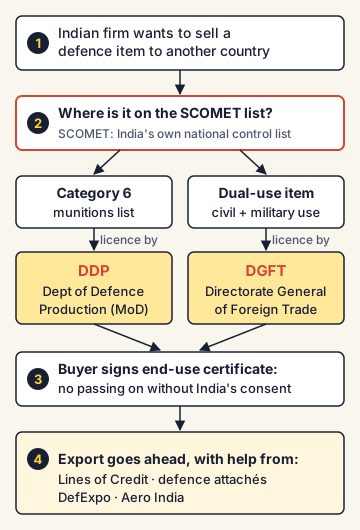
- India controls sensitive items through a list called SCOMET (Special Chemicals, Organisms, Materials, Equipment and Technologies). Category 6 of this list is the munitions list (military items).
- For munitions list items, the company must get an export authorisation from the Department of Defence Production (DDP) in the Ministry of Defence. Dual-use items (things with both civil and military uses) are licensed by the Directorate General of Foreign Trade (DGFT).
- The DDP checks the buyer and the end-use: the buying country must promise that the weapon will not be passed on to a third party without India's consent.
- Government help comes through Lines of Credit (cheap loans to friendly countries to buy Indian goods), defence attachés in Indian embassies who promote Indian products, and defence exhibitions like DefExpo and Aero India.
How big are exports now?
As of 2025-26:
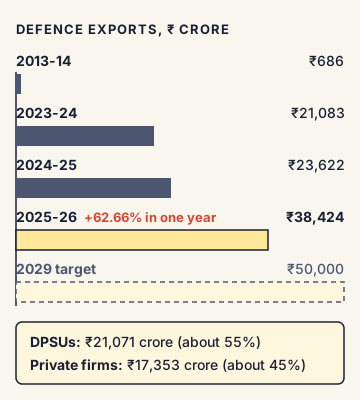
- Total defence exports: ₹38,424 crore, up 62.66% from ₹23,622 crore in 2024-25
- DPSUs: ₹21,071 crore (about 55%)
- Private sector: ₹17,353 crore (about 45%)
- Number of exporting companies: 145; items sent to more than 80 countries
For comparison, exports were only about ₹686 crore in 2013-14 and ₹21,083 crore in 2023-24.
Total defence production in 2025-26 was a record ₹1.78 lakh crore, of which the private sector made about 24%. The government's target is ₹50,000 crore of exports by 2029.
What does India sell?
- BrahMos supersonic cruise missile: In January 2022, the Philippines signed a contract worth about $375 million for three batteries of the shore-based anti-ship version. It was the first export order for BrahMos.
- Artillery and rocket systems: for example, the Pinaka multi-barrel rocket launcher, sold to Armenia.
- Others: Dornier aircraft, Advanced Light Helicopters, radars, patrol vessels, ammunition, body armour, and many parts and sub-systems supplied to big global defence companies.
Global export control regimes
These are informal groups of countries that agree on rules for exporting dangerous technologies. India's status:
- Missile Technology Control Regime (MTCR): joined in 2016 as the 35th member (controls missiles and drones that can carry weapons of mass destruction).
- Wassenaar Arrangement: joined in 2017 as the 42nd member (controls conventional arms and dual-use goods).
- Australia Group: joined on 19 January 2018 as the 43rd member (controls chemical and biological weapon materials).
- Nuclear Suppliers Group (NSG): India is not yet a member. Its application, made in 2016, is pending.
Membership tells the world that India has strong export controls. That makes it easier for India both to buy advanced technology and to sell its own.
India's position in the world
India is still one of the world's biggest importers of weapons. According to the Stockholm International Peace Research Institute (SIPRI), India had an 8.3% share of global arms imports in 2020-24, second only to Ukraine. Russia's share of India's imports fell to 36% in 2020-24, from 72% in 2010-14. SIPRI linked part of the fall in India's imports to its growing capacity to design and make weapons at home.
So India is moving from being a "big buyer" to a "buyer and seller", but the shift is still in progress.
Commonly confused concepts
- Defence exports vs defence production: Production is the total value of defence goods made in India, for India's own forces and for export. Exports are only the part sold abroad. In 2025-26, production was ₹1.78 lakh crore and exports were ₹38,424 crore.
- Private share of exports vs private share of production: The private sector made about 45% of exports in 2025-26, but only about 24% of total production. The "24% to 50%" goal refers to production.
- SCOMET vs export control regimes: SCOMET is India's own national list under its foreign trade law. MTCR, Wassenaar, Australia Group and NSG are international groups whose lists India follows.
- Wassenaar vs MTCR: Wassenaar covers conventional weapons and dual-use goods. MTCR covers missiles and drones that could carry weapons of mass destruction.
- Arms Trade Treaty (ATT) vs export regimes: The ATT (2013) is a UN treaty that regulates the global trade in conventional arms. India has not signed it, though it is a member of Wassenaar.
Issues, criticism and the way forward
- Small global share: Despite fast growth, India's exports are tiny compared with the top exporters (the US, France and Russia).
- Import of key parts: Many "Indian" products still use imported engines, chips or materials. If a supplier country stops supplies, both production and exports suffer.
- Low R&D spending: Most defence R&D is done by DRDO. Private firms spend little on research. The ministry's call to treat R&D as an investment targets this gap.
- Dependence on a few products and buyers: A few big orders can make yearly figures swing sharply.
- Delays and capacity: Slow delivery and limited capacity to scale up can put off foreign buyers. Wars show that quick production of drones, missiles and ammunition matters most.
- Ethical concerns: Selling arms to regions in conflict raises questions about human rights and end use.
- Way forward: Faster export clearances, more Lines of Credit, joint ventures with friendly countries, a larger private sector role, steady R&D funding, and products designed from the start for export markets.
Concepts to Know
- Defence Public Sector Undertaking (DPSU): A company owned by the government that makes defence goods, such as HAL (aircraft) or BEL (electronics).
- Dual-use goods: Items that can be used for both civilian and military purposes, like certain chemicals, drones or computer chips.
- End-use certificate: A written promise by the buyer that it will use the weapon itself and not pass it on to anyone else without the seller's permission.
- Line of Credit (LoC): A loan India gives to a friendly country on easy terms, which that country uses to buy goods (here, defence goods) from India.
- Surge capacity: The ability of factories to sharply increase output in a short time, for example during a war.
- Strategic autonomy: A country's ability to make its own security and foreign-policy choices without depending on, or being pressured by, other powers.
- Defence exports 2025-26: ₹38,424 crore (up 62.66% from ₹23,622 crore); DPSUs ₹21,071 crore, private ₹17,353 crore
- 145 exporters; more than 80 destination countries
- Export target: ₹50,000 crore by 2029
- Defence production 2025-26: ₹1.78 lakh crore; private share about 24%
- Defence exports 2013-14: about ₹686 crore
- BrahMos to the Philippines: January 2022, about $375 million, first export order
- Licensing: munitions list (SCOMET Category 6) by DDP; dual-use by DGFT
- MTCR 2016 (35th), Wassenaar 2017 (42nd), Australia Group 19 January 2018 (43rd); NSG not a member
- SIPRI: India 8.3% of global arms imports in 2020-24, second after Ukraine
● Tracked since March 02, 2026 · last seen October 09, 2026 · updates as the daily brief publishes