Information Commissions (CIC and SICs)
Structure, Powers and Independence
Information commissions are the bodies that make sure the Right to Information (RTI) law actually works. When a government office refuses to give you information, or simply does not reply, you can go to an information commission. The commission hears your case, orders the office to give the information if the law allows it, and can even fine the officer who broke the law. There is one Central Information Commission (CIC) for central government offices, and a State Information Commission (SIC) for each state's offices.
Why do we need them?
The RTI Act gives every citizen the right to ask for government information. But a right is only useful if someone can enforce it. Without an outside referee, a department could simply ignore requests, and the citizen would have to go to the High Court, which is slow and costly. Information commissions are that referee. Think of them like a cricket umpire: the players (government offices) cannot decide for themselves whether they are "out". An independent umpire decides, and everyone must accept the decision.
Where did they come from?
Both kinds of commissions were created by the Right to Information Act, 2005. Parliament passed the Act in June 2005, and it came fully into force on 12 October 2005.
- Chapter III (Sections 12 to 14) sets up the Central Information Commission.
- Chapter IV (Sections 15 to 17) sets up the State Information Commissions.
- Chapter V (Sections 18 to 20) gives both of them their powers and functions, including penalties.
Because they are created by an Act of Parliament and not by the Constitution, they are statutory bodies, not constitutional bodies. This is a favourite Prelims trap.
Who is in the Central Information Commission?
Under Section 12, the CIC has:
- One Chief Information Commissioner (the head), and
- Up to 10 Information Commissioners, as many as the government thinks necessary.
So the commission can have at most 11 members. Its headquarters is in Delhi. The President appoints all of them under Section 12(3), on the recommendation of a three-member selection committee:
- The Prime Minister (chairperson of the committee)
- The Leader of the Opposition in the Lok Sabha
- A Union Cabinet Minister nominated by the Prime Minister
If there is no officially recognised Leader of the Opposition, the leader of the single largest opposition group in the Lok Sabha is treated as the Leader of the Opposition for this purpose. In practice, a search committee of officers first shortlists names, and then the selection committee picks from that list.
Who is in a State Information Commission?
Section 15 mirrors the central design at the state level:
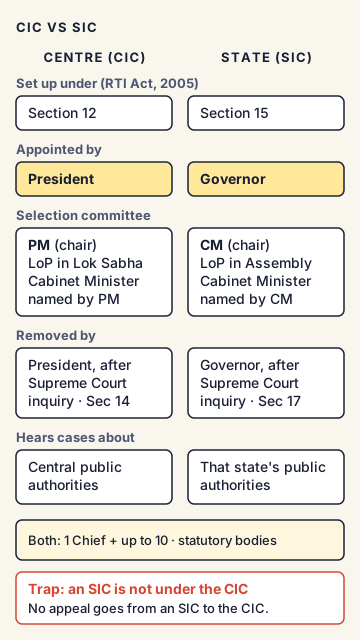
- One State Chief Information Commissioner, and up to 10 State Information Commissioners.
- The Governor appoints them, on the recommendation of a committee of the Chief Minister (chairperson), the Leader of the Opposition in the Legislative Assembly, and a Cabinet Minister nominated by the Chief Minister.
Who can become a commissioner?
Section 12(5) says commissioners must be "persons of eminence in public life" with wide knowledge and experience in fields such as law, science and technology, social service, management, journalism, mass media, or administration and governance. Section 12(6) says a commissioner cannot be a Member of Parliament or of a state legislature, cannot hold any other office of profit, cannot be connected with a political party, and cannot run a business or profession.
Term, salary and the 2019 change
This is the part that changed most over time, and UPSC likes to ask about it.
- Under the original 2005 Act: Commissioners served for 5 years or until age 65, whichever came first, and could not be reappointed. Their salary and status were fixed in the Act itself. The Chief Information Commissioner was equal to the Chief Election Commissioner. Information Commissioners were equal to Election Commissioners. At the state level, the State Chief was equal to an Election Commissioner, and State Information Commissioners were equal to the state's Chief Secretary.
- The Right to Information (Amendment) Act, 2019 removed these fixed terms from the Act. It said the central government will decide the term, salary and service conditions of commissioners at both the Centre and the states, through rules.
- The rules notified in October 2019 fixed the term at 3 years. The Chief Information Commissioner gets a fixed salary of ₹2.5 lakh per month. Information Commissioners of the CIC, and the State Chief Information Commissioners, get ₹2.25 lakh per month.
How does a case reach the commission?
Let us follow one citizen, Meena, who asks her district office for details of how much money was spent on a village road.
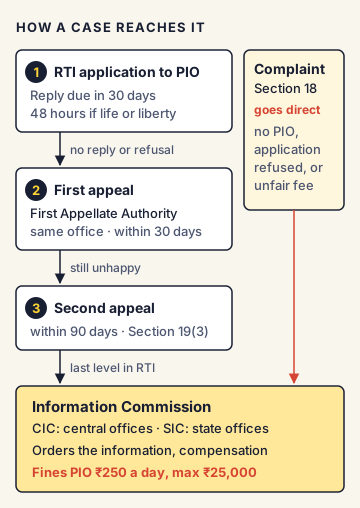
- The RTI application: Meena files a request with the office's Public Information Officer (PIO). The PIO must reply within 30 days (or 48 hours if the matter is about someone's life or liberty).
- First appeal: If she gets no reply, or a refusal she thinks is wrong, she files a first appeal with a senior officer inside the same office, called the First Appellate Authority, within 30 days.
- Second appeal: If she is still unhappy, she files a second appeal with the information commission within 90 days under Section 19(3). This is the last level inside the RTI system.
- Complaint: Separately, under Section 18, she can file a complaint directly with the commission. For example, if no PIO was appointed, if her application was not accepted, or if she was asked for an unfair fee.
What powers does a commission have?
Commissions have real teeth:
- Powers of a civil court (Section 18(3)): They can summon people, make them give evidence on oath, order documents to be produced and inspected, and call for public records. This means an officer cannot simply ignore a commission's notice.
- Seeing any record (Section 18(4)): During a hearing, the commission can examine any record held by the office, and no record can be held back from it.
- Binding orders (Section 19(7) and 19(8)): The commission's decision is binding. It can order the office to give the information, to appoint a PIO, to publish certain information on its own, to improve record-keeping, and to pay compensation to the citizen for any loss.
- Penalty (Section 20(1)): If a PIO refused or delayed information without a reasonable cause, gave false information, or destroyed it, the commission can fine that officer ₹250 per day of delay, up to a maximum of ₹25,000. The officer must first be given a chance to be heard. This fine is paid by the officer personally, not by the department.
- Disciplinary action (Section 20(2)): For repeated or serious failures, the commission can recommend disciplinary action against the PIO under the service rules.
- Annual report (Section 25): Each commission must prepare a yearly report on how the Act is working. The central government places the CIC's report before each House of Parliament. The state government places the SIC's report before the state legislature.
How can a commissioner be removed?
This protects the commission's independence, because the government cannot remove a commissioner just because it dislikes an order.
- Section 14 (Centre): The President can remove the Chief Information Commissioner or an Information Commissioner for proved misbehaviour or incapacity, but only after the Supreme Court holds an inquiry on a reference from the President and reports that the person should be removed. The President may suspend the person while the inquiry goes on.
- The President can also remove a commissioner directly in some clear cases: if the person becomes insolvent, is convicted of an offence involving moral turpitude (a crime showing bad character), takes up other paid work, becomes mentally or physically unfit, or gains a financial interest that could affect their work.
- Section 17 (States): The same system applies to State Information Commissioners, with the Governor in place of the President.
What has the Supreme Court said?
In Anjali Bhardwaj v. Union of India (judgment of 15 February 2019), the Supreme Court dealt with long-pending vacancies in the CIC and SICs. It directed the Centre and states to fill vacancies on time and to make the selection process transparent: publish the names of search committee members, the shortlisted candidates, and the criteria used. It also noted that commissioners should come from a range of fields, not mainly retired government officers. The Court has kept monitoring compliance in later hearings of this case.
India's position: the numbers
Over two decades, the RTI system has handled crores of requests, and the commissions have become the main place where these disputes are settled. But the backlog is a long-standing problem. Studies by citizens' groups show pending appeals and complaints across commissions at around 4 lakh in recent years (about 4.05 lakh on June 30, 2024 and about 4.14 lakh on June 30, 2025).
Some state commissions have at times had no commissioners at all and become defunct (not working), while others work without a Chief. In December 2025, the CIC got a full set of members (a Chief and 10 Information Commissioners) for the first time in about nine years.
Commonly confused concepts
- Central Information Commission vs Chief Information Commissioner: Both are shortened to "CIC". The Commission is the body; the Chief Information Commissioner is the person who heads it.
- Central Information Commission vs Central Vigilance Commission (CVC): The CVC deals with corruption in central government offices, under the CVC Act, 2003. The CIC deals with access to information, under the RTI Act, 2005. Both are statutory bodies.
- CIC vs SIC: The President appoints CIC members; the Governor appoints SIC members. The CIC hears cases about central public authorities; an SIC hears cases about that state's public authorities. An SIC is not under the CIC. The CIC is not an appeal court above the SICs.
- First appeal vs second appeal: The first appeal goes to a senior officer inside the same department. The second appeal goes to the independent information commission.
- Appeal (Section 19) vs complaint (Section 18): An appeal challenges the decision on an RTI request. A complaint is about the process being blocked, such as no PIO, refusal to accept an application, or an unfair fee.
- Statutory vs constitutional body: Information commissions are statutory (created by the RTI Act). The Election Commission (Article 324) and the UPSC (Article 315) are constitutional bodies.
Issues, criticism and the way forward
- Huge backlog and long waits: With lakhs of cases pending, some commissions take years to hear a second appeal. Critics say delayed information is often useless information. For example, details about a tender are of little use after the project is finished.
- Vacancies: Governments often delay appointments, so commissions work with too few members, or none at all. This directly increases the backlog.
- Independence after 2019: Critics argue that letting the central government decide the term and salary of commissioners, through rules that can be changed at any time, weakens their independence. The government's position was that the RTI commissions are statutory bodies, so their service conditions did not need to match those of the constitutional Election Commission, and that the change simply corrected an anomaly.
- Rare penalties: Studies show commissions impose penalties in a very small share of cases where officers broke the law. Without the fear of a fine, some officers feel free to delay or refuse information.
- Composition: Many commissioners are retired civil servants. Critics say this can make commissions too sympathetic to the government departments they are supposed to check.
- Missing annual reports: Many commissions do not publish their yearly reports on time, even though Section 25 requires them. This makes it hard to judge their performance.
- Way forward: Experts and the Supreme Court have suggested filling vacancies before they arise, transparent selection, setting time limits for disposing of appeals, imposing penalties firmly, using digital hearings to speed up work, and publishing data on pending cases regularly.
Concepts to Know
- Statutory body: A body created by an ordinary law passed by Parliament or a state legislature. Parliament can change its powers by passing another law. A constitutional body is created by the Constitution itself and is harder to change.
- Public Information Officer (PIO): The officer in every government office whose job is to receive RTI requests and give the information.
- Public authority: Any body that the RTI Act covers, such as government departments, bodies set up by law, and bodies largely funded by the government. Only public authorities must answer RTI requests.
- Backlog / pendency: Cases that have been filed but not yet decided. If 100 new cases come every month and the commission decides only 80, the backlog grows by 20 every month.
- Moral turpitude: A crime that shows dishonesty or bad character, such as fraud or bribery.
- Defunct commission: A commission that has no commissioners in office, so it cannot hear any case at all.
- Created by the Right to Information Act, 2005 (in force from 12 October 2005); statutory, not constitutional
- CIC: Section 12; SICs: Section 15; removal: Section 14 (CIC, by President) and Section 17 (SIC, by Governor), after a Supreme Court inquiry for proved misbehaviour or incapacity
- Composition: 1 Chief + up to 10 Information Commissioners (at both levels)
- CIC selection committee: PM (chair), Leader of Opposition in Lok Sabha, a Union Cabinet Minister nominated by PM
- SIC selection committee: CM (chair), Leader of Opposition in the Assembly, a Cabinet Minister nominated by CM
- Original term: 5 years or age 65; RTI (Amendment) Act, 2019 lets the Centre fix term and salary; 2019 rules: 3-year term, ₹2.5 lakh/month for the Chief of CIC, ₹2.25 lakh/month for CIC Information Commissioners and State Chiefs
- Second appeal to the commission: within 90 days (Section 19(3)); complaints: Section 18; civil court powers: Section 18(3)
- Penalty on PIO: ₹250 per day, maximum ₹25,000 (Section 20(1))
- Annual report: Section 25, laid before Parliament or the state legislature
- Anjali Bhardwaj v. Union of India (15 February 2019): directions on timely and transparent appointments
● Tracked since October 12, 2026 · last seen October 12, 2026 · updates as the daily brief publishes