India's National Action Plan on Antimicrobial Resistance (NAP-AMR)
India's National Action Plan on Antimicrobial Resistance (NAP-AMR) is the country's main roadmap to slow down the spread of drug-resistant germs. It brings many ministries together, because AMR is caused by what happens in hospitals, farms, fish ponds, drug factories and rivers. India released its first plan in April 2017 for 2017 to 2021, and a second version, NAP-AMR 2.0, on 18 November 2025 for 2025 to 2029.
Why does India need a plan?
No single ministry can solve AMR. The Health Ministry controls hospitals and medicines, but antibiotics in poultry feed fall under animal husbandry, fish farms under fisheries, and factory waste water under the environment ministry. Without a common plan, each works alone and the problem keeps growing. A national plan sets shared goals, divides work and tracks progress.
Where did it come from? The global plan
In May 2015, the World Health Assembly (the yearly meeting of all WHO member countries) adopted the Global Action Plan on AMR through resolution WHA68.7. It asked every country to prepare its own national plan. The global plan had five objectives:
- Improve awareness and understanding of AMR
- Strengthen knowledge through surveillance and research
- Reduce infections through sanitation, hygiene and infection prevention
- Use antimicrobials wisely in human and animal health
- Build the economic case for long-term investment, including in new medicines, tests and vaccines
In 2016, the UN General Assembly held its first high-level meeting on AMR. In May 2026, the 79th World Health Assembly adopted an updated Global Action Plan on AMR for 2026 to 2036. It is the shared plan of the Quadripartite: WHO, the Food and Agriculture Organization (FAO), the UN Environment Programme (UNEP) and the World Organisation for Animal Health (WOAH).
The 2024 UN targets
On 26 September 2024, the UN General Assembly adopted a political declaration on AMR at its second high-level meeting. Its key targets for 2030 are:
- Reduce yearly human deaths linked to bacterial AMR by 10%
- At least 70% of antibiotics used in human health should be from WHO's "Access" group (the safer, first-choice drugs)
- At least 60% of countries should have funded national action plans
- All countries should have basic water, sanitation, hygiene and waste services in all health facilities
- Meaningfully reduce antimicrobial use in agriculture and food systems
- US$100 million in catalytic (starting) funding to help countries
India's journey before the plan
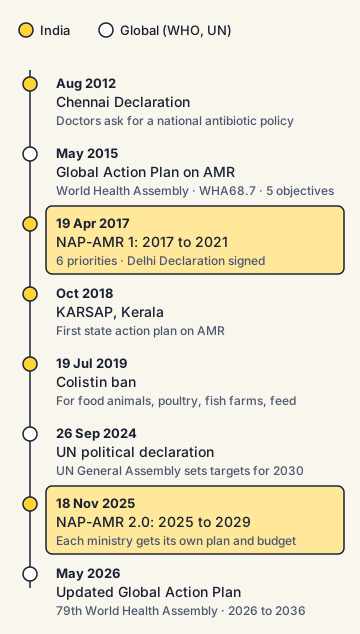
Indian doctors' groups met in Chennai in August 2012 and issued the Chennai Declaration, calling for a national policy on antibiotic use. In 2013, the Indian Council of Medical Research (ICMR) set up its AMR Surveillance and Research Network of hospitals to track resistance. In 2014, Schedule H1 began controlling the sale of newer antibiotics. In 2016, the Red Line campaign asked people to avoid medicines with a red line on the pack unless prescribed.
NAP-AMR 2017 to 2021: the six priorities
India's first plan was released on 19 April 2017. It followed the five global objectives and added a sixth of its own:
- Better awareness and understanding through communication, education and training
- Stronger knowledge and evidence through surveillance
- Fewer infections through infection prevention and control
- Optimised (wise) use of antimicrobials in health, animals and food
- More investment in AMR activities, research and innovation
- Strong leadership and collaboration, at international, national and state levels (India's addition)
At the launch, ministers of the concerned ministries signed the Delhi Declaration on AMR, a promise to work together on the plan. The plan follows a One Health approach, which treats human, animal and environmental health as one connected system. The National Centre for Disease Control (NCDC) under the Health Ministry coordinates it, and NCDC also runs a national surveillance network of laboratories called NARS-Net.
States join in
Health is mainly a State subject under the Constitution, so state plans matter a lot. Kerala became the first state with its own plan, the Kerala Antimicrobial Resistance Strategic Action Plan (KARSAP), launched in October 2018. Some other states have since prepared their own plans.
NAP-AMR 2.0 (2025 to 2029)
Work on the second plan began in 2022, with consultations across human health, animal husbandry, environment and research, followed by high-level meetings led by NITI Aayog. Union Health Minister J.P. Nadda launched it on 18 November 2025, the first day of World AMR Awareness Week. Its main features:
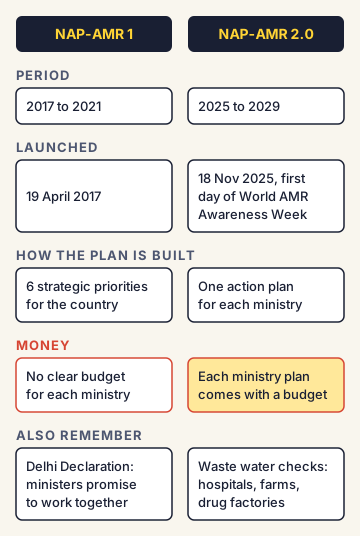
- Each key ministry or department has its own action plan, with a budget and ways to coordinate with others. This answers a major weakness of the first plan.
- It aims to fix gaps found during 2017 to 2021.
- It stresses education and training, stronger laboratories, and infection control in hospitals.
- It calls for monitoring of resistant germs and antibiotic residues in waste water from three high-risk sources: hospitals, farms and pharmaceutical factories.
- Ministries involved include Health, Animal Husbandry and Dairying, Fisheries, Agriculture, Environment, Science and Technology, Chemicals and Fertilisers, AYUSH, Jal Shakti, Education and Information and Broadcasting. Each is expected to prepare its own implementation roadmap.
Other Indian steps to know
- Colistin ban (19 July 2019): The Health Ministry, under the Drugs and Cosmetics Act, 1940, banned making, selling and distributing colistin for food-producing animals, poultry, aqua farming and animal feed supplements.
- Kerala's efforts: Kerala has acted against selling antibiotics without prescription and runs awareness drives, and is often cited as a model state.
Commonly confused concepts
- Global Action Plan vs UN political declaration: The Global Action Plan (2015, updated for 2026 to 2036) is a WHO-led technical plan adopted by the World Health Assembly. The political declarations (2016 and 2024) are promises made by world leaders at the UN General Assembly. The 2024 declaration set the 2030 number targets.
- NAP-AMR vs a state plan: NAP-AMR is the national framework. State plans like KARSAP turn it into local action, because hospitals and drug sale shops are largely regulated by states.
- Schedule H vs Schedule H1: Schedule H drugs need a prescription. Schedule H1 drugs need a prescription and the chemist must also keep a separate register of each sale.
- Plan on paper vs funded plan: Having a plan is not enough. WHO counts a plan as truly working only if it is financed, implemented and monitored.
Issues, criticism and the way forward
- Funding and monitoring gaps: The first plan did not have a clear budget for each ministry, so many actions stayed on paper. NAP-AMR 2.0 tries to fix this with ministry-wise budgets.
- State-level action: Many drivers of AMR, like chemist shops and hospitals, are under the States. Only a few states have their own plans.
- Over-the-counter sale: Antibiotics are still widely sold without prescription, often because people cannot easily see a doctor.
- Farm and factory use: Antibiotic use in poultry and fish farms and drug-factory pollution are hard to monitor.
- The way forward: Experts suggest funded state plans, a strong network of labs for testing, hospital stewardship programmes, limits on antibiotics in farming, waste-water treatment norms for drug factories, and public awareness, all tied together by a One Health approach.
Concepts to Know
- World Health Assembly: The top decision-making meeting of WHO, where health ministers of all member countries meet every year in Geneva.
- Surveillance (in health): Regular, organised collection of data to track a disease or problem, such as how many infections resist a drug.
- Political declaration: A formal written promise made by countries at the UN. It is not a binding law, but it sets shared goals.
- State subject: A topic on which state governments mainly make laws, as listed in the State List of the Seventh Schedule of the Constitution. "Public health and sanitation; hospitals and dispensaries" is in the State List.
- Quadripartite: The four UN-linked bodies that jointly lead global AMR work: WHO, FAO, UNEP and WOAH.
- Global Action Plan on AMR: May 2015, resolution WHA68.7; five objectives
- Updated Global Action Plan on AMR (2026 to 2036): adopted at the 79th World Health Assembly, May 2026
- UN General Assembly high-level meetings on AMR: 2016 and 26 September 2024
- 2024 declaration targets for 2030: 10% cut in AMR-linked deaths; 70% of human antibiotic use from Access group; 60% of countries with funded plans; US$100 million catalytic funding
- NAP-AMR 1: released 19 April 2017, for 2017 to 2021; six strategic priorities; Delhi Declaration signed at launch
- NAP-AMR 2.0: launched 18 November 2025, for 2025 to 2029; ministry-wise action plans with budgets
- First state plan: Kerala's KARSAP, October 2018
- Chennai Declaration: August 2012; ICMR AMR surveillance network: 2013
● Tracked since August 31, 2026 · last seen November 16, 2026 · updates as the daily brief publishes