India's AI Governance Guidelines (2025)
How India Plans to Govern Artificial Intelligence
The India AI Governance Guidelines are the Government of India's official framework for how artificial intelligence (AI) should be built, used and kept safe in the country. They were released by the Ministry of Electronics and Information Technology (MeitY) on 5 November 2025, under the IndiaAI Mission. They are guidelines, not a law: they do not create new punishments. Instead, they set out principles, recommend changes to existing laws, and propose new bodies to watch over AI.
Why does India need AI governance?
AI is now used in banking, health, farming, policing, schools and social media. It can do a lot of good, such as reading X-rays, translating Indian languages or helping farmers spot crop disease. But it can also cause harm. It can spread fake videos, make biased decisions about loans or jobs, leak personal data, or be used for fraud.
Governance simply means having clear rules and responsible bodies, so that we get the benefits of AI while keeping the harms small. Think of it like traffic rules: we do not ban cars because accidents happen; we make rules, signals and licences so that people can drive safely.
Where did the guidelines come from?
The work went through several steps:
- September 2023: An advisory group was set up under the Principal Scientific Adviser to the Government of India to look at AI governance.
- January 2025: A subcommittee report with draft recommendations was released for public comment. Over 2,500 comments were received.
- July 2025: MeitY formed a drafting committee chaired by Prof. Balaraman Ravindran of IIT Madras (head of its Centre for Responsible AI). Members included officials from MeitY and NITI Aayog, researchers and lawyers.
- 5 November 2025: The final guidelines were released, ahead of the India AI Impact Summit, which India hosted at Bharat Mandapam, New Delhi in February 2026 (main summit days 19-20 February).
India's basic choice: no separate AI law for now
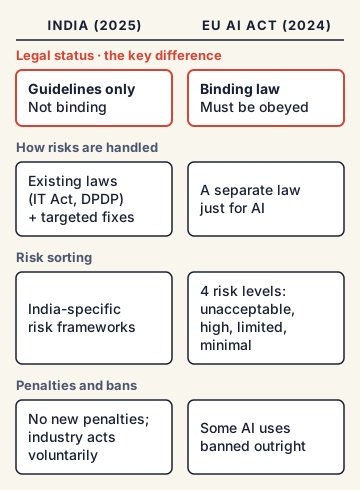
Some places, like the European Union, have passed one big AI law (the EU AI Act, 2024). India chose a different path. The guidelines say India does not need a separate AI law at this stage. Existing laws can handle most AI risks if they are updated. These include the Information Technology Act, 2000, the Digital Personal Data Protection (DPDP) Act, 2023, consumer protection law, copyright law and criminal law.
Where gaps exist, the government should make targeted amendments. The guidelines also say the government should act quickly, even with stricter rules, if a serious harm appears. The overall approach is often called "pro-innovation" or "light-touch", with a "Do No Harm" spirit.
The seven guiding principles ("sutras")
The guidelines are built on seven short principles. They were adapted from the Reserve Bank of India's FREE-AI Committee report (2025) on AI in the financial sector.
- Trust is the foundation: without trust, people will not use AI.
- People first: humans must stay in control, and AI must serve people.
- Innovation over restraint: encourage new ideas, and avoid rules that block progress without good reason.
- Fairness and equity: AI must not discriminate, for example against a caste, gender or region.
- Accountability: someone must be answerable when AI causes harm.
- Understandable by design: people should be able to understand how and why an AI system reached a decision.
- Safety, resilience and sustainability: AI systems must be safe, hard to break, and environment-friendly.
The six pillars of recommendations
The guidelines group their advice into six areas, which fall into three bigger aims.
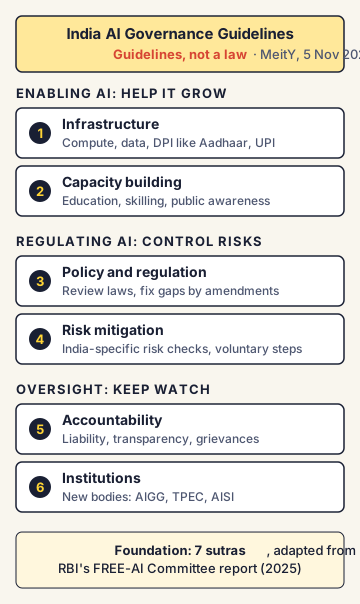
- Enabling AI (helping it grow): (1) Infrastructure: wider access to computing power, data and digital public infrastructure such as Aadhaar and UPI. (2) Capacity building: education, skilling and public awareness about AI's risks and benefits.
- Regulating AI (controlling risks): (3) Policy and regulation: review current laws, find gaps, and fix them with targeted changes. (4) Risk mitigation: India-specific ways to judge AI risks, and voluntary measures by industry.
- Oversight (keeping watch): (5) Accountability: clear liability (who pays or is punished when things go wrong), transparency reports and grievance redressal systems. (6) Institutions: new bodies to coordinate AI governance across government.
Which new bodies are proposed?
The guidelines suggest a "whole-of-government" set-up, meaning all ministries and regulators work together instead of separately:
- AI Governance Group (AIGG): a high-level group that brings together ministries, sector regulators (like the RBI or SEBI) and standard-setting bodies. It coordinates policy and reviews laws.
- Technology and Policy Expert Committee (TPEC): a panel of experts that advises the AIGG on technical and policy questions.
- AI Safety Institute (AISI): the technical arm. It tests AI systems, studies risks and develops safety tools. India announced its AI Safety Institute in January 2025 under the "Safe and Trusted AI" pillar of the IndiaAI Mission. It works on a "hub and spoke" model, meaning a central hub linked with many research institutions and companies.
What is the "techno-legal" approach?
This is a key idea in India's thinking. A pure legal approach says, "Make a rule and punish those who break it." But AI content spreads in seconds, across borders, and is often made by people who cannot be traced. So the law alone is too slow. A techno-legal approach puts the rule inside the technology itself.
Examples are compulsory labels and invisible watermarks on AI-made content, tools that detect fakes, and privacy protections built into software ("privacy by design"). The law sets the duty; technology carries it out automatically. India already used this idea in its digital public infrastructure, such as consent rules built into data-sharing systems.
How do these guidelines connect with the IndiaAI Mission?
The IndiaAI Mission was approved by the Union Cabinet on 7 March 2024 with an outlay of ₹10,371.92 crore over five years. Its motto is "Making AI in India and Making AI Work for India". It has seven pillars, including IndiaAI Compute (shared GPUs at low cost), AIKosh (a national dataset platform), IndiaAI Future Skills, IndiaAI Startup Financing, IndiaAI Application Development, the IndiaAI Innovation Centre (for building Indian foundation models) and Safe and Trusted AI.
The governance guidelines sit under this last pillar. The mission began with a target of 10,000 GPUs and, as of late 2025, had made over 38,000 GPUs available to startups and researchers at subsidised rates.
Commonly confused concepts
- India AI Governance Guidelines vs EU AI Act: The EU AI Act (2024) is a binding law. It sorts AI into risk levels (unacceptable, high, limited, minimal) and bans some uses outright. India's guidelines are a voluntary framework that relies on existing laws, targeted amendments and industry action.
- Guidelines vs Rules vs Act: An Act is passed by Parliament. Rules are made by the government under an Act and are binding (for example, the IT Rules, 2021 under the IT Act). Guidelines are advice and principles; they are not binding by themselves.
- IndiaAI Mission vs AI Governance Guidelines: The Mission is a spending programme that builds AI capacity (GPUs, datasets, skills, startups). The Guidelines are a rulebook of principles on how AI should be governed.
- AI Safety Institute vs CERT-In: The AISI studies and tests the safety of AI systems. CERT-In (Indian Computer Emergency Response Team) responds to cyber attacks and security incidents of all kinds.
Issues, criticism and the way forward
- Too soft? Critics say voluntary guidelines may not stop powerful companies from misusing AI, and that binding duties are needed for high-risk uses like policing or credit scoring. The government's view is that heavy rules too early could choke Indian startups and that existing laws already cover many harms.
- Gaps in old laws: The IT Act, 2000 was written before modern AI. Questions like "who is liable when an AI system gives harmful advice" or "can AI-generated work be copyrighted" are not clearly answered yet.
- Capacity of regulators: Testing AI systems needs skilled people and money. Bodies like the AISI are still being built up.
- Many voices, one system: AI touches every sector. Without good coordination, ministries and regulators may issue rules that clash. This is why the AIGG is proposed.
- Way forward: The guidelines' action plan runs in short, medium and long-term steps: build India-specific risk frameworks and clear liability rules first, and draft new laws later if new risks appear. Experts also stress public awareness, regular review, and close cooperation with other countries.
Concepts to Know
- Artificial Intelligence (AI): Computer systems that can do tasks that usually need human thinking, such as understanding language, recognising faces or making predictions.
- GPU (Graphics Processing Unit): A powerful computer chip that can do many calculations at once. Training and running modern AI needs thousands of them, and they are very costly.
- Foundation model: A very large AI model trained on huge amounts of data, which can then be adapted for many tasks. ChatGPT-type chatbots are built on foundation models.
- Liability: Legal responsibility. If you are liable for a harm, you can be made to pay for it or be punished.
- Digital Public Infrastructure (DPI): Shared digital systems built by the government for everyone to use, like Aadhaar (identity), UPI (payments) and DigiLocker (documents).
- Grievance redressal: A system where a user can complain and get the problem fixed within a fixed time.
- Watermark: A hidden or visible mark inside a photo, video or audio file that shows where it came from or that it was made by AI.
- India AI Governance Guidelines released by MeitY on 5 November 2025, under the IndiaAI Mission
- Drafting committee chaired by Prof. Balaraman Ravindran (IIT Madras); January 2025 draft got over 2,500 public comments
- No standalone AI law at present; rely on IT Act 2000, DPDP Act 2023 and targeted amendments
- 7 sutras (adapted from RBI's FREE-AI Committee report); 6 pillars: infrastructure, capacity building, policy and regulation, risk mitigation, accountability, institutions
- Proposed institutions: AI Governance Group (AIGG), Technology and Policy Expert Committee (TPEC), AI Safety Institute (AISI, announced January 2025)
- IndiaAI Mission: approved 7 March 2024, ₹10,371.92 crore over 5 years, 7 pillars
- India AI Impact Summit: Bharat Mandapam, New Delhi, February 2026
● Tracked since March 13, 2026 · last seen October 08, 2026 · updates as the daily brief publishes