India-Switzerland Relations
India and Switzerland are friendly partners whose ties rest on democracy, the rule of law and a shared habit of staying away from military blocs: India through non-alignment and later strategic autonomy, Switzerland through permanent neutrality. Switzerland is a small, rich European country that is not in the European Union. It matters to India as a source of advanced technology, high-value investment and, through the India-EFTA TEPA, India's first free trade agreement with European countries.
Why does this relationship matter?
- Technology and investment: Switzerland is a leader in precision engineering, pharmaceuticals, machinery, tunnelling and railways, banking and insurance. India needs these to build infrastructure and to grow manufacturing.
- Trade: Switzerland is one of India's larger trading partners in Europe, mainly because India buys large amounts of gold that is refined in Switzerland.
- Global governance: Geneva hosts the UN's European headquarters, the World Trade Organization (WTO), the World Health Organization, the Human Rights Council and many other bodies. So Switzerland is a key venue for Indian diplomacy.
- Tax transparency: Swiss banking secrecy was long linked to black money. Cooperation on tax information is important for India's fight against tax evasion.
- People and skills: Switzerland has an ageing population and needs skilled workers, while India has a large young, educated workforce.
Where did it come from?
- 1851: Commercial links began early. The Swiss trading firm Volkart opened offices in Basel and Mumbai (then Bombay).
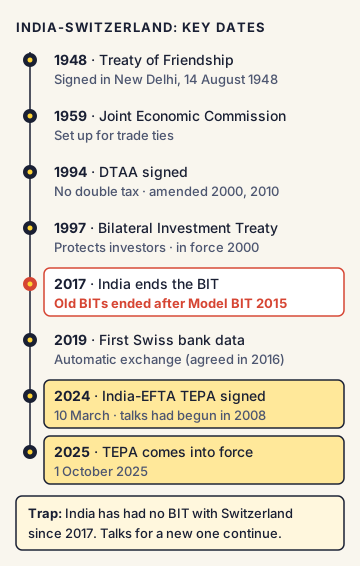
- 14 August 1948: India and Switzerland signed a Treaty of Friendship in New Delhi, one of the first such treaties signed by independent India. It came into force on 5 May 1949.
- 1949: An agreement with a Swiss company helped set up the Integral Coach Factory (ICF) in Chennai, which builds railway coaches.
- 1959: A Joint Economic Commission was set up for trade ties.
- 1994: A Double Taxation Avoidance Agreement (DTAA) was signed, later amended in 2000 and 2010.
- 1997: A Bilateral Investment Treaty (BIT) was signed (in force from 2000). India terminated it in 2017, along with many old BITs, after adopting a new Model BIT in 2015. Talks for a new investment treaty continue.
- 2016: The two sides agreed to start automatic exchange of tax information. The first set of Swiss bank account details reached India in September 2019.
- 10 March 2024: The India-EFTA TEPA was signed after talks that began in 2008. It came into force on 1 October 2025.
- 2026: President Parmelin visited for the AI Impact Summit (February) and made a state visit (October).
How does the relationship work today? (the main mechanisms)
- Foreign Office Consultations: Secretary-level talks set up in 1996; the first round was in 2000.
- Joint Economic Commission (since 1959) and a Financial Dialogue (since 2012).
- Joint Committee on Science and Technology under the 2003 S&T agreement, with the Indo-Swiss Joint Research Programme (from 2005).
- Joint Working Groups on railway technology (MoU of 2017, renewed in 2024) and on climate change and environment.
- Switzerland has an embassy in New Delhi and consulates in Mumbai and Bengaluru; India has an embassy in Berne and a consulate in Geneva.
The key economic facts
- Total trade in FY 2024-25: about $23.27 billion, making Switzerland India's 15th largest trading partner. The balance is in Switzerland's favour because of gold imports.
- India exports organic chemicals, gems and jewellery, textiles, machinery, pharmaceuticals and farm products. Switzerland exports gold, chemicals and pharmaceuticals, machinery, precision instruments and watches.
- Swiss FDI in India from April 2000 to June 2025 was about $10.87 billion, placing Switzerland 12th among investors.
- About 330 Swiss companies work in India, employing over 1.66 lakh people. Most Swiss investment is in Maharashtra, Karnataka, Haryana, Delhi and Tamil Nadu.
- Indian companies, especially IT and pharmaceutical firms, are present in Switzerland.
- Infrastructure examples include the ropeway in Varanasi, the Noida International Airport (Jewar), and rail tunnelling projects in hilly areas.
India's position and Indian examples
- India sees Switzerland as a gateway to the wider EFTA group and as a source of investment under TEPA's $100 billion commitment.
- India has pushed for easier movement of Indian students and professionals, which the migration and mobility and young professionals agreements of 2026 address.
- On tax, India uses the automatic exchange of financial account information to track money held abroad by Indian residents.
- In June 2016, the Swiss President publicly promised support for India's bid to join the Nuclear Suppliers Group (NSG), the 48-member group that controls exports of nuclear material and technology. India's bid was not accepted at the NSG plenary later that month, mainly because India has not signed the Nuclear Non-Proliferation Treaty and the NSG works by consensus. Both sides have now agreed to deepen nuclear energy cooperation.
Commonly confused concepts
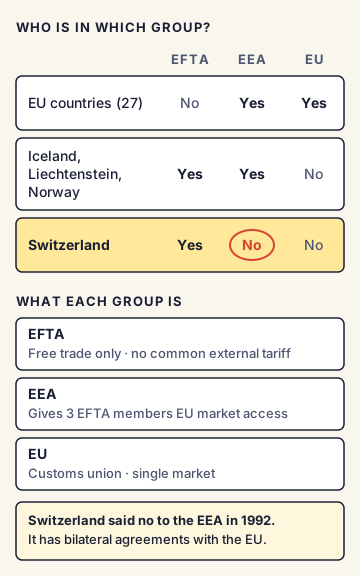
- EFTA vs EU: Switzerland is in the European Free Trade Association (EFTA), not the European Union (EU). EFTA (Iceland, Liechtenstein, Norway, Switzerland) is only a free trade group with no common external tariff. The EU is a customs union and single market with shared institutions.
- Switzerland vs the EEA: Iceland, Liechtenstein and Norway are in the European Economic Area (EEA), which gives them access to the EU single market. Switzerland voted against joining the EEA in 1992 and deals with the EU through bilateral agreements instead.
- Neutrality vs non-alignment: Swiss neutrality is a permanent legal status (it does not join military alliances or wars). India's non-alignment was a political choice during the Cold War to avoid joining either bloc, not a legal status.
- DTAA vs BIT: A DTAA stops the same income from being taxed twice in two countries. A BIT protects foreign investors' money (fair treatment, protection from seizure, dispute settlement).
- Swiss President vs a head of government: The Swiss President is one of the seven members of the Federal Council (the collective government) and holds the post for one year by rotation. It is very different from an executive president or a prime minister.
Issues, criticism and the way forward
- Trade imbalance: India runs a large trade deficit, mostly due to gold imports. Expanding Indian exports of goods and services is the main fix.
- Investment protection gap: Since the old BIT ended in 2017, Swiss investors have asked for a new treaty. Agreeing on dispute-settlement rules is the challenge.
- Tax treaty friction: After India's Supreme Court ruled in the Nestle SA case (October 2023) that a "most favoured nation" (MFN) clause in a tax treaty does not apply automatically without a notification, Switzerland suspended the MFN clause of the DTAA from 1 January 2025. This raised the Swiss withholding tax on dividends paid to Indian residents from 5% to 10%.
- Intellectual property and pharma: Swiss pharma firms want stronger patent protection; India protects access to cheap generic medicines. TEPA tries to balance both, but differences remain.
- Way forward: Delivering TEPA's investment promise, signing a new investment treaty, using the mobility agreements to send skilled Indians, and building joint research in health, clean energy, space and AI.
Concepts to Know
- Gold refining hub: Switzerland refines a large share of the world's gold; refined gold bars are then sold to countries like India.
- Automatic exchange of information (AEOI): A system under which countries share bank account details of each other's residents every year without being asked.
- Withholding tax: Tax cut at the source by the country where income is earned, before the money is paid abroad.
- Most favoured nation (MFN) clause in a tax treaty: A promise that if a country later gives a better tax rate to a third country, the same benefit will also be given to this treaty partner.
- State visit: The highest form of official visit by a head of state, with full ceremonial honours.
- Treaty of Friendship: signed 14 August 1948, in force 5 May 1949
- DTAA: 1994 (amended 2000, 2010); Switzerland suspended the MFN clause from 1 January 2025
- BIT: signed 1997, in force 2000, terminated by India in 2017
- AEOI: first Swiss bank data to India in September 2019
- Trade FY 2024-25: $23.27 billion (15th largest partner); Swiss FDI April 2000 to June 2025: $10.87 billion (12th)
- About 330 Swiss companies in India
- TEPA: signed 10 March 2024, in force 1 October 2025
- Swiss President is chosen for one year from the seven-member Federal Council
● Tracked since October 05, 2026 · last seen October 05, 2026 · updates as the daily brief publishes
See it in today’s brief.
Daily current affairs with every static concept explained in place.
Read the daily brief