Migration and Mobility Partnership Agreements (MMPAs)
A Migration and Mobility Partnership Agreement, or MMPA, is a deal between two countries about the movement of people. It makes it easier for students, researchers, skilled workers and young professionals to go and live, study or work in the other country legally. In return, both countries agree to work together to stop illegal migration and to take back their own citizens who stay illegally. In simple words, it opens a legal front door and helps close the illegal back door.
Why do such agreements exist?
Many rich countries, especially in Europe and East Asia, have ageing populations. They do not have enough young workers for jobs in health care, IT, engineering, construction and farming. India has the opposite situation: a very large young population looking for good jobs and education. An MMPA connects this need and this supply in a safe, legal and organised way. It also protects Indian workers from fake recruitment agents and human trafficking (illegally moving people for forced work or exploitation).
Why does India care so much?
Indians working abroad send money home, called remittances. India is the world's biggest receiver of remittances. It received a record USD 135.46 billion in the financial year 2024-25, and according to the World Bank, India got about 14.3% of all remittances in the world in 2024. Skilled Indians abroad also build business links, carry Indian culture and add to India's "soft power" (influence through attraction, not force).
Where did it come from?
India started signing such comprehensive deals in the last decade:
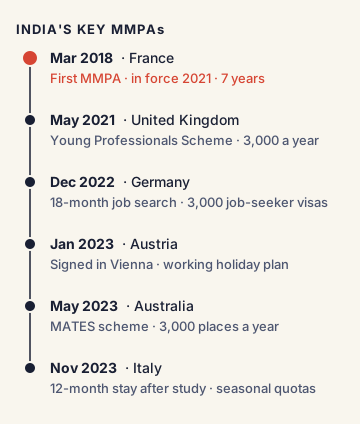
- France (2018): The India-France MMPA was signed on 10 March 2018 during the French President's state visit. It came into force in 2021 and is valid for seven years with automatic renewal.
- United Kingdom (2021): Signed on 4 May 2021. It created the Young Professionals Scheme, which lets up to 3,000 young people (aged 18 to 30) from each country live and work in the other for up to two years.
- Germany (2022): Signed on 5 December 2022 and in force from 7 March 2023. It lets Indian students stay up to 18 months after their studies to look for a job, offers 3,000 job-seeker visas a year and sets up an Academic Evaluation Centre in New Delhi to check Indian degrees.
- Austria (2023): Signed in Vienna on 2 January 2023, with a separate "working holiday" programme.
- Australia (2023): Signed on 23 May 2023. It created MATES (Mobility Arrangement for Talented Early-professionals Scheme) with 3,000 places a year for Indian graduates aged 18 to 30, for up to two years.
- Italy (2023): Signed on 2 November 2023. Indian students can stay up to 12 months after studies to gain work experience, and Italy reserved quotas for seasonal Indian workers.
India has also signed similar arrangements with countries such as Portugal, Denmark, Japan and Israel, and with Switzerland in October 2026. In July 2026, the government said India had signed 28 such agreements with 26 countries [Unverified].
How does an MMPA work?
Most MMPAs have the same building blocks:
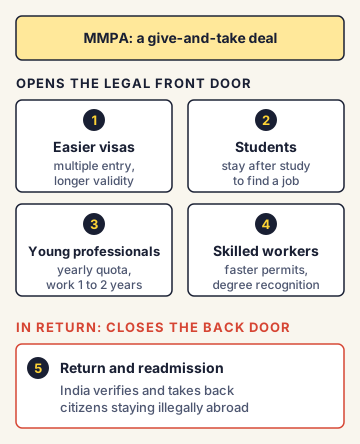
- Easier visas: short-stay visas with multiple entries and longer validity for business people, researchers and tourists.
- Student mobility: easier study visas and permission to stay and look for work after graduation.
- Young professionals schemes: a fixed yearly number (quota) of young people allowed to work in the other country for one to two years to gain experience.
- Skilled worker routes: faster permits for nurses, engineers, IT workers and others, sometimes with help in recognising Indian degrees.
- Return and readmission: India agrees to quickly verify and take back Indian citizens found staying illegally, and both sides fight human trafficking.
India's own legal system for emigration
Inside India, going abroad for work is regulated by the Emigration Act, 1983. Under it, some workers (mainly those without a Class 10 pass going to certain countries) need an "Emigration Check Required" (ECR) clearance before they go. This clearance is now processed online on the e-Migrate portal of the Ministry of External Affairs. In 2025, the Ministry released a draft Overseas Mobility (Facilitation and Welfare) Bill, 2025 to replace the 1983 Act. It proposes an Overseas Mobility and Welfare Council and stronger action against illegal recruitment agents.
The global framework
In December 2018, the UN General Assembly endorsed the Global Compact for Safe, Orderly and Regular Migration (GCM). It is the first global agreement on migration, but it is not legally binding. India supported it. MMPAs are one way India puts the GCM's ideas of "safe, orderly and regular" migration into practice with individual countries.
Commonly confused concepts
- MMPA vs a trade deal's "Mode 4": In trade deals, "Mode 4" means temporary movement of service workers (for example, an IT engineer going to a client site). It is limited to service suppliers. An MMPA is much wider: it covers students, researchers, young professionals, skilled workers and illegal migration.
- MMPA vs a Social Security Agreement (SSA): An SSA stops workers from paying social security (pension) contributions in both countries at the same time. An MMPA is about getting visas and permits, not about pensions.
- Migrant vs refugee: A migrant moves by choice, usually for work or study. A refugee is forced to flee their country because of war or persecution, and is protected by the 1951 Refugee Convention. India is not a party to the 1951 Refugee Convention.
- Emigration vs immigration: Emigration is leaving your own country to live elsewhere. Immigration is coming into a new country to live.
Issues, criticism and the way forward
- Small numbers: Quotas like 300 or 3,000 a year are tiny compared to India's young workforce. Critics say the gains are more symbolic than large-scale.
- Brain drain: If the best doctors, nurses and engineers leave, India may face shortages at home. Supporters reply that remittances, new skills and returning workers ("brain gain") balance this.
- Degree recognition: Many Indian qualifications are not accepted directly abroad, so skilled Indians end up in lower-level jobs.
- Readmission pressure: Partner countries often care most about sending back illegal migrants. India must balance this with protecting its citizens' rights.
- Worker protection: Low-skilled workers, especially in the Gulf, still face problems like unpaid wages and passport confiscation.
- Way forward: Experts suggest skill training matched to partner countries' needs (including language training), faster degree recognition, a modern emigration law to replace the 1983 Act, and better data on Indians working abroad.
Concepts to Know
- Remittance: Money that a person working abroad sends back to family in their home country.
- Readmission: When a country agrees to take back its own citizen who has been staying illegally in another country.
- Quota: A fixed maximum number, for example 3,000 visas a year.
- Brain drain: When highly educated or skilled people leave their country for better opportunities abroad, and the home country loses their skills.
- Emigration Check Required (ECR): A category on some Indian passports. People in this category need government clearance before going to certain countries for work, to protect them from exploitation.
- Soft power: A country's ability to influence others through its culture, values and people, rather than by force or money.
- India-France MMPA: signed 10 March 2018; in force 2021; valid 7 years with auto-renewal
- India-UK MMP: signed 4 May 2021; Young Professionals Scheme of up to 3,000 per year, ages 18 to 30, up to 2 years
- India-Germany MMPA: signed 5 December 2022; in force 7 March 2023; 18-month post-study job search; 3,000 job-seeker visas a year
- India-Austria MMPA: signed 2 January 2023 in Vienna
- India-Australia MMPA: signed 23 May 2023; MATES scheme, 3,000 places a year
- India-Italy agreement: signed 2 November 2023; up to 12 months post-study stay
- Emigration Act, 1983 governs emigration; draft Overseas Mobility (Facilitation and Welfare) Bill, 2025 proposed to replace it
- Global Compact for Safe, Orderly and Regular Migration endorsed by the UN General Assembly in December 2018 (not legally binding)
- India received USD 135.46 billion in remittances in FY 2024-25; about 14.3% of world remittances in 2024 (World Bank)
● Tracked since October 05, 2026 · last seen October 05, 2026 · updates as the daily brief publishes