India-Poland Relations
From the Good Maharaja to Strategic Partnership
India and Poland are two countries that have been friends for a long time, even though they are far apart. They set up formal diplomatic ties in 1954. During the Second World War, Indian rulers gave shelter to thousands of Polish refugee children, a story Poland still remembers with gratitude. In 2024 the two countries raised their relationship to a Strategic Partnership, and today Poland is India's biggest trade and investment partner in Central and Eastern Europe.
Why does this relationship matter?
Poland is one of the largest and fastest-growing economies in the European Union (EU). It sits on NATO's eastern edge, next to Ukraine, Belarus and Russia, so it is central to European security. For India, Poland is a gateway into Central Europe, a market for Indian goods and IT services, and a partner in defence, mining and clean energy.
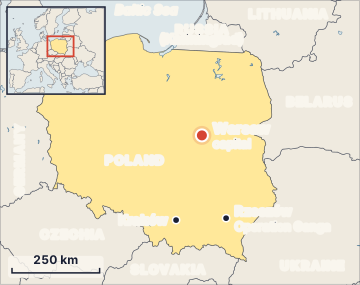
For Poland, India is a fast-growing economy and a big market for its machines and defence products. Good ties with Poland also help India widen its engagement in Europe beyond the big Western countries like France and Germany.
Where did it come from? The early years
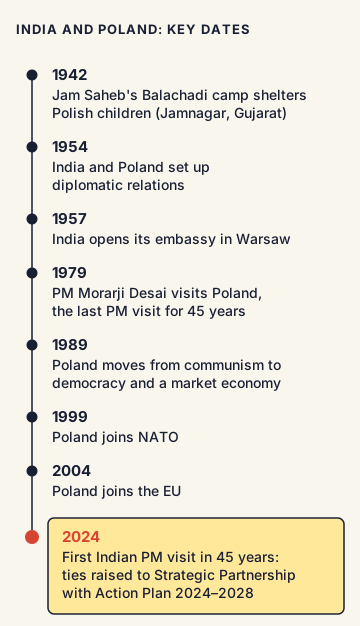
The two countries set up diplomatic relations in 1954, and India opened its embassy in Warsaw in 1957. During the Cold War, Poland was a communist country, but the two were close. Both opposed colonialism (one country ruling another), imperialism and racism. Trade was run by state trading bodies under rupee clearing arrangements, meaning they settled trade in Indian rupees instead of US dollars. Many leaders visited: Prime Ministers Jawaharlal Nehru (1955), Indira Gandhi (1967) and Morarji Desai (1979) went to Poland.
The "Good Maharaja" story
This is the emotional heart of the relationship. In the Second World War, many Polish families were deported to the Soviet Union and later released. Thousands of them, mostly women and children, reached India.
- Jam Saheb Digvijaysinhji Ranjitsinhji Jadeja, ruler of Nawanagar (today's Jamnagar, Gujarat), set up a camp at Balachadi in 1942 for Polish children. The MEA puts the number at more than 1,000 (other sources say about 740 to 800). Poland calls him the "Dobry Maharaja" (Good Maharaja).
- The Valivade camp near Kolhapur, Maharashtra, supported by the Kolhapur royal family, sheltered about 5,000 Polish refugees over the 1940s.
- Poland honours this today: a Square of the Good Maharaja in Warsaw (monument unveiled in 2014), a Kolhapur memorial plaque (2017), and several Polish schools named after the Jam Saheb.
- Indian soldiers also fought alongside Polish troops in the Battle of Monte Cassino in Italy (1944), which is remembered at the Monte Cassino memorial in Warsaw.
How did the relationship change after 1989?
In 1989 Poland moved from communism to democracy and a market economy. Trade with India shifted from rupees to normal hard-currency payments (like US dollars or euros). Poland joined NATO in 1999 and the EU in 2004. After joining the EU, Poland grew fast and became India's key economic partner in Central Europe. Polish Prime Minister Donald Tusk made a state visit to India in 2010, and President Pratibha Patil visited Poland in 2009.
The 2024 Strategic Partnership
The Indian Prime Minister visited Poland on 21–22 August 2024, the first visit by an Indian Prime Minister in 45 years (since Morarji Desai in 1979). It marked the 70th anniversary of diplomatic ties. The main outcome was raising ties to a Strategic Partnership.
- A Joint Statement and an Action Plan (2024–2028) were issued. The Action Plan lists cooperation in defence, trade, energy, green technology, mining, pharmaceuticals, infrastructure and agri-technology. An annual political consultation reviews it.
- India announced the Jamsaheb Memorial Youth Exchange Programme, under which the Government of India brings groups of 20 Polish youth to India, including to Balachadi and Valivade. The first group came in February 2025.
- A Social Security Agreement was signed on 25 November 2024. It means Indian professionals working in Poland for a short time do not have to pay into both countries' pension systems.
The key economic facts
Trade has grown steadily and is in India's favour (India sells more than it buys).
- Total trade rose from $1.95 billion in 2013 to $6.36 billion in 2025 (Polish statistics), a rise of about 192%. In 2025 India exported about $4.83 billion and imported about $1.53 billion.
- India mainly sells textiles, base metals, chemicals, machinery, footwear and transport equipment. It mainly buys machinery, mineral products and metals.
- Indian investment in Poland is over $3 billion. Around 11 Indian IT companies (like TCS, Infosys, HCL and Wipro) employ more than 10,000 people there. Polish investment in India is about $685 million.
- Poland depends on India for many active ingredients for medicines, such as raw materials for antibiotics.
- In mining, Poland has strong clean-coal skills. An India-Poland MoU on coal and mining was signed in February 2019, and Coal India engineers have trained in Polish mines.
Defence and security cooperation
An MoU on Defence Cooperation has existed since 2003, with a Joint Working Group on Defence Cooperation. Poland is rearming fast. It spends more on defence, as a share of its economy, than any other NATO member: about 4.3% of GDP in 2025, planned at about 4.8% in 2026. This makes Poland both a buyer and a growing maker of weapons, and it wants to export defence products to India. India, in turn, wants partners who will make weapons in India under Make in India.
People-to-people ties
About 30,000 Indians live in Poland, including about 5,000 students. Poland has a strong tradition of Indology (the study of India): Sanskrit was taught at the Jagiellonian University in Kraków in 1860–61, and a Chair of Sanskrit was set up there in 1893. In 2022, during Operation Ganga, Poland helped India bring home its students stuck in war-hit Ukraine. Many were flown out from Rzeszów airport in Poland.
India's position
India sees Poland as an important EU member and a leader of Central and Eastern Europe. India's approach is to build ties based on trade, technology and history, without taking sides in European security quarrels. On the Russia-Ukraine war, India supports dialogue and diplomacy and a peaceful end to the conflict.
Commonly confused concepts
- Strategic Partnership vs alliance: A strategic partnership is a promise of close, long-term cooperation in many areas. It is not a military alliance; there is no duty to defend each other. NATO, which Poland belongs to, is an alliance: under Article 5 of the NATO treaty, an attack on one member is treated as an attack on all.
- Balachadi vs Valivade: Balachadi (Jamnagar, Gujarat) was the Jam Saheb's camp for children. Valivade (Kolhapur, Maharashtra) was a larger settlement of about 5,000 refugees, mostly women and children.
- Visegrad Group vs Weimar Triangle: Both are groups that include Poland and were formed in 1991. The Visegrad Group (V4) is Poland, Czechia, Slovakia and Hungary. The Weimar Triangle is Poland, France and Germany.
- Poland in the EU and Schengen, but not the eurozone: Poland uses its own currency, the złoty, not the euro.
Issues, criticism and the way forward
- Small trade base: Trade of about $6 billion is small for two large economies. The target to double it by 2030 depends on the India-EU FTA coming into force and on more Polish investment in India.
- Trade imbalance: Poland buys much more from India than it sells. Poland wants more access for its machines, food products and defence goods.
- Different views on Russia: Poland sees Russia as its main threat and strongly backs Ukraine. India keeps close ties with Russia for defence and energy. Both sides manage this difference by focusing on areas where they agree.
- EU rules: As an EU member, Poland follows EU trade rules, including the Carbon Border Adjustment Mechanism (CBAM), which may raise costs for Indian steel and aluminium.
- Way forward: Use the Action Plan (2024–2028) to build joint projects in defence manufacturing, clean coal and mining, green hydrogen, IT, pharmaceuticals and education, and keep the "Good Maharaja" goodwill alive through youth exchanges and tourism.
Concepts to Know
- NATO (North Atlantic Treaty Organization): A military alliance of North American and European countries set up in 1949. Members promise to defend each other if one is attacked.
- European Union (EU): A group of 27 European countries that work as one market, with shared trade rules and free movement of goods and people.
- Joint Statement: A document issued by two governments after talks, listing what they agreed. It is a political promise, not a legally binding treaty.
- Action Plan: A list of specific tasks and timelines that two countries agree to carry out to put a partnership into practice.
- Co-development and co-production: When companies from two countries design a product together and then manufacture it together, instead of one country simply buying from the other.
- Rupee clearing arrangement: A system where two countries settle their trade in Indian rupees instead of a foreign currency like the US dollar.
- Indology: The academic study of India's languages, history, religions and culture.
- Diplomatic relations: 1954; Indian Embassy in Warsaw: 1957
- PM visits to Poland: Nehru (1955), Indira Gandhi (1967), Morarji Desai (1979), then August 2024 (first in 45 years)
- Strategic Partnership: August 2024, with Action Plan 2024–2028
- Balachadi camp (Jamnagar), 1942; Valivade camp (Kolhapur), about 5,000 refugees
- Jamsaheb Memorial Youth Exchange Programme: 20 Polish youth to India; first batch February 2025
- Social Security Agreement: signed 25 November 2024
- Defence Cooperation MoU: 2003; Coal and mining MoU: February 2019
- Trade: $6.36 billion (2025), up from $1.95 billion (2013); balance in India's favour
- Indian investment in Poland: over $3 billion; Polish investment in India: about $685 million
- Poland joined NATO 1999, EU 2004; currency is the złoty
- Indian community in Poland: about 30,000
● Tracked since October 22, 2026 · last seen October 22, 2026 · updates as the daily brief publishes