India-Mexico Relations
India and Mexico are two large developing democracies, one in Asia and one in North America. They share old cultural links, close cooperation in farming science and growing trade. Mexico was the first Latin American country to establish diplomatic relations with independent India, in 1950. Today the relationship is mainly driven by trade and investment, as Indian companies use Mexico as a base to reach the huge North American market.
Why does this relationship matter?
Mexico is one of the biggest economies in Latin America and a member of the G20. It shares a long border with the United States and is part of the USMCA (United States-Mexico-Canada Agreement), a free trade deal among the three countries. So a company that makes goods in Mexico can sell them into the US and Canada at low or zero duty.
For India, this makes Mexico a gateway to North and Latin America. For Mexico, India is a large market for its crude oil and a source of affordable cars, medicines and IT services.
Where is Mexico?
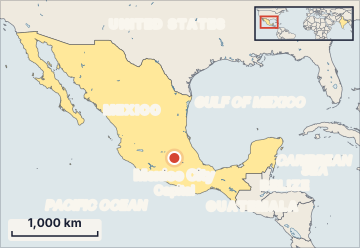
Mexico lies in North America, south of the United States. It borders Guatemala and Belize to the south-east. It has coasts on the Pacific Ocean to the west and the Gulf of Mexico and Caribbean Sea to the east. Its capital is Mexico City. Mexico was a Spanish colony and won independence from Spain in 1821. Its official language is Spanish.
Where did the relationship come from?
The links are older than formal ties:
- M.N. Roy, the Indian revolutionary, lived in Mexico and helped found the Communist Party of Mexico in 1919, before returning to Asian politics.
- Pandurang Khankhoje, an Indian freedom fighter of the Ghadar movement, worked in Mexico as an agricultural scientist on maize. A bust of him stands at Chapingo University in Mexico.
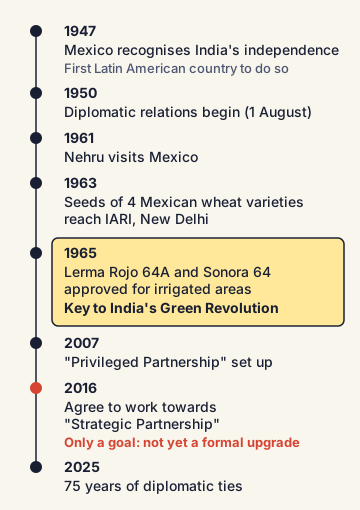
- Mexico recognised India's independence in 1947, the first Latin American nation to do so, and formal diplomatic relations began on 1 August 1950. The year 2025 marked 75 years of ties.
- Jawaharlal Nehru visited Mexico in 1961. The Mexican poet Octavio Paz served as Mexico's ambassador to India from 1962 to 1968. He later won the Nobel Prize in Literature (1990), and his writings on India are widely read in Mexico.
The Green Revolution link
This is the most important historical fact for UPSC. In the 1960s, India faced severe food shortages. The American scientist Norman Borlaug, working in Mexico at the centre that later became CIMMYT (International Maize and Wheat Improvement Center), had bred short, high-yielding wheat varieties. In 1963, seeds of four Mexican varieties reached the Indian Agricultural Research Institute (IARI) in New Delhi.
In 1965, two of them, Lerma Rojo 64A and Sonora 64, were approved for cultivation in irrigated areas. These Mexican wheats, along with improved varieties developed by Indian scientists, powered India's Green Revolution and made the country self-sufficient in food grains.
How has the partnership grown?
- 2007: During the visit of Mexican President Felipe Calderón to India, the two sides set up a "Privileged Partnership". An extradition treaty and a mutual legal assistance treaty on criminal matters were also signed.
- 2016: The Indian Prime Minister visited Mexico City (June 2016). The two leaders agreed to work towards raising ties to a "Strategic Partnership". Note: this is a goal they agreed on, not an upgrade already completed.
- 2023: Mexico opened a Consulate in Mumbai.
- 2025: The two leaders held their first meeting in June 2025 on the sidelines of the G7 Summit in Canada.
Trade and investment, the main driver today
- Mexican figures (as reported by India's Ministry of External Affairs): bilateral trade was about USD 11.09 billion in 2025, with Indian exports of USD 9.13 billion and imports of about USD 1.97 billion. India is Mexico's ninth largest trading partner.
- Indian figures (Commerce Ministry, financial year basis) are lower: about USD 7.83 billion in 2025-26. Figures differ because each country counts trade in its own way and over different periods.
- What India sells: cars and auto parts, two-wheelers, medicines, engineering goods and chemicals.
- What India buys: mainly crude oil (about 75% of Mexico's export basket to India), plus gold, chemicals and phones.
- Investment: Indian investment in Mexico is about USD 4 billion (up to 2024), and over 250 Indian companies work there, mainly in IT (TCS, Infosys, HCL, Wipro, Tech Mahindra), pharmaceuticals (Sun Pharma, Dr. Reddy's, Lupin, Zydus) and automobiles. Mexican investment in India is much smaller, about USD 810 million, from around 17 major companies such as Cinépolis (cinemas), Bimbo (India's largest bread maker after buying Harvest Gold), Nemak and Softtek.
- The Indian community in Mexico is small, about 12,000 people, mostly IT professionals.
Nearshoring: why Mexico is attractive now
"Nearshoring" means a company shifts its factories closer to its main customers. Many firms that sell to the US now want to make goods in Mexico instead of far-away Asia, to cut shipping time and to use USMCA's low duties. Indian auto-part and pharma makers see this as a big opportunity.
Cooperation in other areas
- Science and technology: A 2023 MoU links India's CSIR with Mexico's development agency AMEXCID.
- Training: India's ITEC (Indian Technical and Economic Cooperation) programme has been open to Mexico since 1991.
- Culture: The Gurudev Tagore Indian Cultural Centre in Mexico City has run since 2010, teaching yoga, classical dance and music.
- Multilateral: Both are members of the UN and G20 and speak for the Global South.
Commonly confused concepts
- Privileged Partnership vs Strategic Partnership: India-Mexico ties have been a "Privileged Partnership" since 2007. Since 2016, both sides have only agreed to work towards a "Strategic Partnership". Do not write that Mexico is already a formal strategic partner.
- USMCA vs NAFTA: NAFTA (North American Free Trade Agreement) came into force in 1994. It was replaced by the USMCA, in force since 1 July 2020.
- Mexico vs Brazil in India's Latin America ties: Brazil is India's partner in BRICS and IBSA. Mexico is not in BRICS. Both are in the G20.
- UN Security Council reform: India is part of the G4 (India, Brazil, Germany, Japan), which seeks new permanent seats. Mexico belongs to the Uniting for Consensus group, which opposes new permanent seats. This is one area where the two countries take different positions.
Issues, criticism and the way forward
- No trade agreement so far: Until now, India and Mexico had no trade deal at all. This left Indian goods exposed when Mexico raised duties in 2026.
- Heavy dependence on a few goods: Mexico's exports to India are mostly crude oil, so trade can swing with oil prices and India's buying choices.
- US influence: Experts link Mexico's 2026 duty increases to its close trade ties with the US, which wants Mexico to limit cheap imports from Asia.
- Distance and weak connectivity: There are no direct flights or short shipping routes, which raises costs and limits tourism and people-to-people ties.
- Way forward: Conclude the PTA quickly; widen it later into a fuller trade deal; complete the move to a Strategic Partnership; and expand cooperation in pharmaceuticals, digital public infrastructure, space, renewable energy and critical minerals.
Concepts to Know
- Trade surplus: When a country sells more to a partner than it buys from it. India sells more to Mexico than it buys, so India has a surplus.
- G20: A group of 19 countries plus the European Union and the African Union that together make up most of the world's economy. India held its presidency in 2023.
- Green Revolution: The big jump in India's wheat and rice output in the late 1960s and 1970s, made possible by high-yielding seeds, irrigation, fertilisers and government support.
- CIMMYT: The International Maize and Wheat Improvement Center, a research centre based in Mexico that develops better maize and wheat varieties for the world.
- Nearshoring: Moving production to a country close to your main market, for example from Asia to Mexico for goods sold in the US.
- Mexico recognised India's independence in 1947; diplomatic relations from 1 August 1950 (first in Latin America)
- Octavio Paz: Mexican ambassador to India, 1962-1968; Nobel Prize in Literature, 1990
- Mexican wheat (Lerma Rojo 64A, Sonora 64) reached IARI in 1963; approved in 1965; key to the Green Revolution
- "Privileged Partnership": 2007; agreed to work towards "Strategic Partnership": 2016
- Bilateral trade (Mexican data): USD 11.09 billion in 2025; India is Mexico's 9th largest trading partner
- Indian investment in Mexico: about USD 4 billion; Mexican investment in India: about USD 810 million
- Indian community in Mexico: about 12,000
- USMCA in force since 1 July 2020 (replaced NAFTA of 1994)
● Tracked since October 28, 2026 · last seen October 28, 2026 · updates as the daily brief publishes