India-Lebanon Relations
Old Friendship, New Areas of Cooperation
Lebanon is a small country in West Asia, on the eastern coast of the Mediterranean Sea. India and Lebanon set up diplomatic relations in 1954. Their ties are friendly and steady, built on trade, culture, medicines, training of officials, and India's long role in UN peacekeeping in south Lebanon.
Where is Lebanon, and why does it matter?
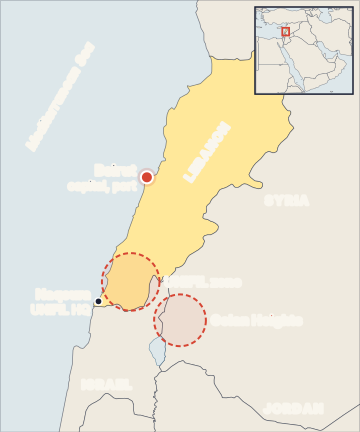
Lebanon shares land borders with only two countries: Syria to the north and east, and Israel to the south. Its capital is Beirut, a major port city. Lebanon sits in one of the most unstable parts of the world, the Levant (the region along the eastern Mediterranean). What happens there affects the security of the whole West Asia region, where about 9 million Indians live and work, and from where India buys much of its oil and gas. So peace in Lebanon matters to India even though the country is small.
How is Lebanon governed?
Lebanon has many religious communities. To keep a balance between them, top posts are shared by religion. This is called a confessional system (a "confession" here means a religious community).
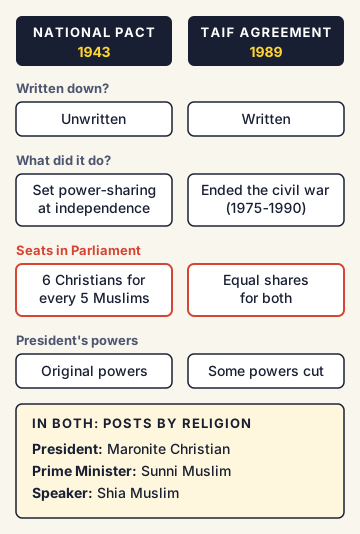
- The President must be a Maronite Christian.
- The Prime Minister must be a Sunni Muslim.
- The Speaker of Parliament must be a Shia Muslim.
This rule began with the unwritten National Pact of 1943, agreed when Lebanon became independent from French rule. A long civil war was fought from 1975 to 1990. The Taif Agreement of 1989, negotiated in Taif, Saudi Arabia, helped end it. It changed the seat ratio in Parliament from 6 Christians for every 5 Muslims to equal shares, and cut some powers of the President.
In January 2025, former army chief Joseph Aoun became President, and Nawaf Salam, then President of the International Court of Justice, became Prime Minister.
Lebanon's recent troubles
Since 2019, Lebanon has faced a very deep economic crisis. In 2021, the World Bank said it was likely among the 10, and possibly among the 3, worst economic crises anywhere in the world since the mid-1800s. On 4 August 2020, about 2,750 tonnes of ammonium nitrate (a chemical used in fertilisers and explosives), stored unsafely at Beirut port, exploded.
Over 200 people died. Lebanon has also seen repeated fighting between Israel and Hezbollah, an armed group and political party based in Lebanon, including the 2006 war and later rounds of conflict.
History of India-Lebanon ties
- Diplomatic relations were set up in 1954. Prime Minister Jawaharlal Nehru visited Lebanon in 1956 and 1960.
- India kept its embassy in Beirut open through the whole civil war (1975-1990), when many other countries shut theirs. Lebanese people still remember and value this.
- Both countries worked together as non-permanent members of the UN Security Council in 2010.
- India has steadily supported the Palestinian cause and has strong ties with the Arab world, which helps its image in Lebanon.
India's role in UN peacekeeping in Lebanon
An Indian Army battalion, called INDBATT, has served in the United Nations Interim Force in Lebanon (UNIFIL) since November 1998. As of July 2026, the Indian contingent had about 600 personnel. INDBATT also runs small community projects for local villages in south Lebanon, like generators, solar panels, water pumps and sports facilities. These are funded by India as Quick Impact Projects (small, fast projects that help ordinary people directly).
Trade and investment
Trade between the two countries is small but growing. According to the MEA, Lebanon's imports from India were worth about US$ 337 million in 2025, up from US$ 323 million in 2024. India was Lebanon's 11th largest source of imports. India mainly sells chemicals, pearls and precious stones, machinery, textiles and plastics. India mainly buys base metals and some manufactured items from Lebanon.
Some Lebanese firms work in India, and Indian firms have projects in Lebanon (for example, power plants and the supply of Ashok Leyland trucks).
Medicines and health
Pharmaceuticals are a natural area of cooperation, because India is a major maker of low-cost generic medicines. In October 2024, India gifted 33 tonnes of medicines to Lebanon. In August 2024, Lebanese health officials visited India to discuss recognition of the Indian Pharmacopoeia (India's official book of standards for medicines) and the possible adoption of India's Jan Aushadhi model (shops selling cheap generic medicines). India also signed an MoU in November 2025 to renovate a government hospital in Qana.
Digital cooperation
In February 2025, the Indian embassy held a seminar in Beirut to promote India's Digital Public Infrastructure (DPI), such as Aadhaar (digital identity) and UPI (instant digital payments). Lebanon's ministers attended. DPI is now a major tool of Indian diplomacy, because many developing countries want low-cost, open digital systems.
Development help and people-to-people ties
- Humanitarian aid: After the 2020 Beirut port blast, India sent 58 tonnes of medical, food and relief supplies. India also gave US$ 1 million in 2014 and 2016 for refugee-related needs linked to the Syrian crisis.
- Training: Under the ITEC (Indian Technical and Economic Cooperation) programme, India offers 75 training slots a year to Lebanon.
- Culture: Yoga is popular in Lebanon. The famous Lebanese-American writer Khalil Gibran was a friend of Rabindranath Tagore; a bust of Tagore was installed at the Gibran Museum in Bsharri in 2025.
- Diaspora: Around 1,500 Indians live in Lebanon. In March 2026, during fighting in the region, the embassy helped 355 Indian workers return home on two flights.
- Agreements: These include a Cultural Exchange Agreement (1997) and an educational exchange MoU (2013). Lebanon also signed the International Solar Alliance (ISA) Framework Agreement in August 2024.
Commonly confused concepts
- Lebanon vs Syria vs Israel: Lebanon borders only Syria and Israel. It does not border Jordan or Iraq.
- Levant vs Gulf: The Levant is the eastern Mediterranean region (Lebanon, Syria, Israel, Palestine, Jordan). The Gulf region is around the Persian Gulf (Saudi Arabia, UAE, Qatar, Kuwait, Oman, Bahrain, plus Iran and Iraq).
- UNIFIL vs other UN missions near Lebanon: UNIFIL works in south Lebanon. UNDOF (UN Disengagement Observer Force) works on the Golan Heights between Israel and Syria. Indian troops have served in both at different times.
- National Pact (1943) vs Taif Agreement (1989): The National Pact was unwritten and set the original power-sharing at independence. Taif was written, ended the civil war and changed the balance in Parliament.
Issues, criticism and the way forward
- Security risks: Repeated conflict in and around Lebanon puts Indian peacekeepers, workers and trade at risk. India's peacekeeping role will also change as UNIFIL ends its mandate.
- Small trade base: Trade of a few hundred million dollars is small. Lebanon's economic crisis limits its buying power.
- Balancing act: India has close ties with Israel, Arab countries and Iran at the same time. It must keep a neutral, careful position on Lebanon's conflicts.
- Way forward: Use India's strengths in generic medicines, digital public infrastructure, training and small development projects. Regular official talks, such as FOCs, can turn goodwill into concrete projects.
Concepts to Know
- West Asia: The region India's government calls what many Western books call the "Middle East". It includes the Gulf countries, Iran, Iraq, Syria, Lebanon, Israel, Jordan and others.
- Hezbollah: A Shia armed group and political party based in Lebanon. It has fought several conflicts with Israel.
- Generic medicine: A cheaper copy of a branded medicine, with the same active ingredient, made after the original patent ends.
- Digital Public Infrastructure (DPI): Shared digital systems built for the whole public, such as digital ID (Aadhaar) and digital payments (UPI), on which both government and private services can be built.
- Diaspora: People of one country's origin living in another country.
- Diplomatic relations: 1954
- Nehru visited Lebanon: 1956 and 1960
- Indian embassy stayed open through Lebanon's civil war (1975-1990)
- INDBATT in UNIFIL since November 1998; about 600 personnel (July 2026)
- Lebanon's imports from India: about US$ 337 million (2025); India is Lebanon's 11th largest import source
- 33 tonnes of medicines gifted by India: October 2024
- 58 tonnes of relief after the 4 August 2020 Beirut port blast
- ITEC slots for Lebanon: 75 per year
- Confessional system: President (Maronite Christian), PM (Sunni), Speaker (Shia); National Pact 1943, Taif Agreement 1989
- Lebanon signed the ISA Framework Agreement: 27 August 2024
● Tracked since November 09, 2026 · last seen November 09, 2026 · updates as the daily brief publishes