Foreign Office Consultations (FOC)
How India Runs Official-Level Diplomacy
Foreign Office Consultations, or FOC, are regular, planned meetings between senior officials of the foreign ministries of two countries. On India's side, the Ministry of External Affairs (MEA) takes part. The officials sit together, review the whole relationship, and decide what to push forward next. Think of it as a regular "review meeting" of a relationship, held by the officers who run it day to day.
Why do countries need FOCs?
Ministers and heads of government meet only now and then, and their time is short. Someone has to do the steady work in between: follow up on old promises, clear pending issues, and prepare the ground for the next big visit. FOCs do this work. Without them, decisions taken at summits could stay on paper, and small problems could grow because no one talked about them early.
Who sits at the table?
On the Indian side, an FOC is usually led by a Secretary of the MEA. The MEA has several Secretaries, each looking after a group of countries or a subject, for example Secretary (East), Secretary (West), Secretary (South), Secretary (Economic Relations) and Secretary (CPV and OIA). For very important partners, the Foreign Secretary (the senior-most officer of the MEA) may lead.
The other country sends an officer of similar rank: a Secretary General, a Deputy Foreign Minister, a Permanent Under-Secretary or a similar post. The ranks differ from country to country, but both sides try to send people of roughly equal level.
How does an FOC work?
- The two ministries agree on a date and a venue. Rounds usually alternate between the two capitals.
- Each side prepares a list of topics (the agenda), such as trade, defence, energy, culture or consular matters.
- The officials review each area, note what has moved and what is stuck, and agree on next steps.
- They also exchange views on regional and global issues, such as conflicts or UN matters.
- After the meeting, the ministries usually issue a short press release. Rounds are numbered for each pair of countries, for example the "8th round" of an FOC, so the number tells you how long the two sides have been talking in this format.
How FOCs fit into the ladder of diplomacy
India talks to other countries at many levels. It helps to see them as steps on a ladder:
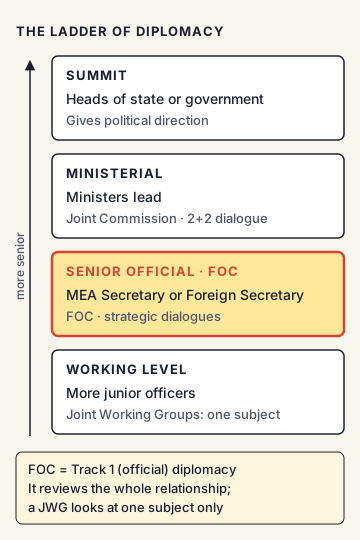
- Summit level: Meetings of heads of state or government, such as the Prime Minister's visits. These give political direction.
- Ministerial level: Meetings of ministers, for example a Joint Commission led by foreign ministers, or a 2+2 dialogue where the foreign and defence ministers of both countries meet together. India holds 2+2 dialogues with a few close partners such as the United States (since 2018), Japan, Australia and Russia.
- Senior official level: FOCs, strategic dialogues and similar meetings led by Secretaries.
- Working level: Joint Working Groups (JWGs) on single subjects, such as counter-terrorism, trade or health, led by more junior officers.
India's use of FOCs
India holds FOCs with a very large number of countries, from big powers like the United Kingdom and Russia to smaller states in Latin America, Africa and West Asia. For smaller partners, the FOC is often the main regular channel of talks, because summit visits are rare. FOCs are also a common way to start or restart a relationship. A "first round" of FOC often signals that two countries want to give their ties a regular, structured shape.
Commonly confused concepts
- FOC vs Joint Commission: An FOC is led by officials (Secretaries). A Joint Commission is usually led by ministers and covers a wide range of economic and technical cooperation.
- FOC vs 2+2 dialogue: An FOC involves only the foreign ministries, at official level. A 2+2 brings together two ministers from each side (foreign and defence) at ministerial level.
- FOC vs Joint Working Group (JWG): An FOC reviews the whole relationship. A JWG looks at one subject only.
- Track 1 vs Track 2 diplomacy: FOCs are Track 1 diplomacy, which means official talks between governments. Track 2 means informal talks between non-government people, such as retired officials, scholars and think tanks. Track 1.5 is a mix of both.
- Agreement vs MoU vs Joint Statement: An FOC does not usually sign treaties. A treaty or agreement is legally binding. A Memorandum of Understanding (MoU) records shared intentions and is usually not legally binding. A joint statement is a political declaration of what both sides agree on.
Issues, criticism and the way forward
- Gaps between rounds: With some countries, years pass between two FOC rounds. This weakens follow-up. Fixing a regular calendar, for example once a year, helps.
- Talk without delivery: FOCs can turn into routine meetings with general statements and few results. Experts suggest setting clear targets and checking them at the next round.
- Limited staff: India's foreign service is small compared with the number of countries it deals with. Senior officers must cover many countries at once, which limits how deep each review can go.
- Way forward: Link FOCs closely to summit outcomes, involve other ministries (commerce, health, IT) where needed, and use them to push practical projects such as trade promotion, health cooperation and digital public infrastructure.
Concepts to Know
- Ministry of External Affairs (MEA): The ministry of the Government of India that handles India's relations with other countries. It is headed by the External Affairs Minister.
- Foreign Secretary: The senior-most civil servant in the MEA. He or she manages the ministry's work and leads talks with the most important partners.
- Bilateral: Between two countries. "Multilateral" means among many countries, such as at the UN.
- CPV and OIA: Consular, Passport and Visa, and Overseas Indian Affairs. It is one of the divisions of the MEA, headed by a Secretary.
- Agenda: The list of topics to be discussed in a meeting.
- FOC = regular official-level talks between two foreign ministries; on India's side, usually led by an MEA Secretary, sometimes the Foreign Secretary
- Rounds are numbered for each pair of countries and usually alternate between the two capitals
- FOC is Track 1 (official) diplomacy; Track 2 is unofficial; Track 1.5 is mixed
- 2+2 dialogue = foreign and defence ministers of both sides; India's first 2+2 was with the US in 2018
- MoU is usually not legally binding; a treaty is legally binding
● Tracked since November 09, 2026 · last seen November 09, 2026 · updates as the daily brief publishes