India-Chile Relations
Trade, Minerals and the CEPA
Chile is a long, narrow country on the Pacific coast of South America, between the Andes mountains and the ocean. For India, it matters mainly for three reasons: it is the world's largest producer of copper, it holds the world's largest lithium reserves, and it is a gateway to Antarctica and to the fast-growing Pacific economies of Latin America. India and Chile already have a small trade deal, and are now negotiating a much bigger one, a CEPA.
Why does this relationship matter?
India is building electric vehicles, solar and wind power, electricity grids and electronics factories. All of these need large amounts of copper (for wires and motors) and lithium (for batteries). India produces very little lithium and imports most of its copper ore. If one or two countries control these minerals, they can stop supplies or raise prices.
So India wants reliable suppliers that are friendly democracies. Chile fits this need. For Chile, India is a large and growing market for its fruits, wine, minerals and other products, and a way to reduce its own dependence on China, its biggest buyer.
Where did it come from?
The two countries set up diplomatic relations in 1949. Chile was one of the first Latin American countries to sign a trade agreement with India, in 1956. The modern trade link is built on three steps:
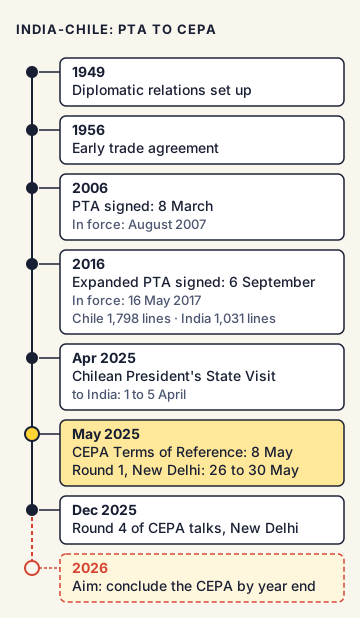
- Preferential Trade Agreement (PTA): signed on 8 March 2006, in force from August 2007. A PTA cuts duties only on a limited list of goods.
- Expanded PTA: signed on 6 September 2016, in force from 16 May 2017. Under it, Chile gave duty concessions on 1,798 tariff lines (products) with a margin of preference of 30% to 100%, and India gave concessions on 1,031 tariff lines with a margin of preference of 10% to 100%.
- CEPA talks: Chile's President made a State Visit to India from 1 to 5 April 2025. The two sides signed the Terms of Reference (the agreed list of subjects for the talks) on 8 May 2025, and the first round of negotiations was held in New Delhi from 26 to 30 May 2025. A fourth round was held in New Delhi in December 2025, and both sides aim to conclude by the end of 2026.
How does a PTA differ from a CEPA?
Think of a PTA as a small discount coupon on a few items in a shop. A CEPA is like a full membership card: it covers almost all goods, plus services, investment and new areas. The India-Chile CEPA is expected to cover goods, critical minerals, services, digital services, MSMEs (small businesses) and investment.
What does each side trade?
- India sells to Chile: cars and vehicles, medicines, electrical machinery, textiles, chemicals, food products, and iron and steel goods.
- India buys from Chile: mostly minerals and ores, especially copper concentrate, plus molybdenum, iodine and gold, and some fruits and chemicals.
Because India buys more than it sells, India runs a trade deficit with Chile. Chile is India's fifth-largest trading partner in the Latin America and Caribbean region.
Chile's minerals: the key facts
- Copper: Chile produced about 5.3 million tonnes in 2025, about 23% of world mine output, the largest of any country. It also has the largest copper reserves. Its state-owned company Codelco is one of the world's largest copper miners.
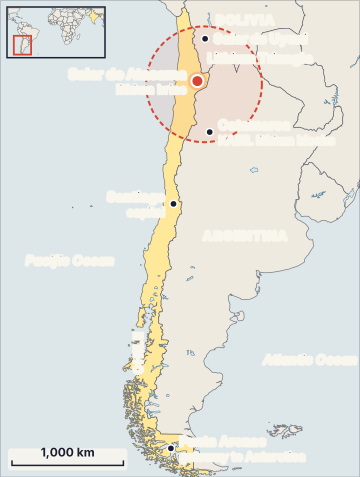
- Lithium: Chile has the world's largest lithium reserves and is the second-largest producer after Australia. Together with Argentina and Bolivia, Chile forms the "Lithium Triangle", a region of high-altitude salt flats (called salares) where lithium is taken from salty underground water (brine). The Salar de Atacama in northern Chile is the most important.
- Chile's lithium law: Since a 1979 law, lithium in Chile is a "non-concessible" mineral reserved for the State. This means private companies cannot simply get a normal mining licence for it; they need a special contract with the State. In 2023, Chile announced a National Lithium Strategy to keep more state control, and in 2024 Codelco and the private company SQM formed a joint venture for the Salar de Atacama. This legal framework is the main reason Chile says it cannot give India the special lithium access India wants.
How do the two countries cooperate beyond trade?
- During the April 2025 State Visit, they signed a Letter of Intent on Antarctica cooperation, an MoU on disaster management between Chile's disaster agency (SENAPRED) and India's National Disaster Management Authority, a cultural exchange programme, and an MoU between Codelco and Hindustan Copper Limited (HCL).
- India sees Chile as a gateway to Antarctica, because southern Chile is one of the closest points to the Antarctic continent.
- The two sides hold a Joint Commission at foreign minister level (first held in 2020, second in August 2024) and regular foreign office consultations.
- Chile is a founding member of the Pacific Alliance (with Mexico, Colombia and Peru), and India has been an observer in it since 2014. Chile is also an original member of the CPTPP, a large trade bloc of Pacific countries. India is not part of the CPTPP.
India's wider approach
Chile is part of India's plan to secure critical minerals from many countries. Other examples are KABIL (Khanij Bidesh India Limited), which signed an agreement in January 2024 to explore five lithium brine blocks in Catamarca, Argentina, and India's membership of the US-led Minerals Security Partnership. Trade deals with Latin America have also become more urgent because high US tariffs have hit Indian exports.
Commonly confused concepts
- PTA vs FTA vs CEPA: A PTA cuts duties on a limited list of goods. An FTA removes or cuts duties on most goods. A CEPA is a wide FTA that also covers services, investment and other areas. India-Chile moved from a PTA (2006) to an expanded PTA (2016), and is now negotiating a CEPA.
- India-Chile PTA vs India-MERCOSUR PTA: Chile has its own bilateral PTA with India. MERCOSUR is a separate South American trade bloc (Brazil, Argentina, Paraguay, Uruguay and Bolivia), with its own PTA with India. Chile is only an associate state of MERCOSUR, not a full member.
- Lithium Triangle vs Chile alone: The Lithium Triangle is a region across three countries (Chile, Argentina, Bolivia), not only Chile.
- Reserves vs production: Chile has the largest lithium reserves (what is in the ground and can be mined profitably), but Australia is the largest producer (what is actually mined each year).
- Pacific Alliance vs CPTPP: The Pacific Alliance is a four-member Latin American group. The CPTPP is a larger trade agreement of countries around the Pacific Ocean, including Japan, Canada, Australia and Chile.
Issues, criticism and the way forward
- Minerals vs market access: India wants minerals; Chile wants to sell processed goods and protect its state-controlled lithium model. A balance could be joint ventures, investment in processing inside Chile with assured offtake (buying) agreements, and long-term supply contracts, instead of legal "preferential access".
- Trade deficit: India imports far more than it exports to Chile. Indian exporters want lower Chilean duties on cars, medicines and machinery.
- Distance and shipping: Chile is very far from India, so shipping costs are high and direct shipping links are few.
- Competition from China: China is Chile's biggest trade partner and a large investor in its lithium and copper sector. India is a late entrant.
- Way forward: Experts suggest finishing the CEPA with a strong critical-minerals chapter, more investment by Indian public and private companies in Chilean mining and processing, better shipping and banking links, and wider cooperation in Antarctica, renewable energy and agriculture.
Concepts to Know
- Tariff line: One specific product in a country's customs list, each with its own code and duty rate. "1,031 tariff lines" means 1,031 separate products.
- Margin of preference: How much lower the duty is for the partner country compared with the normal duty. A 50% margin means the partner pays half the normal duty.
- Preferential access: A special right, given to one country, to buy a resource or sell a product on better terms than other countries get.
- Value-added product: A product that has been processed further, so it is worth more. For example, copper cathodes or lithium chemicals instead of raw copper ore or brine.
- Trade deficit: When a country buys (imports) more from another country than it sells (exports) to it.
- Brine: Very salty water found under salt flats. Lithium is extracted from it by letting the water evaporate in large ponds.
- Critical minerals: Minerals that are very important for the economy and security but whose supply is at risk. India listed 30 of them in 2023.
- Diplomatic relations: 1949; early trade agreement: 1956
- India-Chile PTA: signed 8 March 2006, in force August 2007
- Expanded PTA: signed 6 September 2016, in force 16 May 2017; Chile 1,798 tariff lines (MoP 30-100%), India 1,031 tariff lines (MoP 10-100%)
- Chilean President's State Visit to India: 1 to 5 April 2025
- CEPA Terms of Reference signed: 8 May 2025; first round: New Delhi, 26 to 30 May 2025
- Chile: largest copper producer (about 5.3 million tonnes, about 23% of world output in 2025); largest lithium reserves; second-largest lithium producer
- Lithium declared non-concessible in Chile in 1979; National Lithium Strategy 2023
- India: Pacific Alliance observer since 2014
● Tracked since October 04, 2026 · last seen October 04, 2026 · updates as the daily brief publishes