Hydrogen Valley Innovation Clusters (HVIC)
A hydrogen valley is a fixed geographical area, such as a city, an industrial belt or a large campus, where the whole hydrogen chain works together in one place. Hydrogen is produced there, stored there, moved there and used there by more than one kind of user, such as factories, vehicles and the energy sector.
A Hydrogen Valley Innovation Cluster (HVIC) is India's government-supported version of this idea. It is a real-life testing ground where new hydrogen technology moves out of the laboratory and into everyday industrial use.
Why does India need hydrogen valleys?
Making green hydrogen is only one part of the problem. The hydrogen also has to be stored safely, carried to users and used in machines that are built for it. If a factory makes hydrogen but no nearby user is ready to buy it, the plant sits idle. If a bus company wants hydrogen buses but no fuel station exists, the buses never come.
A hydrogen valley solves this "chicken and egg" problem by putting producers, transporters and users together in one area at the same time. Think of it like building a new market: you need sellers, buyers, roads and shops all at once, or nobody comes.
Where did the idea come from?
The idea of hydrogen valleys first grew in Europe, where regions built small, joined-up hydrogen systems. It became a global goal through Mission Innovation, a group of countries that work together on clean energy research. India has been a member since Mission Innovation started in 2015. In June 2021, under the second phase of Mission Innovation, countries launched the Clean Hydrogen Mission.
One of its targets is to deliver at least 100 large-scale clean hydrogen valleys worldwide by 2030, along with bringing the cost of clean hydrogen down to about US$2 per kg.
How did India start its own programme?
In India, the Department of Science and Technology (DST) came up with the HVIC idea. The steps went like this:
- 2022-23: DST invited proposals for "Hydrogen Valley Platforms" in India.
- January 2023: The Union Cabinet approved the National Green Hydrogen Mission, India's main programme for green hydrogen.
- April-May 2023: DST invited expressions of interest (a first, formal statement that an organisation wants to take part) for Hydrogen Valley Innovation Clusters. It offered ₹25 lakh to each shortlisted team to prepare a detailed project report.
- 27 June 2025: The Ministry of New and Renewable Energy (MNRE) issued revised scheme guidelines covering both Hydrogen Valley Innovation Clusters and Green Hydrogen Hubs. HVICs now run as part of the National Green Hydrogen Mission, which is managed by MNRE, while DST handles the science and project side.
- July 2025: MNRE released the first instalment of central money, about ₹67.95 crore in total, to four clusters.
- November 2025: At the 3rd International Conference on Green Hydrogen (ICGH-2025) at Bharat Mandapam, New Delhi, the government presented the four valleys as the core of the programme.
What kinds of valleys are there?
DST's call described two small-scale types:
- City-wide or town-wide valley: covers a city or town and the area around it, up to a radius of roughly 100 km, and includes several parts of the hydrogen chain.
- Campus-wide valley: the whole hydrogen chain sits inside the campus of one research institution or one industrial site.
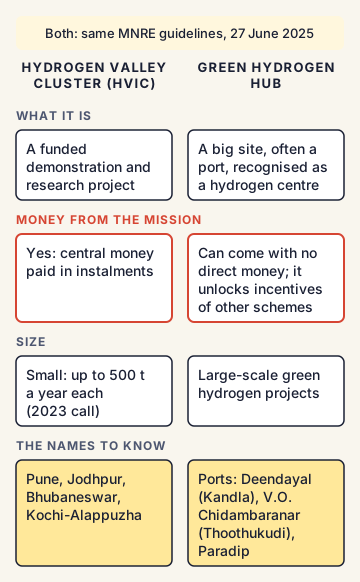
DST's earlier platform call (2022) also separated valleys by size. A small-scale valley had to produce at least 500 tonnes of renewable hydrogen a year, and a large-scale valley at least 5,000 tonnes a year, using new production capacity. The 2023 HVIC call used a different limit: each small-scale HVIC aims to produce up to 500 tonnes of green hydrogen a year.
How does an HVIC work?
Each cluster is a public-private partnership: a team in which a government-funded lead institution works together with private companies. The steps are:
- A lead institution (such as an IIT or a CSIR laboratory) forms a team with industry partners.
- The team sets up a separate company to run the valley.
- DST issues the award once MNRE gives its approval.
- Central money is paid to that company in instalments, based on the advice of a Project Appraisal Committee (a panel that checks progress and costs).
- Industry partners put in their own money and their technology in their areas of skill.
The central share is capped. According to the 2023 call, DST would give up to ₹30 crore or 50% of the total cost of the cluster, whichever is lower. So, under that call, the team's partners (mainly industry) had to carry at least half the cost. The money finally approved for the four clusters is higher than ₹30 crore each: the Mission's share for all four together is about ₹169.89 crore (see below). So remember ₹30 crore as the limit in the 2023 call, not as the amount each cluster finally got.
The four Hydrogen Valley Innovation Clusters
The total cost of the four clusters is about ₹485 crore. Of this, about ₹169.89 crore comes from the National Green Hydrogen Mission and about ₹315.43 crore from industry and other team partners.
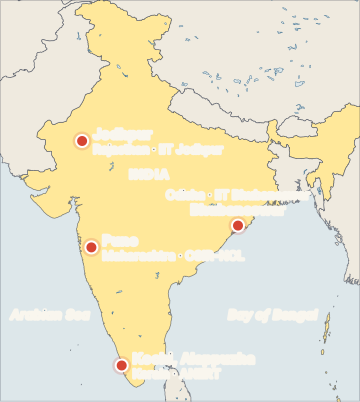
| Cluster | Lead institution | Main focus |
|---|---|---|
| Pune (Pune-Mumbai region), Maharashtra | CSIR-National Chemical Laboratory (CSIR-NCL) | Green chemicals and clean transport |
| Jodhpur, Rajasthan | IIT Jodhpur (on campus) | Hydrogen vehicles, including hydrogen engines; green ammonia; mixing hydrogen into city gas pipelines |
| Bhubaneswar, Odisha | IIT Bhubaneswar (on campus) | Green steel through the direct reduced iron route; hydrogen-based transport in mining |
| Kochi and Alappuzha, Kerala | ANERT (Agency for New and Renewable Energy Research and Technology, Kerala) | Green ammonia; mixing hydrogen into city gas; hydrogen transport on land and waterways |
The first instalments released in July 2025 were about ₹21.36 crore for ANERT Kerala, ₹17.03 crore for CSIR-NCL Pune, ₹14.96 crore for IIT Bhubaneswar and ₹14.60 crore for IIT Jodhpur.
How does it fit into the National Green Hydrogen Mission?
The Mission has a total outlay of ₹19,744 crore. The largest part, ₹17,490 crore, goes to the SIGHT programme (Strategic Interventions for Green Hydrogen Transition), which gives incentives for making electrolysers and producing green hydrogen. ₹1,466 crore is for pilot projects, ₹400 crore for research and development, and ₹388 crore for other parts of the Mission. HVICs are the Mission's real-world testing grounds: they show that the full chain works before big factories and ports copy it.
Commonly confused concepts
- Hydrogen Valley Innovation Cluster vs Green Hydrogen Hub: Both are covered by the same June 2025 guidelines, but they are different. An HVIC is a funded demonstration and research project led by an institution like an IIT. A Green Hydrogen Hub is a large location, often a port, that the government recognises as a centre for big green hydrogen projects. Recognition as a hub can come without direct money from the Mission; it helps the site get incentives under other central and state schemes. In 2025, MNRE recognised three major ports as Green Hydrogen Hubs: Deendayal Port (Kandla, Gujarat), V.O. Chidambaranar Port (Thoothukudi, Tamil Nadu) and Paradip Port (Odisha).
- A state calling a place a "hydrogen valley" vs the HVIC scheme: A state government may describe a region as a "green hydrogen valley" to attract investment. That is a description, not selection under the central HVIC scheme. As of November 2026, the four selected HVICs are Pune, Jodhpur, Bhubaneswar and Kerala.
- DST vs MNRE: DST (under the Ministry of Science and Technology) designed the HVIC idea and handles the science side. MNRE is the nodal ministry for the National Green Hydrogen Mission and approves the money.
- "At least 500 tonnes" vs "up to 500 tonnes": The 2022 Hydrogen Valley Platform call set a floor: a small-scale valley had to make at least 500 tonnes a year. The 2023 HVIC call set a ceiling: each small-scale HVIC aims for up to 500 tonnes a year. Do not mix up the two calls.
- Hydrogen valley vs Special Economic Zone (SEZ): An SEZ is a zone with special tax and trade rules for exporters. A hydrogen valley is about bringing together the hydrogen chain in one place; it does not, by itself, change tax or customs rules.
Issues, criticism and the way forward
- Small scale: Each cluster is small compared with India's 2030 goal of making 5 million tonnes of green hydrogen a year. Critics say demonstration projects must be followed quickly by commercial plants.
- Cost: Green hydrogen still costs more than grey hydrogen made from natural gas. Valleys only succeed if users are willing to pay this extra price until costs fall.
- Safety and standards: Hydrogen is a very light, easily burning gas. Pipelines, storage tanks and fuel stations need clear national safety codes, which are still being built up.
- Water and land: Electrolysers need clean water and large solar or wind farms, which can compete with farms and towns for land and water.
- Way forward: Experts suggest linking HVICs with nearby hubs and ports, creating steady buyers through government purchase targets, building local skills, and sharing what each valley learns so that later projects cost less.
Concepts to Know
- Green hydrogen: Hydrogen made by splitting water into hydrogen and oxygen using electricity from renewable sources like solar and wind. Almost no carbon dioxide is released.
- Grey hydrogen: Hydrogen made from natural gas. This releases a lot of carbon dioxide. Hydrogen made from coal is usually called brown or black hydrogen, not grey.
- Electrolyser: The machine that uses electricity to split water into hydrogen and oxygen.
- Hydrogen value chain: All the steps hydrogen goes through: production, storage, transport and final use.
- Direct reduced iron (DRI): A way of making iron in which a gas (such as hydrogen) removes oxygen from iron ore without melting it. Using green hydrogen here can make "green steel".
- City gas blending: Mixing a small share of hydrogen into the natural gas that pipelines send to homes and factories, so less fossil gas is burnt.
- Public-private partnership (PPP): A project in which the government and private companies share the cost, the work and the risk.
- Mission Innovation: A global group of countries, started in 2015, that work together to speed up clean energy research. India is a member.
- Hydrogen valley: a defined area where hydrogen is produced, stored, transported and used by more than one sector (industry, mobility, energy)
- HVIC idea conceived by the Department of Science and Technology (DST); now part of the National Green Hydrogen Mission under MNRE
- National Green Hydrogen Mission approved by the Union Cabinet in January 2023; outlay ₹19,744 crore (SIGHT ₹17,490 crore, pilots ₹1,466 crore, R&D ₹400 crore, others ₹388 crore)
- Revised guidelines for HVICs and Green Hydrogen Hubs: 27 June 2025
- Four HVICs: Pune (CSIR-NCL), Jodhpur (IIT Jodhpur), Bhubaneswar (IIT Bhubaneswar), Kerala (ANERT; Kochi and Alappuzha)
- Total cost about ₹485 crore: about ₹169.89 crore from the Mission, about ₹315.43 crore from industry and partners
- First instalment released by MNRE in July 2025: about ₹67.95 crore for all four clusters
- Small-scale types: city-wide (a city or town and its surroundings, up to roughly 100 km radius) and campus-wide
- 2023 HVIC call: central share up to ₹30 crore or 50% of cluster cost, whichever is lower; each small-scale HVIC aims for up to 500 tonnes of green hydrogen a year
- Mission Innovation Clean Hydrogen Mission (launched June 2021): at least 100 large-scale hydrogen valleys worldwide by 2030; clean hydrogen at about US$2 per kg
- Green Hydrogen Hubs recognised in 2025: Deendayal (Kandla), V.O. Chidambaranar (Thoothukudi) and Paradip ports
● Tracked since November 20, 2026 · last seen November 20, 2026 · updates as the daily brief publishes