Green Ammonia
Green ammonia is ammonia (NH3) made using green hydrogen, which is hydrogen produced by splitting water with electricity from renewable sources like solar and wind. Normal ammonia is made using hydrogen taken from natural gas or coal, which releases a lot of carbon dioxide (CO2). Green ammonia is the same chemical, but made with almost no CO2. It can be used as a fertiliser raw material, as a clean fuel, and as a convenient way to carry hydrogen across the world.
Why does it matter?
Ammonia is one of the most produced chemicals on Earth. About 70% or more of it goes into fertilisers like urea, which feed a large part of the world's population [Unverified]. But making ammonia the normal way releases about 1% of the world's yearly CO2 emissions. So cleaning up ammonia is important for meeting climate goals. Green ammonia also helps countries like India cut imports of natural gas and ammonia, which improves energy security.
Where did it come from?
Ammonia has been made at factory scale for over a hundred years using the Haber-Bosch process. The German chemist Fritz Haber developed the method around 1908-1909, and Carl Bosch turned it into a large factory process at the company BASF by 1913. For most of the last century, the hydrogen for this process came from natural gas, coal or naphtha. Green ammonia became a serious option only in the last decade, as solar and wind power and electrolysers became cheaper.
How is green ammonia made, step by step?
- Make renewable electricity from solar panels or wind turbines.
- Split water (H2O) into hydrogen and oxygen in a machine called an electrolyser, using that electricity. This gives green hydrogen.
- Take nitrogen from the air using an air separation unit. Air is about 78% nitrogen.
- Combine hydrogen and nitrogen in the Haber-Bosch process, at high temperature and pressure with an iron-based catalyst, to make ammonia (N2 + 3H2 → 2NH3).
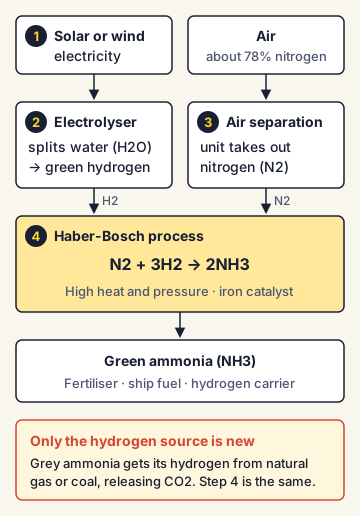
A simple way to picture it: the Haber-Bosch "kitchen" stays the same. Only the main "ingredient", hydrogen, now comes from clean water and sunlight instead of gas or coal.
Why ship ammonia instead of hydrogen?
Hydrogen is the lightest gas. To turn it into a liquid for shipping, it must be cooled to about minus 253°C, which is costly and hard. Ammonia becomes liquid at about minus 33°C at normal pressure, or at room temperature under moderate pressure, like cooking gas (LPG) in a cylinder. A cubic metre of liquid ammonia holds roughly 1.5 times or more hydrogen than a cubic metre of liquid hydrogen.
Also, the world already has ships, ports and pipelines for ammonia, because it has been traded as a fertiliser material for decades. That is why ammonia is called a hydrogen carrier. At the buyer's end, it can be used directly or "cracked" back into hydrogen.
Main uses of green ammonia
- Fertilisers: replacing grey ammonia in urea and other fertiliser plants.
- Shipping fuel: large ships can run on ammonia engines. The International Maritime Organization's Net-Zero Framework (approved in draft in April 2025) is pushing shipping towards such clean fuels.
- Power plants: mixing ammonia with coal in power stations (called co-firing) to cut emissions, something Japan is testing.
- Hydrogen carrier: exporting hydrogen energy in the form of ammonia.
India's framework and examples
- Green ammonia is a key part of the National Green Hydrogen Mission (2023). Under its SIGHT programme, the Solar Energy Corporation of India (SECI) ran auctions for fertiliser companies to buy green ammonia, with a total planned quantity of 7.24 lakh tonnes a year across 13 auctions.
- The first SECI auction in 2025 found a price of ₹55.75 per kg (75,000 tonnes a year for Paradeep Phosphates, Odisha). A later auction found a record low of ₹49.75 per kg.
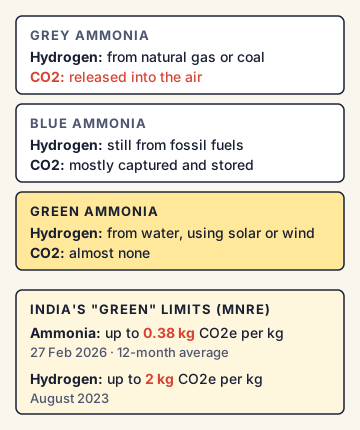
- On 27 February 2026, the Ministry of New and Renewable Energy (MNRE) notified the Green Ammonia Standard. Ammonia counts as "green" only if its emissions are no more than 0.38 kg of CO2 equivalent per kg of ammonia, averaged over 12 months. A matching standard was set for green methanol.
- Large green hydrogen and ammonia hubs are planned on India's coasts, such as Pudimadaka (Andhra Pradesh), Kandla (Gujarat), Paradip (Odisha) and Tuticorin (Tamil Nadu) [Unverified].
Commonly confused concepts
- Green vs grey vs blue ammonia: Grey ammonia uses hydrogen from natural gas or coal, with CO2 released into the air. Blue ammonia also uses fossil fuels, but most of the CO2 is captured and stored. Green ammonia uses green hydrogen made from renewable electricity.
- Green ammonia vs green hydrogen: Green hydrogen is the basic clean fuel (H2). Green ammonia is made from it by adding nitrogen. Ammonia is easier to store and ship; hydrogen is the direct fuel.
- Green hydrogen standard vs green ammonia standard: The Green Hydrogen Standard (August 2023) allows up to 2 kg CO2 equivalent per kg of hydrogen. The Green Ammonia Standard (February 2026) allows up to 0.38 kg CO2 equivalent per kg of ammonia.
- Ammonia (NH3) vs ammonium (NH4+): Ammonia is a gas made of molecules. Ammonium is a charged particle (ion) found in fertiliser salts like ammonium nitrate.
Issues, criticism and the way forward
- High cost: Green ammonia still costs more than grey ammonia, mainly because electrolysers and round-the-clock renewable power are expensive.
- Buyers hesitate: Many export projects wait for long-term purchase contracts (offtake agreements). Buyers hesitate because prices are high and rules in importing countries are still changing.
- Safety: Ammonia is toxic. A leak can harm people and fish, so strict handling rules are needed.
- Water and land: Electrolysers need clean water, often from desalination plants on dry coasts, and renewable plants need large land areas.
- Nitrous oxide risk: Burning ammonia as a fuel can release nitrogen oxides, including nitrous oxide, a strong greenhouse gas, unless engines are well designed.
- Way forward: Experts suggest cheaper electrolysers through local manufacturing, government-backed demand (like SECI auctions), clear global certification so Indian exports are accepted, and port infrastructure for ammonia.
Concepts to Know
- Electrolyser: A machine that uses electricity to split water into hydrogen and oxygen.
- Catalyst: A substance that speeds up a chemical reaction without being used up itself.
- CO2 equivalent (CO2e): A common unit that counts different greenhouse gases by how much warming they cause compared to CO2.
- Offtake agreement: A long-term contract where a buyer promises to buy a fixed amount of a product, which helps a project get loans.
- Desalination: Removing salt from sea water to make fresh water.
- Formula: NH3; made by the Haber-Bosch process (Fritz Haber, around 1908-1909; industrialised by Carl Bosch at BASF by 1913)
- Ammonia production causes about 1% of global CO2 emissions
- Ammonia liquefies at about minus 33°C; hydrogen at about minus 253°C
- India's Green Ammonia Standard: notified 27 February 2026; limit 0.38 kg CO2e per kg ammonia (12-month average)
- Green Hydrogen Standard: August 2023; limit 2 kg CO2e per kg hydrogen
- SECI green ammonia auctions under SIGHT: 13 auctions, 7.24 lakh tonnes a year; first price ₹55.75/kg; record low ₹49.75/kg
● Tracked since March 13, 2026 · last seen October 13, 2026 · updates as the daily brief publishes