Hybrid Annuity Model (HAM)
The Hybrid Annuity Model, or HAM, is a way for the government and a private company to build infrastructure together and share the cost. The government pays 40% of the project cost while the work is being built. The private company arranges the other 60% and gets it back, with interest, through fixed payments called annuities spread over many years after the project is finished.
It is a "hybrid" because it mixes two older models: one where the government pays for everything, and one where the private company pays for everything.
Why was it needed?
Big projects like highways, ports and sewage plants cost thousands of crores. The government alone does not have that much money at once, so it wants private companies to invest too. In the early 2010s, many private builders in India took on road projects where they had to earn back their money from tolls. Traffic often turned out lower than expected, land acquisition got delayed, and loans became bad debts.
By around 2014, private companies had almost stopped bidding for such projects, and banks did not want to lend to them. HAM was designed to bring private builders back by taking away their biggest fear: that not enough people will use the project.
Where did it come from?
In January 2016, the Cabinet Committee on Economic Affairs (CCEA) approved the Hybrid Annuity Model as one way to build national highways. The National Highways Authority of India (NHAI) began awarding HAM road projects from 2016. In the same month, the Union Cabinet also approved HAM for sewage treatment plants under the Namami Gange programme (cleaning the Ganga).
This was the first time HAM was used outside roads; a 14 MLD (million litres a day) plant in Haridwar was described as India's first HAM sewage plant when it opened in 2019. Since then, HAM has spread to other sectors, including ports such as VOC Port.
First, understand the older models
HAM makes sense only when you see what it replaced:
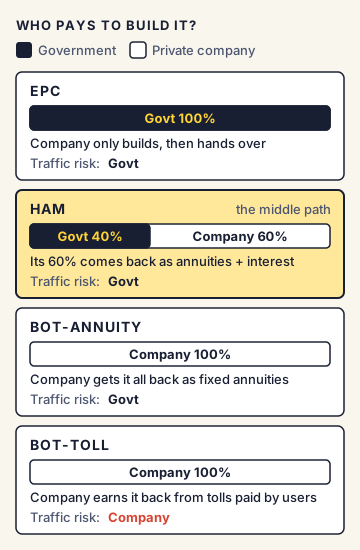
- EPC (Engineering, Procurement and Construction): The government pays the full cost. The private company only builds the project and hands it over, like a contractor building your house. The company carries almost no long-term risk, but the government must find all the money upfront.
- BOT-Toll (Build-Operate-Transfer, toll): The private company pays the full cost, builds the project and runs it for many years. It earns its money back by collecting tolls (user charges). Then it hands the project back to the government. The government spends nothing upfront, but the company carries the traffic risk: if fewer vehicles come, it loses money.
- BOT-Annuity: The private company pays the full cost and builds the project, and the government pays it fixed annuities over the years. The company does not depend on traffic, but it must borrow the whole amount, which is very costly.
HAM sits in the middle of these: the government pays part (like EPC), the company pays part, and the company's share comes back as annuities (like BOT-Annuity), not tolls.
How does HAM work, step by step?
Take the road model used by NHAI as the standard example:
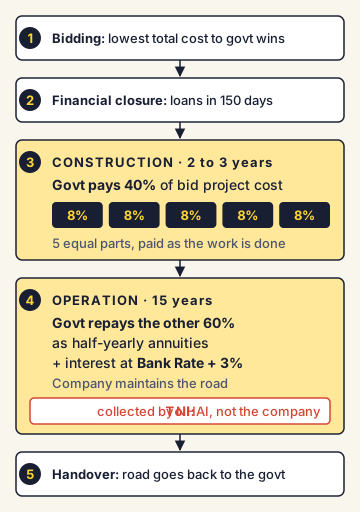
- Bidding: Companies bid on the cost of building the project (the "bid project cost") and the cost of maintaining it. The bidder with the lowest overall cost to the government usually wins.
- Financial closure: The winning company must arrange its loans and its own money within a fixed time (150 days from signing the agreement under the model contract).
- Construction (usually 2 to 3 years): The government pays 40% of the bid project cost as "construction support". It is released in five equal instalments of 8% each, linked to how much physical work is done.
- Operation (15 years for roads): The company maintains the project. The government repays the remaining 60% in fixed half-yearly annuities, plus interest on the unpaid amount at the Bank Rate + 3%. The government also pays a separate fee for operation and maintenance.
- Handover: At the end of the concession period, the project returns fully to the government.
In road projects, the toll is collected by the government (NHAI), not by the company. So the company's income does not depend on how many vehicles use the road.
A simple comparison
Think of buying a house with a builder. In EPC, you pay the full price before moving in. In BOT-Toll, the builder pays for the house and earns back money by renting rooms to strangers, which is risky for him. In HAM, you pay 40% while the house is being built, and the remaining 60% in fixed EMIs over 15 years, with interest. The builder knows exactly how much he will get, as long as he builds well and keeps the house in good shape.
Who carries which risk?
Risk sharing is the heart of any public-private partnership (PPP):
- Construction risk (delays, cost overruns): mainly the private company.
- Maintenance risk (keeping the asset in good condition): the private company. Its annuities can be cut if it fails quality standards.
- Traffic or revenue risk (whether enough people use it): the government.
- Inflation risk: shared. The bid project cost is adjusted for inflation using a price index, so the company is protected from rising prices.
- Interest rate risk: reduced for the company, because the interest it receives is linked to the Bank Rate.
India's position and Indian examples
- Highways: HAM became one of NHAI's main ways of awarding highway projects after 2016, alongside EPC.
- Sewage and rivers: The National Mission for Clean Ganga (NMCG) uses HAM for sewage treatment plants in cities such as Haridwar, Varanasi, Prayagraj and Patna. Under Namami Gange, the 40% construction support and the annuities are paid fully by the Centre.
- Ports: VOC Port in Thoothukudi switched its outer harbour project to HAM after two earlier tenders failed to attract good bids.
- States: Several states use HAM for state highways and urban projects.
Commonly confused concepts
- HAM vs BOT-Annuity: In BOT-Annuity, the private company pays 100% of the cost upfront. In HAM, the government pays 40% during construction, so the company borrows much less.
- HAM vs BOT-Toll: In BOT-Toll, the company collects tolls and carries traffic risk. In HAM, the government collects tolls and the company gets fixed annuities.
- HAM vs EPC: In EPC, the government pays 100% and the company only builds. In HAM, the company also invests 60% and maintains the asset for many years.
- HAM vs DBFOT (Design-Build-Finance-Operate-Transfer): In DBFOT, the private firm designs, funds, builds and runs the asset and earns from users (such as container handling charges at a port terminal). It carries the business risk. This is why, at VOC Port, the risky basic works (breakwaters, dredging) are under HAM, while the money-earning container terminals are under DBFOT.
- HAM vs TOT (Toll-Operate-Transfer): In TOT, the government first builds a road with its own money and then leases a finished, running road to a private firm for an upfront payment, letting it collect tolls. No new construction by the private firm is involved.
- Annuity vs viability gap funding (VGF): An annuity is a regular payment over many years. VGF is a one-time grant to make a weak project bankable.
Issues, criticism and the way forward
- Government's long-term burden: HAM moves traffic risk to the government and creates fixed payment promises for 15 years or more. These are like hidden future debts. NHAI's debt rose sharply in this period, to around ₹3.3 lakh crore by March 2024 from about ₹24,000 crore in 2015, which pushed the government to try more BOT-Toll projects again from 2024-25.
- Financial closure problems: In the early years, many HAM road projects struggled to get bank loans in time. A 2018 report said 64 of 115 HAM projects awarded had not achieved financial closure.
- Land and clearances: Delays in land acquisition and approvals, which are the government's job, still slow down HAM projects.
- Interest rate design: Because the interest on annuities is linked to the Bank Rate, a fall in interest rates cuts the developer's income, which lenders worry about.
- Weak bidder interest: Smaller companies find it hard to raise their 60% share, so only large firms often bid, which reduces competition.
- Way forward: Experts suggest picking the model based on the project. Where traffic is strong and predictable, BOT-Toll saves government money. Where traffic is uncertain but the asset is essential, HAM is suitable. Faster land acquisition, quicker dispute settlement and better contract design make every model work better.
Concepts to Know
- Public-Private Partnership (PPP): An arrangement where the government and a private company work together to build and run public infrastructure, sharing money, work and risk.
- Annuity: A fixed amount paid at regular intervals (for example, every six months) for a set number of years, like an EMI.
- Concession period: The number of years a private company is allowed to build and run a project before handing it back to the government.
- Financial closure: The point when a project has arranged all the money it needs (loans plus its own money) and can start drawing it.
- Bank Rate: The rate at which the Reserve Bank of India (RBI) lends to banks for a longer term without taking securities. It is now kept equal to the Marginal Standing Facility (MSF) rate.
- Traffic risk: The danger that fewer people use a project than expected, so it earns less money.
- HAM approved by the CCEA for highways in January 2016; NHAI awards since 2016
- Government share: 40% of bid project cost during construction, in 5 equal instalments of 8% linked to progress
- Private share: 60%, repaid as half-yearly annuities over the operation period (15 years for NHAI roads) with interest at Bank Rate + 3%
- Toll on HAM roads is collected by the government, not the company
- Financial closure deadline under the road model contract: 150 days
- Namami Gange: HAM approved in January 2016 for sewage treatment plants with 100% central funding; first HAM sewage plant at Haridwar (14 MLD)
- NHAI debt: about ₹3.3 lakh crore by March 2024
● Tracked since March 10, 2026 · last seen November 09, 2026 · updates as the daily brief publishes