High Court Benches
Permanent Benches and Circuit Benches
A High Court usually has one main building, called its principal seat, for example Chennai for the Madras High Court. But a state can be very large, and some people may live hundreds of kilometres away. So a High Court can also sit at other places in its territory. A group of judges sitting at such a place is called a bench.
A bench that works there all year is a permanent bench. A bench whose judges visit and sit there for some days or on a regular schedule is a circuit bench. Both are parts of the same High Court, not new High Courts.
Why are benches needed?
Going to court is costly. A farmer from a far district must pay for travel, stay in a city hotel, pay a lawyer from that city and lose days of work for every hearing. If the High Court is 400 km away, many poor people simply give up. A bench brings the court closer to them.
This is linked to the idea of access to justice: justice is not real if ordinary people cannot reach the court. Benches also help share the load of cases, because local lawyers and local cases are handled closer to home.
Where does the power come from?
The Constitution itself says little about benches. Article 214 says there shall be a High Court for each state. The main rules on benches come from a law, the States Reorganisation Act, 1956, Section 51:
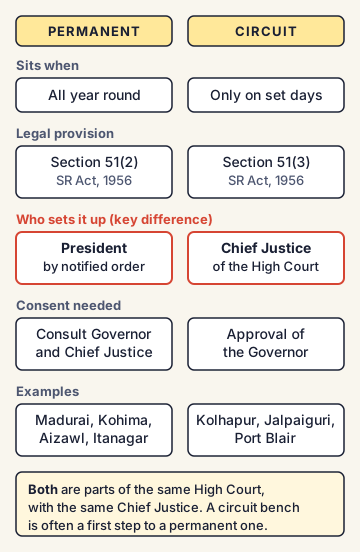
- Section 51(2): permanent bench. The President can, by a notified order, set up a permanent bench at a place other than the principal seat. The President must first consult the Governor of the state and the Chief Justice of that High Court.
- Section 51(3): sittings at other places. The Chief Justice of the High Court can let judges and division benches sit at other places in the state, with the approval of the Governor. Circuit benches are usually set up under this route.
The President acts on the advice of the Union Council of Ministers (Article 74). So in practice the decision on a permanent bench is taken by the Union government, usually through Union Cabinet approval, after the state and the High Court agree.
How does a bench get created, step by step?
- A demand starts, often from local lawyers and people of a far region.
- The state government sends a complete proposal to the Union government. The proposal must have the consent of the Chief Justice of the High Court and the Governor.
- The Union government examines it, often using the guidelines of the Jaswant Singh Commission (see below).
- The President issues an order (for a permanent bench), or the Chief Justice notifies sittings with the Governor's approval (for a circuit arrangement).
- The state provides the building, staff and money. The Chief Justice decides which judges sit there and which cases go there, because the Chief Justice is the master of the roster (the person who decides which judge hears which case).
The Jaswant Singh Commission
The Union government set up this commission in 1981, headed by Justice Jaswant Singh, to study demands for High Court benches, especially one for western Uttar Pradesh. It gave its report in April 1985. It laid down broad principles for deciding when a bench away from the principal seat is needed and where it should be.
It also suggested starting some benches as circuit benches and later turning them into permanent benches. The Union government still refers to these guidelines when it gets a new demand.
What did the Supreme Court say?
In Federation of Bar Associations in Karnataka v. Union of India (2000), lawyers asked the Supreme Court to order a permanent High Court bench in north Karnataka. The Court refused. It said no litigant has a fundamental right to a High Court bench at a place of their choice. Whether to have a bench is a policy decision for the government, the High Court and the state, not something a court can order.
Examples of benches in India
Many High Courts work from more than one place:
- Bombay High Court: principal seat in Mumbai; benches at Nagpur, Aurangabad (Chhatrapati Sambhajinagar) and Panaji (Goa). A circuit bench at Kolhapur began sitting on 18 August 2025 for six districts of western Maharashtra.
- Madras High Court: a bench at Madurai, set up by a Presidential order under the States Reorganisation Act and working since 24 July 2004.
- Calcutta High Court: a circuit bench at Port Blair for the Andaman and Nicobar Islands, and a circuit bench at Jalpaiguri (order of February 2019, working since 11 March 2019) for Darjeeling, Kalimpong, Jalpaiguri and Cooch Behar.
- Gauhati High Court: principal seat at Guwahati; permanent benches at Kohima (1972), Aizawl (1990) and Itanagar (2000). Its earlier benches at Imphal, Agartala and Shillong became full High Courts of Manipur, Tripura and Meghalaya in March 2013.
- High Court of Jammu and Kashmir and Ladakh: sits at Srinagar and Jammu, and now has a bench in Ladakh.
Common High Courts and Union Territories
Some High Courts serve more than one area:
- Article 231 lets Parliament set up one common High Court for two or more states, or for two or more states and a UT. Example: the Punjab and Haryana High Court also serves the UT of Chandigarh.
- Article 230 lets Parliament extend a High Court's jurisdiction to a UT, or exclude it. That is why the Madras High Court covers Puducherry and the Kerala High Court covers Lakshadweep.
- Article 241 lets Parliament set up a High Court for a UT. Delhi is a UT with its own High Court. For a UT without a legislature, a bench can also be set up through a Presidential regulation under Article 240, as was done for Ladakh in 2026.
Commonly confused concepts
- Bench vs separate High Court: A bench is part of the same High Court, with the same Chief Justice. A separate High Court has its own Chief Justice and is created by Parliament (for example, the Manipur, Tripura and Meghalaya High Courts in 2013).
- Permanent bench vs circuit bench: A permanent bench sits there throughout the year (Section 51(2), Presidential order). A circuit bench sits on set days or periods, usually arranged by the Chief Justice with the Governor's approval (Section 51(3)). Circuit benches are often a first step towards permanent ones.
- Bench (place) vs bench (number of judges): The word "bench" is also used for the judges hearing a case: a single bench (one judge), a division bench (two judges) or a full bench (three or more). These are about how many judges hear a case, not where the court sits.
- High Court bench vs Supreme Court sitting outside Delhi: Article 130 says the Supreme Court sits in Delhi or at any other place the Chief Justice of India decides with the President's approval. But the Supreme Court has no regular bench outside Delhi. The Law Commission's 229th Report (2009) suggested regional "cassation benches" of the Supreme Court, but this was not accepted.
Issues, criticism and the way forward
- Access vs unity: Supporters say benches cut cost and travel for poor and remote litigants. Some judges and lawyers argue that too many benches can split the High Court, weaken uniform rulings and divide the bar.
- Lawyers' protests: Demands for new benches (and opposition to them from lawyers at the principal seat) have led to long strikes, which delay cases further.
- Money and staff: A bench needs a building, judges, staff and housing. States must pay, and some cannot.
- Judge vacancies: A new bench does not help much if the High Court itself is short of judges.
- Way forward: Experts suggest clear, published criteria for new benches (building on the Jaswant Singh Commission), wider use of video-conferencing and e-filing under the e-Courts project for far areas, and filling judge vacancies quickly.
Concepts to Know
- Principal seat: The main city and building where a High Court is based and where its Chief Justice normally sits.
- Litigant: A person who is a party to a court case, either the one who files it or the one it is filed against.
- Master of the roster: The power of the Chief Justice to decide which judges sit in which bench and hear which cases.
- Access to justice: The idea that every person, rich or poor, near or far, must be able to reach a court and get a fair hearing at a reasonable cost.
- Presidential order / regulation: A legal order issued in the name of the President under a law or the Constitution. The President acts on the advice of the Union Council of Ministers.
- Article 214: a High Court for each state; Article 230: extension of High Court jurisdiction to UTs; Article 231: common High Court; Article 241: High Court for a UT
- States Reorganisation Act, 1956, Section 51(2): permanent bench by Presidential order after consulting the Governor and the Chief Justice of the High Court
- Section 51(3): judges may sit at other places as the Chief Justice decides, with the Governor's approval
- Jaswant Singh Commission: set up 1981, report April 1985, guidelines for High Court benches
- Federation of Bar Associations in Karnataka v. Union of India (2000): no fundamental right to a High Court bench at a chosen place
- Article 130: Supreme Court sits in Delhi or elsewhere as the CJI decides with the President's approval; Law Commission 229th Report (2009) suggested regional cassation benches
- Examples: Madurai (Madras HC, 2004); Jalpaiguri (Calcutta HC, 2019); Kolhapur (Bombay HC, 2025); Kohima, Aizawl, Itanagar (Gauhati HC)
● Tracked since October 18, 2026 · last seen October 18, 2026 · updates as the daily brief publishes