Group of Seven (G7)
The Group of Seven, or G7, is an informal club of seven rich democracies: the United States, Japan, Germany, the United Kingdom, France, Italy and Canada. The European Union also takes part in all its meetings. Their leaders meet once a year at a summit to discuss the world economy, security, energy, climate and other global problems. The G7 has no treaty, no permanent office and no power to force anyone to do anything; its strength comes from the economic weight of its members.
Why does it exist?
In the early 1970s, the world economy went through two big shocks. In 1971, the United States ended the link between the dollar and gold, which broke the old fixed exchange-rate system (the Bretton Woods system). Then, in 1973, Arab oil producers cut supply, and oil prices rose about four times. Rich countries felt they needed a small, informal place where their top leaders could talk frankly and coordinate their responses. Big bodies like the United Nations were too large and too formal for quick, private talks.
Where did it come from?
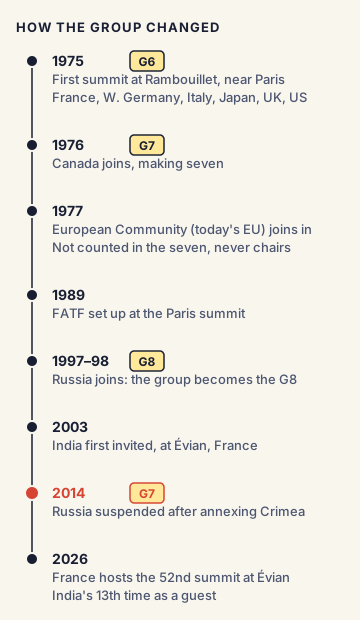
- 1975: The leaders of France, West Germany, Italy, Japan, the United Kingdom and the United States met at Rambouillet, near Paris. The idea came from French President Valéry Giscard d'Estaing and West German Chancellor Helmut Schmidt. This group of six was the G6. They agreed to meet every year with a rotating chair.
- 1976: Canada joined, and the group became the G7.
- 1977 onwards: The European Community (today's EU) began to take part. The EU is called a "non-enumerated" member: it attends fully but is not counted in the "seven" and never holds the presidency.
- 1997–1998: Russia was brought in, and the group became the G8.
- March 2014: Russia's membership was suspended after it annexed Crimea from Ukraine. The group went back to being the G7. Russia later said it would leave for good.
How does it work?
The G7 has no headquarters, no secretariat and no founding treaty.
- Presidency: Each year one member holds the presidency (for one calendar year). The presidency hosts the leaders' summit, sets the agenda and pays for the meetings. The order of rotation is fixed.
- Sherpas: Each leader appoints a personal representative, called a sherpa (named after the Himalayan guides who help climbers). Sherpas negotiate the summit texts months in advance.
- Ministerial meetings: Ministers of foreign affairs, finance, energy, health and others also meet during the year. The Paris meeting in this news is one such foreign ministers' meeting.
- Communiqué: At the end of a summit, leaders issue a joint statement. It is a political promise, not a legally binding treaty.
- Outreach: The host invites some non-member countries and international organisations as guests to "outreach" sessions.
Recent and upcoming presidencies
- 2023: Japan (summit at Hiroshima)
- 2024: Italy (summit in Apulia)
- 2025: Canada (summit at Kananaskis)
- 2026: France (52nd summit, held at Évian-les-Bains, June 15–17, 2026)
- 2027: United States
What has the G7 created or launched?
The G7 is more an agenda-setter than an implementer, but several well-known bodies and plans came from it:
- Financial Action Task Force (FATF), set up at the G7 summit in Paris in 1989 to fight money laundering (later also terror financing).
- The Global Fund to Fight AIDS, Tuberculosis and Malaria (2002), which grew out of G8 talks.
- The Partnership for Global Infrastructure and Investment (PGII) (2022), to fund roads, ports and power in developing countries.
- The price cap on Russian oil (from December 2022), set together with the EU and Australia, to limit Russia's oil income while keeping oil flowing.
- The Hiroshima AI Process (2023), on rules for advanced artificial intelligence.
How big is the G7?
As of 2025, G7 countries produce roughly 43–45% of world GDP at market exchange rates, down from about two-thirds around 1990. Measured by purchasing power parity (PPP), their share is only about 28%. They are home to only about a tenth of the world's people [Unverified]. Their falling share is a big reason why the G20 has become more important.
India's position and Indian examples
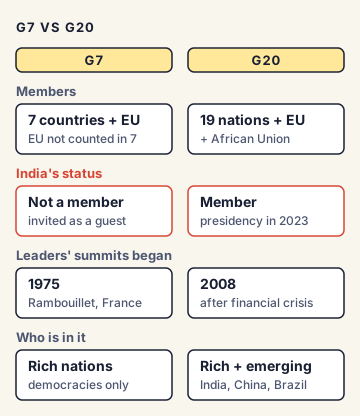
India is not a member of the G7. It is invited regularly as a guest (an "outreach" or "partner" country).
- India was first invited in 2003, to the G8 summit at Évian, France.
- The 2026 Évian summit was India's 13th participation in a G7/G8 summit, according to the Ministry of External Affairs. France invited India as a partner country.
- India uses these meetings to raise issues of the Global South: food and energy security, climate finance, debt, terrorism and reform of global institutions.
- India's position on the Russian oil price cap is that it buys oil based on its own energy security needs and is not bound by the G7 decision.
Commonly confused concepts
- G7 vs G8: Same club. It was the G8 only while Russia was a member (1997/98 to 2014).
- G7 vs G20: The G20 has 19 countries plus the EU and the African Union, and includes emerging economies like India, China and Brazil. The G20 leaders' summit started in 2008, after the global financial crisis. India held the G20 presidency in 2023. India is a member of the G20, but only a guest at the G7.
- G7 vs BRICS: BRICS is a group of emerging economies (Brazil, Russia, India, China, South Africa and newer members). It is often seen as a counterweight to the G7.
- G7 vs G77: The G77 is a large group of developing countries at the United Nations, formed in 1964. It now has more than 130 members, including India. Same "G" style, completely different group.
- G7 vs the "Big Seven" by GDP: The G7 is a fixed club, not a list of today's seven largest economies. China and India have larger economies than several G7 members but are not part of it.
Issues, criticism and the way forward
- Legitimacy: Critics say a small group of rich countries should not set agendas for the whole world, especially as its share of world output falls.
- No binding power: Promises in communiqués are often not kept, for example on aid and climate finance.
- Internal divisions: Members disagree on trade tariffs, climate policy and how to end the Russia-Ukraine war, which weakens joint statements.
- Missing voices: Large emerging economies are only guests. Supporters reply that the G7's small size lets like-minded democracies act quickly together.
- Way forward: Experts suggest wider and more regular outreach with countries like India, closer coordination with the G20, and turning pledges (such as PGII funding) into delivered projects.
Concepts to Know
- Bretton Woods system: The post-1944 world money system in which currencies were fixed to the US dollar and the dollar was fixed to gold. It broke down in 1971.
- GDP (Gross Domestic Product): The total value of all goods and services produced in a country in a year.
- Purchasing power parity (PPP): A way to compare economies that adjusts for the fact that things are cheaper in some countries. ₹100 buys more in India than its dollar value buys in the US, so PPP makes India's economy look bigger.
- Communiqué: A formal joint statement issued at the end of a meeting.
- Annexation: When one country takes over another country's territory and declares it its own.
- Outreach session: A part of the summit where invited non-member countries join the G7 leaders for talks.
- Members: US, UK, France, Germany, Italy, Japan, Canada; EU is a "non-enumerated" member
- First summit: Rambouillet, France, 1975 (G6); Canada joined 1976
- Russia joined 1997/98 (G8); suspended March 2014 after annexing Crimea
- No charter, no secretariat; presidency rotates every calendar year
- 2026 presidency: France (52nd summit, Évian, June 15–17, 2026); 2027: United States
- FATF created at the G7 Paris summit, 1989
- India: not a member; first invited 2003 (Évian); 2026 was its 13th participation
- Share of world GDP: about 43–45% (nominal, 2025); about 28% (PPP)
● Tracked since May 19, 2026 · last seen November 09, 2026 · updates as the daily brief publishes