Chernobyl Nuclear Disaster (1986)
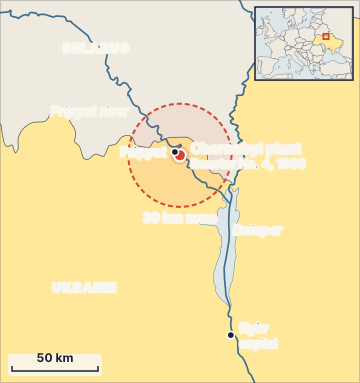
The Chernobyl disaster was the worst accident in the history of nuclear power. On 26 April 1986, reactor No. 4 at the Chernobyl Nuclear Power Plant blew apart during a safety test. The plant is in northern Ukraine (then part of the Soviet Union), close to the border with Belarus. Huge amounts of radioactive material spread over Ukraine, Belarus, Russia and much of Europe, and towns had to be emptied for decades.
Why does it matter?
Chernobyl changed how the whole world thinks about nuclear safety. It showed that a reactor accident in one country can poison land and food in many others. It led to new international treaties, a global scale for rating nuclear accidents, and much stricter safety rules. Today the damaged reactor still needs a giant protective shield to keep radioactive dust locked in.
What kind of reactor was it?
Reactor No. 4 was an RBMK-1000, a Soviet design.
- It used graphite (a form of carbon) to slow down neutrons, and ordinary water to carry heat away.
- It had a dangerous feature called a positive void coefficient. In simple words: when the cooling water boiled into steam, the reaction became stronger, not weaker. That is like a car whose accelerator presses itself harder when the engine overheats.
- It did not have a strong concrete-and-steel containment building around the reactor, which most Western and Indian reactors have.
How did the accident happen?
- On the night of 25–26 April 1986, operators were running a test. They wanted to see if the spinning turbines could keep power flowing to the cooling pumps for a short time during a blackout.
- To run the test, they switched off some safety systems and let the reactor run at very low, unstable power.
- At about 1:23 am on 26 April, power suddenly shot up. Water flashed into steam, and the positive void coefficient made the reaction surge even more.
- A steam explosion blew the heavy lid off the reactor. A second explosion followed. The graphite caught fire and burned for about ten days, carrying radioactive smoke high into the air.
Later investigations found that the disaster came from both design flaws in the RBMK reactor and operator errors, along with a weak safety culture. It was not a nuclear bomb explosion; a power reactor cannot explode like a bomb.
What was released and who was harmed?
- The main dangerous materials were iodine-131 (which collects in the thyroid gland, especially in children) and caesium-137 (which stays in soil for decades).
- 2 workers died on the night of the explosion. 134 plant workers and firefighters suffered acute radiation sickness, and 28 of them died within months.
- Thousands of thyroid cancer cases later appeared among people who were children at the time, mainly in Belarus, Ukraine and Russia. A 2005 UN-led study (the Chernobyl Forum) estimated that up to about 4,000 people among the most exposed groups could eventually die from radiation effects [Unverified]. Other estimates are higher, and the true total is still debated.
- The nearby town of Pripyat, built for plant workers, was evacuated the day after the accident. An exclusion zone, first 10 km and later 30 km around the plant, was created, and more people were moved out.
How was the reactor covered?
- The Sarcophagus (1986): Within months, workers built a quick concrete-and-steel cover, often called the "sarcophagus" (a stone coffin), over the wrecked reactor. It was finished by late 1986 but was never meant to last.
- The New Safe Confinement (2016): A huge steel arch, one of the largest movable land structures ever built, was slid over the old cover in 2016. It was paid for by many countries through a fund managed by the European Bank for Reconstruction and Development (EBRD). It was designed to last about 100 years and to let the old cover be taken apart safely.
- The plant's last working reactor was shut down in 2000.
What has happened during the Russia-Ukraine war?
- Russian forces captured the Chernobyl site on 24 February 2022, the first day of the full-scale invasion, and left around the end of March 2022.
- On 14 February 2025, a drone struck the New Safe Confinement. It made a hole of about 15 square metres in the arch and damaged about 200 square metres of panels. Radiation levels outside stayed within normal limits.
- The EBRD says at least €500 million is needed to repair the arch and restore it fully, and the work should be finished by 2030 to stop the steel from rusting.
How are nuclear accidents rated? The INES scale
In 1990, the International Atomic Energy Agency (IAEA) introduced the International Nuclear and Radiological Event Scale (INES).
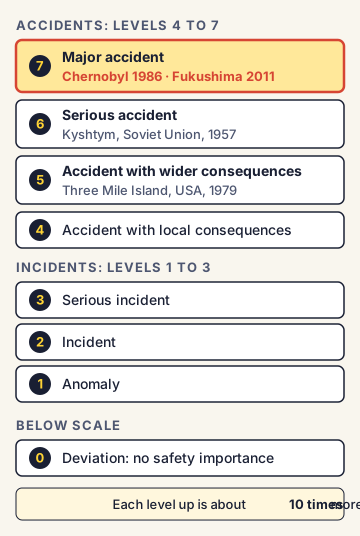
- It has levels from 0 (no safety importance) to 7 (major accident). Levels 1–3 are "incidents" and levels 4–7 are "accidents".
- Each level up is roughly ten times more severe than the one below.
- Only two events are rated Level 7: Chernobyl (1986) and Fukushima Daiichi, Japan (2011).
- Kyshtym (Soviet Union, 1957, a waste tank explosion) is rated Level 6. Three Mile Island (USA, 1979) is rated Level 5.
What did the world change after Chernobyl?
The Soviet Union did not warn neighbouring countries at first; high radiation was first detected in Sweden. To avoid this ever again, IAEA members quickly agreed two treaties in 1986:
- Convention on Early Notification of a Nuclear Accident: A country must quickly inform the IAEA and nearby countries about any accident that could spread radiation across borders. It came into force on 27 October 1986.
- Convention on Assistance in the Case of a Nuclear Accident or Radiological Emergency: Countries agree to help each other, with the IAEA, after an accident.
- Later came the Convention on Nuclear Safety (1994), which sets basic safety rules for civilian nuclear power plants. India is a party to all three [Unverified for the Convention on Nuclear Safety].
India's position and Indian examples
- India has no RBMK reactors. Most Indian reactors are Pressurised Heavy Water Reactors (PHWRs), which use heavy water. The Kudankulam plant in Tamil Nadu uses Russian VVER pressurised water reactors, a different design with a containment building.
- India's nuclear safety regulator is the Atomic Energy Regulatory Board (AERB), set up in 1983. The SHANTI Act, 2025 (Sustainable Harnessing and Advancement of Nuclear Energy for Transforming India) gave the AERB statutory (legal) status. It also replaced the Atomic Energy Act, 1962 and the Civil Liability for Nuclear Damage Act, 2010, and opened civil nuclear power to private companies.
- The National Disaster Management Authority (NDMA) has guidelines for nuclear and radiological emergencies.
Commonly confused concepts
- Chernobyl vs Fukushima: Both are INES Level 7. Chernobyl (1986, Soviet Ukraine) was caused by a reactor power surge during a test. Fukushima (2011, Japan) was caused by an earthquake and tsunami that knocked out cooling, leading to meltdowns.
- Chernobyl vs Three Mile Island: Three Mile Island (1979, USA) was a partial meltdown with very little radiation released, because the containment building held. It is Level 5.
- Nuclear reactor accident vs nuclear bomb: A reactor uses low-enriched fuel and a controlled chain reaction. It can overheat, melt or have a steam explosion, but it cannot explode like an atomic bomb.
- Sarcophagus vs New Safe Confinement: The sarcophagus is the rushed 1986 cover. The New Safe Confinement is the giant arch placed over it in 2016.
- INES vs Richter scale: INES rates nuclear events; the Richter scale measures earthquakes. Both are steps where each level is much bigger than the last.
Issues, criticism and the way forward
- Safety culture: Chernobyl showed that good machines are not enough; operators must follow rules and be free to report problems.
- Nuclear plants in war zones: Fighting near Chernobyl and Zaporizhzhia (Europe's largest nuclear plant, also in Ukraine) shows a new danger. The IAEA has stressed that nuclear sites must never be targets.
- Cost of the past: Decades later, countries still pay to keep Chernobyl safe. The donor gap for repairing the arch shows how long this burden lasts.
- Public fear vs clean energy: Chernobyl turned many people against nuclear power. Supporters argue that modern reactors are much safer and that nuclear power produces almost no carbon dioxide. Critics point to waste, cost and accident risk.
- Way forward: Stronger independent regulators, international peer reviews by the IAEA, transparent and fast reporting of incidents, and steady funding for cleanup.
Concepts to Know
- Nuclear reactor: A machine that splits atoms of uranium in a controlled way (nuclear fission) to make heat, which boils water to drive turbines and make electricity.
- Neutron: A tiny particle inside an atom. When it hits a uranium atom, the atom splits and releases more neutrons, which keeps the chain reaction going.
- Moderator: A material (graphite, water or heavy water) that slows down neutrons so they can split more uranium atoms.
- Containment building: A very thick concrete-and-steel shell around a reactor, built to trap radiation if something goes wrong.
- Acute radiation sickness: Illness caused by a very large dose of radiation in a short time. It damages blood cells and organs and can kill within weeks.
- Radioactive isotope: A form of an element that is unstable and gives out harmful radiation as it breaks down. Iodine-131 loses half its strength in about 8 days; caesium-137 takes about 30 years.
- IAEA (International Atomic Energy Agency): The UN-linked body, based in Vienna, that promotes safe and peaceful use of nuclear energy. India is a founding member.
- Date: 26 April 1986; reactor No. 4, Chernobyl plant, Soviet Ukraine (near Belarus border)
- Reactor type: RBMK-1000 (graphite-moderated, water-cooled; positive void coefficient; no full containment)
- Deaths: 2 on the night; 28 of 134 acute radiation sickness cases died within months
- Pripyat evacuated; exclusion zone expanded to 30 km
- Sarcophagus built 1986; New Safe Confinement placed 2016 (EBRD-managed fund); last reactor shut 2000
- INES (IAEA, 1990): levels 0–7; Level 7 = Chernobyl and Fukushima (2011)
- 1986 treaties: Early Notification Convention (in force 27 October 1986) and Assistance Convention
- Drone strike on the arch: 14 February 2025; repairs need at least €500 million, by 2030
- India: AERB (1983) given statutory status by the SHANTI Act, 2025
● Tracked since November 09, 2026 · last seen November 09, 2026 · updates as the daily brief publishes