Green Steel
Decarbonising Iron and Steel Making
Green steel is steel made with very little or almost no release of carbon dioxide (CO2), the main gas causing climate change. Normal steel making burns huge amounts of coal. Green steel replaces coal with cleaner options like hydrogen made from renewable power, electricity from solar and wind, and recycled scrap. In India, the government has also given an official definition: steel is "green" only if its emissions are below a fixed limit.
Why does it matter?
The steel industry is one of the biggest sources of carbon pollution in the world. In India, it is responsible for about 12% of the country's CO2 emissions. Indian steel releases about 2.5 tonnes of CO2 per tonne of crude steel, higher than the world average of about 1.9 tonnes. As India's steel output grows several times by 2047, emissions will also grow unless the method of making steel changes.
Green steel is also becoming a trade issue: buyers in Europe and elsewhere are starting to charge for the carbon inside imported goods.
Why does normal steel release so much CO2?
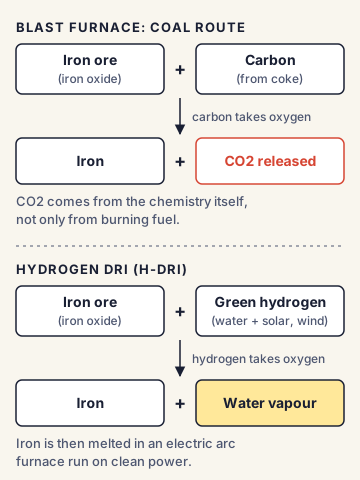
To make iron, you must remove oxygen from iron ore (iron oxide). In a blast furnace, this is done with carbon from coke. The carbon grabs the oxygen and leaves as CO2. So CO2 is not just a side effect of burning fuel; it comes from the basic chemistry of the process. In India, much of the sponge iron is made using coal in rotary kilns, which is also very carbon-heavy (around 3 tonnes of CO2 per tonne).
How is steel made green? The main routes
- Hydrogen-based DRI (H-DRI): Hydrogen, not carbon, removes the oxygen from iron ore. The waste product is water vapour, not CO2. If the hydrogen is made by splitting water with renewable electricity (green hydrogen), the process is almost carbon-free. The iron is then melted in an electric arc furnace run on clean power.
- Scrap-based electric arc furnace (EAF): Melting old steel scrap with electricity avoids the iron-making step completely. It releases only about 0.7 tonnes of CO2 per tonne, and less if the electricity is green. But the world does not have enough scrap to meet all demand.
- Natural gas-based DRI: Gas releases less CO2 than coal. It is a "bridge" step, and plants can later shift from gas to hydrogen.
- Cleaner blast furnaces: Using more renewable power, injecting hydrogen into blast furnaces, better energy efficiency, and carbon capture, utilisation and storage (CCUS) (catching CO2 and storing or reusing it).
Where did it start? Global examples
Sweden's HYBRIT project (a joint venture of SSAB, LKAB and Vattenfall) produced the world's first hydrogen-reduced sponge iron at a pilot plant in Luleå in June 2021, and delivered the first fossil-free steel to Volvo in August 2021. Many European steel makers are now building hydrogen-ready plants.
India's framework for green steel
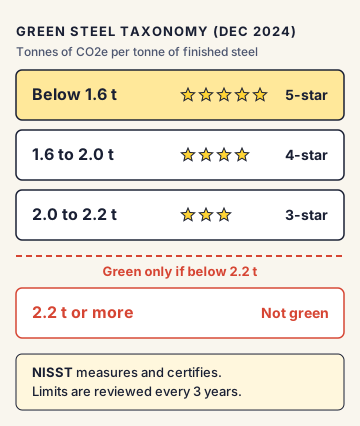
- Green Steel Taxonomy (12 December 2024): Released by the Ministry of Steel. India was among the first countries to define green steel officially. Steel is "green" if it releases less than 2.2 tonnes of CO2-equivalent per tonne of finished steel. It is then given a star rating:
- 5-star: below 1.6 tonnes
- 4-star: 1.6 to 2.0 tonnes
- 3-star: 2.0 to 2.2 tonnes
- The National Institute of Secondary Steel Technology (NISST) is the nodal body for measuring, verifying and certifying green steel. The thresholds will be reviewed every three years. The emissions counted are Scope 1, Scope 2 and a limited part of Scope 3 (up to finished steel; not mining or transport).
- National Green Hydrogen Mission (January 2023): Total outlay of ₹19,744 crore. Target of producing 5 million tonnes of green hydrogen a year by 2030. Under it, the Ministry of Steel has ₹455 crore for pilot projects (to FY 2029-30) testing hydrogen in DRI plants and blast furnaces.
- Steel Scrap Recycling Policy (2019) and vehicle scrapping rules support more scrap-based steel.
- Climate goals: At COP26 in Glasgow (2021), India announced the target of net zero emissions by 2070. The draft steel policy links the sector's target of 1.54 tonnes of CO2 per tonne of crude steel by 2047 to this goal.
The trade angle: EU's CBAM
The European Union's Carbon Border Adjustment Mechanism (CBAM) entered its definitive (paying) phase on 1 January 2026. Importers in the EU must now buy certificates for the carbon emitted in making goods like steel, aluminium and cement. Iron and steel form the biggest part of India's CBAM-covered exports to the EU. So high-carbon Indian steel faces an extra cost in Europe, while green steel can compete better.
Commonly confused concepts
- Green steel vs green hydrogen: Green hydrogen is a fuel made by splitting water with renewable power. Green steel is a product that may use green hydrogen to reduce iron ore.
- Grey, blue and green hydrogen: Grey hydrogen is made from natural gas with CO2 released. Blue hydrogen is made the same way, but the CO2 is captured. Green hydrogen is made from water using renewable electricity, with no CO2.
- Emission intensity vs total emissions: Intensity is CO2 per tonne of steel. Total emissions is all the CO2 released by the sector. India's target lowers intensity, but total emissions can still rise if production grows fast.
- Green Steel Taxonomy vs CBAM: The taxonomy is India's own label for green steel. CBAM is the EU's charge on carbon in imports.
- Net zero vs zero emissions: Net zero means any CO2 still released is balanced by removing the same amount (for example, through forests or carbon capture). It does not mean no emissions at all.
Issues, criticism and the way forward
- High cost: Green hydrogen is still expensive. Steel is sold at thin margins, so a plant using costly hydrogen may lose out to cheaper coal-based steel.
- Locked-in coal plants: Most new capacity being planned in India still uses coal. A blast furnace runs for decades, so plants built now may keep emitting till mid-century.
- Scrap shortage: India does not yet produce enough scrap; much of its steel is still young and in use.
- Clean power and water: H-DRI needs huge amounts of renewable electricity and water for electrolysis.
- Small units: Thousands of small sponge iron and induction furnace units lack the money and know-how to upgrade.
- Way forward: Experts suggest green public procurement (government buying green steel for its projects), carbon pricing through the Carbon Credit Trading Scheme, cheaper finance for clean plants, more scrap collection, and gradual blending of hydrogen into existing plants.
Concepts to Know
- Decarbonisation: Reducing the carbon dioxide released by an activity, ideally close to zero.
- CO2-equivalent (CO2e): A common unit that counts all greenhouse gases as if they were carbon dioxide, based on how much each one warms the planet.
- Electrolysis: Using electricity to split water into hydrogen and oxygen.
- Scope 1, 2 and 3 emissions: Scope 1 is emissions from a company's own furnaces and fuel. Scope 2 is from the electricity it buys. Scope 3 is from its supply chain, such as raw materials and transport.
- Carbon capture, utilisation and storage (CCUS): Catching CO2 from a chimney and either using it in products or storing it deep underground.
- Steel: about 12% of India's CO2 emissions
- Indian steel emission intensity: about 2.5 tCO2 per tonne of crude steel (global average about 1.9)
- Draft steel policy target: 1.54 tCO2 per tonne of crude steel by 2047
- Green Steel Taxonomy: launched 12 December 2024; green if below 2.2 tCO2e per tonne of finished steel
- Star ratings: 5-star below 1.6; 4-star 1.6 to 2.0; 3-star 2.0 to 2.2
- Nodal agency: NISST; thresholds reviewed every 3 years
- National Green Hydrogen Mission: ₹19,744 crore; 5 MMT green hydrogen per year by 2030; ₹455 crore for steel pilots
- EU CBAM definitive phase: from 1 January 2026
- HYBRIT (Sweden): first fossil-free steel delivered in August 2021
- India's net zero target year: 2070 (announced at COP26, 2021)
● Tracked since October 11, 2026 · last seen October 11, 2026 · updates as the daily brief publishes