Green India Mission (GIM)
The Green India Mission, officially the National Mission for a Green India, is the Government of India's main programme to protect, restore and increase the country's forests. It is one of the eight national missions under India's National Action Plan on Climate Change (NAPCC). Its aim is not just to plant trees, but to bring back healthy forests, grasslands and wetlands that give people water, fodder, fuel and income, and that also soak up carbon dioxide from the air.
Why does India need it?
Forests do many jobs at once. They store carbon, which slows climate change. They hold soil and recharge groundwater. They give firewood, fodder, fruits and medicinal plants to crores of rural and tribal families. But many of India's forests are thin and degraded: the trees are there on paper, but the canopy is open and the soil is eroding.
Planting more trees and improving the quality of existing forests is also one of India's international climate promises. GIM was created to do both jobs in one programme.
Where did it come from?
In June 2008, India released the NAPCC, its first national climate plan. It had eight missions:
- National Solar Mission
- National Mission for Enhanced Energy Efficiency
- National Mission on Sustainable Habitat
- National Water Mission
- National Mission for Sustaining the Himalayan Ecosystem
- National Mission for a Green India
- National Mission for Sustainable Agriculture
- National Mission on Strategic Knowledge for Climate Change
The Green India Mission document was released by the Ministry of Environment and Forests in 2011. On 20 February 2014, the Cabinet Committee on Economic Affairs (CCEA) approved the scheme, with work on 2.8 million hectares at a cost of ₹13,000 crore during the 12th Five-Year Plan (which ran up to March 2017). This 2.8 million hectares was only the first part of the mission's bigger 10 million hectare goal (see the goals below).
Actual work on the ground began in 2015-16. On 17 June 2025 (the World Day to Combat Desertification and Drought), the Ministry released a revised mission document. It widened the focus to restoring whole damaged landscapes, especially the Aravallis, the Western Ghats, the Himalayas and mangrove areas.
What are its goals?
The mission has a ten-year vision with three main goals:
- Increase forest and tree cover on 5 million hectares (new greening).
- Improve the quality of forest and tree cover on another 5 million hectares of forest and non-forest land (so the two goals together cover 10 million hectares).
- Increase forest-based livelihood income for about 3 million households living in and around forests.
It also aims to improve "ecosystem services" (the free benefits nature gives us), such as clean water, biodiversity, fuel, fodder and timber. Carbon storage is treated as a co-benefit, a useful side result of healthy forests, not the only aim.
What work does it fund?
The mission is split into five sub-missions and one support activity:
- Sub-mission 1: improve the quality of existing forests (making thin forests dense again).
- Sub-mission 2: restore damaged ecosystems and increase forest cover, including scrublands, grasslands and ravines.
- Sub-mission 3: increase tree cover in towns, cities and on institutional land (like campuses).
- Sub-mission 4: promote agroforestry (trees grown along with crops on farms) and social forestry.
- Sub-mission 5: restore wetlands.
- Support activity: give forest families alternatives to firewood, such as biogas, solar devices, LPG and improved cookstoves, so that forests are not cut for fuel.
How does it work on the ground?
GIM is a Centrally Sponsored Scheme, which means the Centre and the states share the cost. The share is 60:40 (Centre:State) for most states and 90:10 for the north-eastern and Himalayan (hill) states. Money flows down a ladder of bodies:
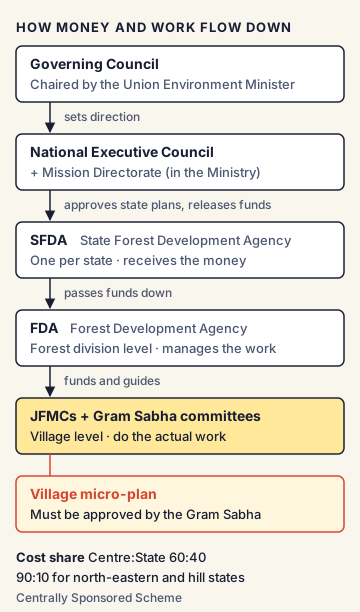
- Governing Council, chaired by the Union Environment Minister, sets direction. It is supposed to meet at least once a year.
- National Executive Council and the Mission Directorate in the Ministry approve state plans and release funds.
- State Forest Development Agency (SFDA) in each state receives the money.
- Forest Development Agency (FDA) at the forest division level manages the work. (A forest division is a unit of the state forest department, often close to a district in size, but it is not the same as a district.)
- Joint Forest Management Committees (JFMCs) and committees of the Gram Sabha at the village level do the actual work.
Each village makes a micro-plan (a small, detailed work plan for that village's land). The Gram Sabha, the assembly of all adult voters of the village, must approve it. The idea is that local people decide what to plant and where, and then protect it. Because the mission's own budget was small, it was designed to converge, or join hands, with bigger funds: CAMPA money (the compensatory afforestation money paid by projects that cut forests), MGNREGS (Mahatma Gandhi National Rural Employment Guarantee Scheme) wages (for planting and pit-digging work) and the National Afforestation Programme.
India's position and Indian examples
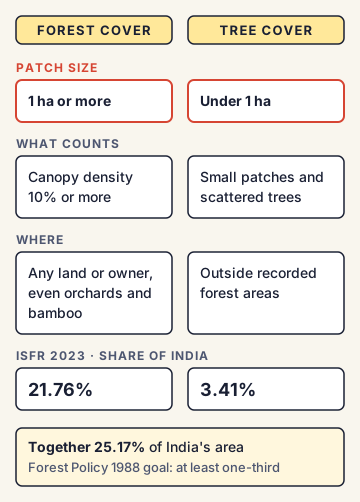
Under its first climate pledge (NDC) under the Paris Agreement in 2015, India promised to create an additional carbon sink of 2.5 to 3 billion tonnes of CO2 equivalent by 2030, through more forest and tree cover. GIM is one of the main tools for this. As per the India State of Forest Report (ISFR) 2023, released by the Forest Survey of India in December 2024, India's total forest and tree cover was 8,27,357 sq km, or 25.17% of its geographical area (forest cover 21.76%, tree cover 3.41%).
The National Forest Policy, 1988 set a goal of at least one-third of India's geographical area under forest or tree cover. The revised mission also supports the Aravalli Green Wall Project, which the Environment Ministry launched on 25 March 2023. It is a green buffer of about 5 km around the Aravalli hills, to slow the spread of the Thar desert towards Delhi.
Commonly confused concepts
- GIM vs National Afforestation Programme (NAP): NAP is an older centrally sponsored scheme for planting on degraded forest land through FDAs and JFMCs. GIM is the larger climate mission under the NAPCC. NAP money was meant to flow into GIM through convergence.
- GIM vs CAMPA: CAMPA is not a scheme. CAMPA stands for Compensatory Afforestation Fund Management and Planning Authority: it is the body that manages a fund made of money that projects pay when they divert forest land for non-forest use. This fund is governed by the Compensatory Afforestation Fund Act, 2016. GIM was supposed to use some of that money.
- Forest cover vs tree cover: Forest cover means all land of at least 1 hectare with tree canopy density of 10% or more, whatever the ownership or legal status (it can include orchards and bamboo). Tree cover means small patches and scattered trees outside recorded forest areas, each patch smaller than 1 hectare.
- Forest cover vs recorded forest area: Recorded forest area is land marked as forest in government records. It may or may not actually have trees. Forest cover is what the satellite actually sees.
- Afforestation vs reforestation: Afforestation means planting trees on land that was not forest for a long time. Reforestation means re-growing trees on land that was forest earlier but was cleared.
Issues, criticism and the way forward
- Very low achievement: The CAG (Comptroller and Auditor General of India) audit (Report No. 4 of 2026) found work on only about 0.15 million hectares against the 2.8 million hectare target, roughly 5%.
- Convergence failed: The plan depended on money from CAMPA, MGNREGS and NAP, but that money did not reach the mission. The mission's own budget was also released only in part.
- Wrong sites: Saplings were planted inside already dense forests, where they add little. Scrublands, ravines and abandoned mines, which most needed restoration, were often left out.
- Weak monitoring: Satellite checks found no change at about 70% of the sites. Survival of saplings was not tracked well. Carbon captured was not measured.
- Weak governance and people's role: The Governing Council rarely met, annual reports were not made, social audits were mostly skipped, and many village plans were never approved by the Gram Sabha.
- The grassland debate: Ecologists warn that planting trees on natural grasslands and open savannas can harm wildlife like the great Indian bustard. Restoration should match the original ecosystem, not just add trees.
- Way forward: The PAC (Public Accounts Committee of Parliament) has asked for a fixed time frame and revised guidelines. Experts suggest satellite-based tracking of every site, counting only surviving trees, paying communities for protection, and giving Gram Sabhas real control over planning.
Concepts to Know
- National Action Plan on Climate Change (NAPCC): India's first national plan to deal with climate change, released in June 2008. It works through eight national missions on solar power, energy efficiency, water, forests and other areas.
- Carbon sink: Anything that absorbs more carbon dioxide from the air than it releases, like a growing forest or the ocean. It works like a sponge for carbon.
- CO2 equivalent: A common unit to measure all greenhouse gases together, by converting each gas into the amount of carbon dioxide that would cause the same warming.
- Centrally Sponsored Scheme: A scheme run by states but funded jointly by the Centre and the states, in a fixed ratio such as 60:40.
- Convergence: Joining money and work from two or more government schemes at the same place, so that one project gets more funds without a new budget.
- Joint Forest Management (JFM): An arrangement, started in 1990, where the forest department and the local village community protect and manage a forest together and share its benefits.
- Social audit: A check of a government scheme done by the people it is meant to help, comparing official records with what actually happened on the ground.
- Nationally Determined Contribution (NDC): The climate target each country sets for itself under the Paris Agreement.
- One of 8 missions under the NAPCC (released 30 June 2008)
- Mission document: 2011; CCEA approval: 20 February 2014 (2.8 million ha in the 12th Five-Year Plan, ₹13,000 crore); work began 2015-16
- Goals: increase forest/tree cover on 5 million ha + improve quality on another 5 million ha; livelihood income for about 3 million households
- 5 sub-missions: forest quality, ecosystem restoration, urban tree cover, agroforestry/social forestry, wetlands
- Centrally Sponsored: 60:40; 90:10 for north-eastern and hill states
- Village micro-plans approved by the Gram Sabha; JFMCs implement; FDA and SFDA manage funds
- Revised mission document released 17 June 2025: focus on Aravallis, Western Ghats, Himalayas and mangroves
- India's NDC (2015): additional carbon sink of 2.5 to 3 billion tonnes CO2 equivalent by 2030
- ISFR 2023: forest and tree cover 25.17% of geographical area (forest 21.76%, tree 3.41%)
● Tracked since November 19, 2026 · last seen November 19, 2026 · updates as the daily brief publishes