Green Crackers
Less-Polluting Firecrackers and the Law Behind Them
Green crackers are firecrackers made with a changed chemical recipe so that they release less smoke, dust and harmful gases than normal crackers. They were developed in India by the CSIR-National Environmental Engineering Research Institute (CSIR-NEERI), a government science lab in Nagpur. They are less polluting, not pollution-free. They still produce smoke and noise, only less of it.
Why were they needed?
Around Diwali, the air in north India, and especially in Delhi, is already very bad because of cold, still weather, vehicle smoke, dust and stubble burning in nearby states. Normal firecrackers add a big burst of fine dust and toxic metals on top of this in just a few hours. Doctors warn this triggers asthma attacks, breathing trouble and heart problems, especially in children and the elderly.
But crackers are also part of celebrations and give work to lakhs of people, mainly in Sivakasi in Tamil Nadu. Green crackers were created as a middle path: let people celebrate, but with less harm.
Where did they come from?
The idea came out of the Supreme Court's firecracker cases:
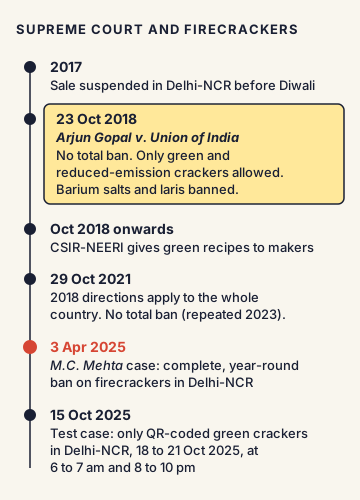
- 2017: The Supreme Court suspended the sale of firecrackers in Delhi-NCR before Diwali.
- 23 October 2018, Arjun Gopal v. Union of India: Child petitioners asked for a complete ban. The bench of Justices A.K. Sikri and Ashok Bhushan refused a total ban. Instead it allowed only "reduced emission" (improved) and green crackers, banned barium salts in crackers, banned joined crackers (series crackers or "laris"), and fixed time slots for bursting (for example, 8 pm to 10 pm on Diwali).
- October 2018 onwards: CSIR-NEERI and other CSIR labs showed the new green formulations to manufacturers.
- 29 October 2021: The Supreme Court said its 2018 directions, including the ban on barium salts, apply across the whole country, not just Delhi-NCR. It made clear there is no total ban on all firecrackers. It repeated this in November 2023.
- 3 April 2025: In the M.C. Mehta air pollution case, the Supreme Court ordered a complete, year-round ban on firecrackers in Delhi-NCR.
- 15 October 2025: A bench led by CJI B.R. Gavai relaxed this as a temporary "test case" and allowed only green crackers with valid QR codes to be sold and burst in Delhi-NCR from 18 to 21 October 2025, in fixed time slots (6 am to 7 am and 8 pm to 10 pm), with online sales banned.
How do green crackers work?
Normal crackers use oxidisers (chemicals that supply oxygen for burning) like barium nitrate, which gives a green colour but releases toxic barium. Green crackers change the recipe:
- They remove or reduce harmful chemicals such as barium nitrate, and use smaller shells and less raw material.
- They add materials that suppress dust, for example by releasing water vapour so that dust particles settle quickly.
- The result is about 30% or more reduction in particulate matter (fine dust) compared to normal crackers, as reported by CSIR-NEERI.
The three CSIR-NEERI types (a favourite Prelims fact):
- SWAS (Safe Water Releaser): Releases water vapour that suppresses the dust released, and avoids potassium nitrate and sulphur.
- STAR (Safe Thermite Cracker): Made without potassium nitrate and sulphur, so it gives out less particulate matter and has lower sound.
- SAFAL (Safe Minimal Aluminium): Uses very little aluminium (only in the flash powder that starts the burst), which reduces dust by about 35 to 40%.
How are they checked?
Two bodies are involved:
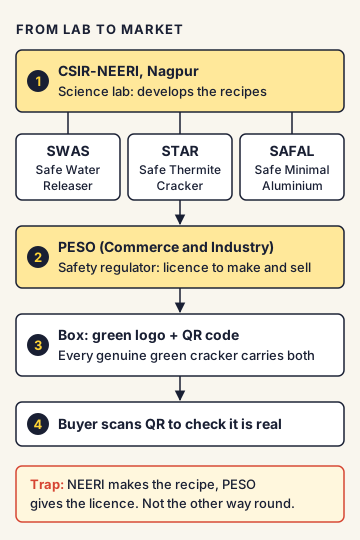
- CSIR-NEERI develops and approves the formulations and gives them to manufacturers.
- The Petroleum and Explosives Safety Organisation (PESO), under the Ministry of Commerce and Industry, gives the licence to make and sell them, since firecrackers are explosives.
- Each genuine green cracker box carries the green logo and a QR code, which buyers can scan to check it is real.
Rules that apply to all firecrackers
Under the Environment (Protection) Rules, 1986, as amended in 1999, crackers producing noise above 125 dB(AI) or 145 dB(C)pk at 4 metres from the bursting point are banned. Firecracker manufacturing and storage also come under the Explosives Act, 1884 and the Explosives Rules, 2008.
Commonly confused concepts
- Green crackers vs "no crackers": Green crackers still pollute; they only pollute less. Courts have treated them as a compromise, not a solution.
- Green crackers vs reduced-emission (improved) crackers: Both were allowed in 2018. Improved crackers are normal crackers with some changes (like no barium); green crackers use the new CSIR-NEERI formulations with dust suppressants.
- CSIR-NEERI vs PESO: NEERI is the science lab that develops and tests the recipe; PESO is the safety regulator that licenses manufacturing and sale.
- Arjun Gopal (2018) vs M.C. Mehta (air pollution case): Arjun Gopal is the main firecracker judgment; M.C. Mehta is the larger, long-running case on Delhi air pollution in which firecracker orders are also passed.
Issues, criticism and the way forward
- Fake green crackers: Normal crackers are often sold with fake green labels or QR codes, and checking every shop is hard.
- Weak enforcement of time limits: Police find it very hard to stop bursting outside the allowed hours, as the amicus pointed out in court.
- Limited benefit: A 30% cut helps, but when lakhs of crackers are burst on one night, the air can still become "severe".
- Livelihoods: The Sivakasi industry employs a very large number of workers. Strict bans hit them hard, and switching to new formulas needs money and training.
- Faith vs health debate: Some see bans as interfering with festivals. Others point out that Article 25 itself allows limits for health, and that no religious text requires crackers.
- Way forward: Experts suggest strict testing and licensing, better tracing of fake products, public awareness, community fireworks displays instead of individual bursting, and support for the industry to shift to cleaner products.
Concepts to Know
- Particulate matter (PM2.5 and PM10): Tiny dust particles in the air. PM2.5 particles are smaller than 2.5 micrometres (about 30 times thinner than a human hair) and can go deep into the lungs and blood.
- Oxidiser: A chemical in a cracker that gives oxygen to help the fuel burn quickly and explode.
- Amicus curiae: Latin for "friend of the court". A senior lawyer appointed by a court to help it understand a case, without representing either side.
- Decibel (dB): The unit used to measure how loud a sound is. Every 10 dB rise means the sound is about ten times more intense.
- Developed by CSIR-NEERI, Nagpur; licensed by PESO (Ministry of Commerce and Industry)
- Types: SWAS (Safe Water Releaser), STAR (Safe Thermite Cracker), SAFAL (Safe Minimal Aluminium)
- About 30% or more lower particulate emissions than normal crackers (as reported by CSIR-NEERI)
- Arjun Gopal v. Union of India (23 October 2018): no total ban; only green and reduced-emission crackers; barium salts and joined crackers (laris) banned
- 29 October 2021: 2018 directions apply to all states and UTs
- 3 April 2025: complete year-round ban in Delhi-NCR (M.C. Mehta case); relaxed on 15 October 2025 for green crackers from 18 to 21 October 2025
- Noise limit: 125 dB(AI) or 145 dB(C)pk at 4 metres (Environment (Protection) Rules, as amended in 1999)
● Tracked since July 26, 2026 · last seen October 12, 2026 · updates as the daily brief publishes