Great Indian Bustard (GIB)
The Great Indian Bustard (GIB) is a large, tall bird that lives in open grasslands and dry scrublands of India. It is one of the heaviest flying birds in the world; adult males can weigh up to about 15 kg. Its scientific name is Ardeotis nigriceps, and in Rajasthan it is locally called Godawan. It is the state bird of Rajasthan and is Critically Endangered: only about 150 birds are believed to survive, most of them in the Thar Desert of Rajasthan.
What does the bird look like and how does it live?
The GIB stands about one metre tall. It has a long neck, long bare legs, a brownish body and a black crown (cap) on its head. It walks slowly across open land, eating seeds, insects, small lizards and snakes. Farmers once valued it because it eats crop pests like grasshoppers. It prefers flat, open grassland where it can see far in all directions, because its main defence against danger is spotting it early.
Why is it so hard for this bird to recover?
The GIB breeds very slowly. A female usually lays only one egg at a time, directly on bare ground with no real nest. The egg and chick are easy targets for foxes, dogs, crows and monitor lizards, and can be crushed by cattle. So even if adult birds stop dying, the population grows back very slowly. Think of a bank account where you deposit only a few rupees each year: any big withdrawal takes decades to make up.
Where is it found?
Once the GIB lived across large parts of western and central India and in Pakistan. Today it survives in small, scattered pockets in six Indian states:
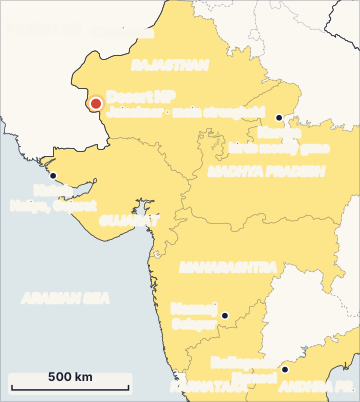
- Rajasthan: the main stronghold, especially Desert National Park (Jaisalmer and Barmer) and the Pokhran area
- Gujarat: Kutch (the Naliya grasslands and the tiny Kutch Bustard Sanctuary)
- Maharashtra: the Solapur area (Great Indian Bustard Sanctuary, Nannaj)
- Madhya Pradesh: Karera and Ghatigaon (birds have largely vanished from here)
- Karnataka and Andhra Pradesh: small numbers around Ballari and Rollapadu
A few birds also live across the border in Pakistan's Cholistan desert.
Why did its numbers fall?
The population fell from an estimated 1,000 or more in the 1960s [Unverified] to about 250 in 2011 and about 150 by 2018. The main reasons are:
- Power lines: This is the biggest killer today. The GIB has wide-angle eyes on the sides of its head and poor forward vision. Being heavy, it cannot turn quickly in flight. So it often flies straight into overhead electricity wires and dies from the collision or an electric shock. Many new wind and solar plants and their power lines have come up in the Thar Desert.
- Loss of grassland: Grasslands are often treated as "wasteland". They are converted to farms, canals, roads and plantations, or covered with solar panels.
- Hunting: In the past, hunting killed many birds, especially in Pakistan.
- Stray dogs and predators: These eat eggs and chicks.
What protection does the law give?
The GIB has the highest protection at every level:
- Wildlife (Protection) Act, 1972: listed in Schedule I, the highest category of protection in India. Hunting it is a serious crime.
- IUCN Red List: Critically Endangered (moved up to this category in 2011).
- CITES: Appendix I, which bans international commercial trade in the bird or its parts.
- CMS (Bonn Convention): added to Appendix I in February 2020 at COP13 held in Gandhinagar, Gujarat. India proposed the listing, and the GIB-inspired mascot of that meeting was named "Gibi".
What has the government done to save it?
- Species Recovery Programme: The GIB is one of the critically endangered species picked under the Species Recovery Programme, a part of the centrally sponsored scheme Integrated Development of Wildlife Habitats (IDWH). This programme began in 2008-09.
- Project Great Indian Bustard (Rajasthan): Rajasthan launched this on 5 June 2013, the first state to start a dedicated programme for the bird. It focused on fenced breeding enclosures and habitat protection.
- Habitat Improvement and Conservation Breeding of GIB: In 2016, MoEFCC approved this programme with the Wildlife Institute of India (WII) as the nodal (lead) agency, working with state forest departments. MoEFCC sanctioned Rs 33.85 crore for five years, paid from the central part of the CAMPA fund.
- Breeding centres: The first conservation breeding centre opened at Sam (Jaisalmer) in 2019. A second centre at Ramdevra (near Pokhran, Jaisalmer district) became operational in 2022. Eggs were collected from the wild, hatched in incubators and the chicks were raised by experts.
- Bird diverters and undergrounding: Bright, swinging discs called bird diverters are hung on power lines so birds can see them. In key habitats, courts have ordered that power lines be laid underground.
How does conservation breeding work?
First, experts collect a few eggs from wild nests that are at risk. They hatch them in incubators (machines that keep eggs warm at the right temperature). The chicks grow up in large, safe enclosures with as little contact with humans as possible, so they do not become tame. Once the captive birds breed, their chicks add to the "insurance population".
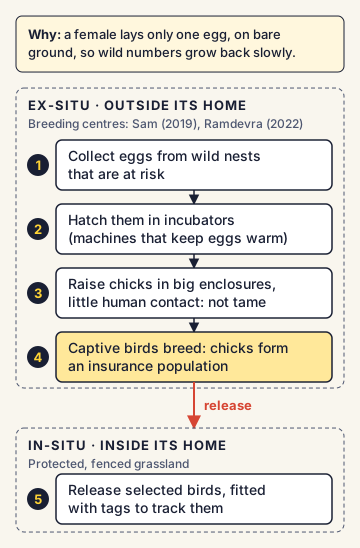
Finally, selected birds are released into protected, fenced grassland, often fitted with tags to track them. This method of keeping a species safe outside its natural home is called ex-situ conservation. Protecting it inside its natural home, as in a national park, is called in-situ conservation. A good programme uses both together.
What did the Supreme Court say?
In the case M.K. Ranjitsinh v. Union of India:
- In April 2021, the Supreme Court ordered that overhead power lines across about 99,000 sq km of possible GIB habitat in Rajasthan and Gujarat be laid underground where possible, and that bird diverters be put on existing lines.
- On 21 March 2024, a three-judge bench changed this order. It said such a blanket rule over a huge area would hurt India's solar and wind energy goals, which are also needed to fight climate change. It set up an expert committee to decide where undergrounding is really needed. In this judgment the Court also said, for the first time, that people have a right to be free from the adverse effects of climate change, which comes from Article 14 (right to equality) and Article 21 (right to life).
- On 19 December 2025, the Court accepted the expert committee's recommendations. It fixed revised priority conservation areas of about 14,013 sq km in Rajasthan and 740 sq km in Gujarat, where power lines must be managed strictly, and allowed a power corridor of up to 5 km width at least 5 km south of the southernmost enclosure of Desert National Park.
Commonly confused concepts
- Great Indian Bustard vs Lesser Florican vs Bengal Florican: All three are Indian bustards and all three are Critically Endangered. The GIB is the largest and lives in dry grasslands of western India. The Lesser Florican is small and lives in grasslands of western and central India (it breeds during the monsoon). The Bengal Florican lives in the tall, wet grasslands of the Terai and the Brahmaputra floodplains (Uttar Pradesh, Assam, Arunachal Pradesh).
- Great Indian Bustard vs MacQueen's (Houbara) Bustard: The MacQueen's Bustard is a smaller bird that only visits western India in winter. It is listed as Vulnerable, not Critically Endangered.
- Godawan vs Great Bustard: "Godawan" is just the local name of the GIB. The Great Bustard (Otis tarda) is a different species found in Europe and Central Asia.
- Ex-situ vs in-situ conservation: Breeding centres at Sam and Ramdevra are ex-situ. Desert National Park is in-situ.
Issues, criticism and the way forward
- Green energy vs bird safety: The Thar Desert is ideal for solar and wind energy, which India needs to cut carbon emissions. But the power lines from these plants kill GIBs. Laying lines underground is expensive and, for high-voltage lines, technically hard. Energy companies point to cost; conservationists say the species may vanish without it. The Supreme Court's priority-area approach tries to balance both.
- Grasslands are undervalued: Indian land records often call grasslands "wasteland". Experts suggest a national grassland policy so that these habitats are protected like forests.
- Slow and risky reintroduction: Released birds may not know how to avoid predators or power lines. Each death matters greatly in such a small population, so scientists release birds slowly, track them closely and refine the method.
- Low genetic diversity: A very small population means close relatives breed with each other, which can weaken the species over time. Collecting eggs from different areas helps.
- Way forward: Experts suggest making the priority areas power-line-safe, involving local communities (for example, paying farmers who protect nests), controlling stray dogs, restoring grassland, and extending breeding and release to Gujarat and Maharashtra.
Concepts to Know
- Critically Endangered: The most serious IUCN category for a species still found in the wild. It means the species faces an extremely high risk of dying out in the wild very soon.
- IUCN Red List: A global list, kept by the International Union for Conservation of Nature, that tells how close each species is to extinction.
- CITES: The Convention on International Trade in Endangered Species of Wild Fauna and Flora (1973). It controls cross-border trade in wild animals and plants. Appendix I species cannot be traded for commercial purposes.
- CMS (Bonn Convention): The Convention on the Conservation of Migratory Species of Wild Animals (1979). It protects animals that cross national borders. Appendix I lists endangered migratory species that member countries must strictly protect.
- Schedule I (Wildlife Protection Act): The list of animals that get the highest protection under Indian law. Hunting or trading them brings the heaviest penalties.
- CAMPA: Compensatory Afforestation Fund Management and Planning Authority. When forest land is used for projects like mines or roads, the project pays money to plant forests elsewhere. CAMPA manages this money, and part of it is used for wildlife programmes.
- Wildlife Institute of India (WII): A research institute in Dehradun under MoEFCC that studies and advises on wildlife conservation.
- Telemetry: Tracking an animal by fitting it with a small radio or satellite tag that sends its location.
- Bird diverter: A bright disc or spiral hung on power lines so that flying birds can see the wires and avoid them.
- Scientific name: Ardeotis nigriceps; local name: Godawan; state bird of Rajasthan
- Male weight: up to about 15 kg; lays usually one egg per clutch
- Population: about 250 (2011) and about 150 (2018 estimate), mostly in Rajasthan
- Range states: Rajasthan, Gujarat, Maharashtra, Madhya Pradesh, Karnataka, Andhra Pradesh
- Status: IUCN Critically Endangered (since 2011); WPA 1972 Schedule I; CITES Appendix I; CMS Appendix I (2020, COP13 Gandhinagar)
- Project Great Indian Bustard (Rajasthan): launched 5 June 2013
- Habitat Improvement and Conservation Breeding of GIB: approved 2016, WII nodal agency, Rs 33.85 crore over 5 years from CAMPA
- Breeding centres: Sam (2019), Ramdevra (2022), both in Jaisalmer district
- Species Recovery Programme under IDWH: began 2008-09
- M.K. Ranjitsinh v. Union of India: April 2021 order (about 99,000 sq km); 21 March 2024 modification and right against adverse effects of climate change (Articles 14 and 21); 19 December 2025 priority areas of 14,013 sq km (Rajasthan) and 740 sq km (Gujarat)
● Tracked since March 26, 2026 · last seen October 04, 2026 · updates as the daily brief publishes