Desert National Park
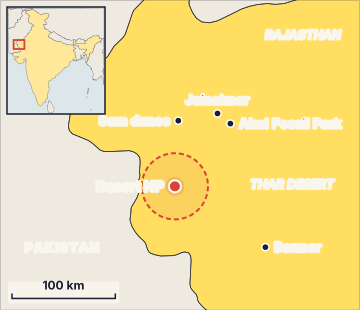
Desert National Park is a large protected area in the Thar Desert of western Rajasthan, spread over the Jaisalmer and Barmer districts. It covers about 3,162 sq km, which makes it one of the largest protected areas in India. It protects the desert ecosystem: sand dunes, rocky land, salt lake bottoms and dry grasslands. It is best known as the most important home of the Great Indian Bustard.
Why was it created?
Most people think a desert is empty. In fact the Thar is one of the most crowded deserts in the world, with people, livestock and wildlife sharing the land. Animals and plants here have adapted to very little rain, extreme heat and cold nights. As farming, grazing and roads spread, this special ecosystem and its rare animals, like the GIB, were losing space. The park was created to keep a large piece of the Thar desert ecosystem safe.
How did it become a protected area?
The Rajasthan government first notified the area as a wildlife sanctuary on 4 August 1980 under Section 18 of the Wildlife (Protection) Act, 1972. On 8 May 1981, it issued a preliminary notification under Section 35 to make it a national park. However, the final notification that would make it a national park in the full legal sense is still pending.
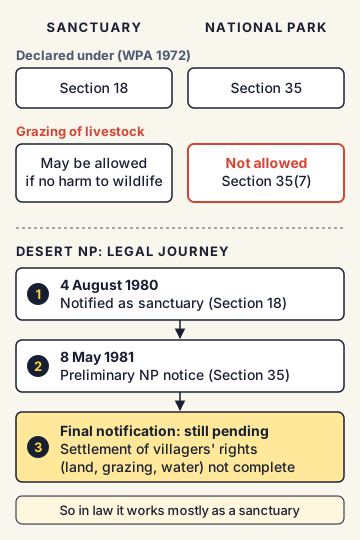
The reason is that the settlement of rights of the many villages inside the park (their rights over land, grazing and water) has not been completed. So in legal terms it works mostly as a sanctuary, even though it is called a national park.
What does the land look like?
- Sand dunes make up about 44% of the park. Some dunes shift with the wind; others are fixed by plants. The famous Sam sand dunes are part of this landscape.
- Rocky ground and compact salt lake bottoms cover other areas.
- Grasslands with grasses like sewan (Lasiurus sindicus) are the most important habitat for the GIB.
- There are many villages and small settlements inside the park, and local people graze their livestock here.
Which animals and plants live here?
- Birds: The Great Indian Bustard is the flagship (star) species. The park is also rich in birds of prey, such as the tawny eagle, short-toed eagle, spotted eagle, laggar falcon and kestrel, plus sandgrouse and many winter migrants.
- Mammals: Chinkara (Indian gazelle), blackbuck, desert fox, Bengal fox, desert cat, Indian wolf, hedgehog and nilgai.
- Reptiles: Many desert reptiles, such as the spiny-tailed lizard, monitor lizard and saw-scaled viper.
What is special about its fossils?
The park area holds fossils of plants and animals about 180 million years old, from the Jurassic period. This shows that this dry land was once covered by sea and forest. Near the park, the Akal Wood Fossil Park (about 21 hectares, around 18 km from Jaisalmer) preserves fossilised tree trunks from this era.
Fenced enclosures for the GIB
Inside the park, the forest department has built fenced enclosures where grazing and human movement are stopped. Grass grows back, insects return, and the GIB gets a safe place to breed. Sudasari is the best-known of these enclosures and a well-known spot to see the bird. The breeding centre at Sam also lies in this landscape.
How does a national park differ from a sanctuary under the law?
Under the Wildlife (Protection) Act, 1972:
- A wildlife sanctuary is declared under Section 18. Some human activities, such as grazing, may be allowed if they do not harm wildlife.
- A national park is declared under Section 35. It gives stronger protection: no grazing of livestock is allowed (Section 35(7)), and the rights of people inside must be settled or bought out before the final notification.
- The boundaries of a national park can be changed only by a resolution of the state legislature, on the recommendation of the National Board for Wildlife (NBWL).
Commonly confused concepts
- Desert National Park vs Thar Desert: The Thar Desert (Great Indian Desert) covers about 2 lakh sq km across Rajasthan, Gujarat, Punjab, Haryana and Pakistan. Desert National Park protects only a small part of it.
- Desert National Park vs Akal Wood Fossil Park: Desert National Park is a wildlife protected area. Akal Wood Fossil Park is a small site that protects fossils, not wildlife.
- Desert National Park vs Rann of Kutch: The Rann of Kutch (Gujarat) is a salt marsh, home to the Indian Wild Ass Sanctuary. Desert National Park is a sandy desert in Rajasthan.
- Wildlife sanctuary vs national park vs tiger reserve: A tiger reserve (under Section 38V) is made of a core area (usually a national park or sanctuary) and a buffer zone around it, managed for tigers. Desert National Park is not a tiger reserve.
Issues, criticism and the way forward
- People inside the park: Many villages exist inside the park and depend on grazing. Strict rules can affect their livelihoods. This is the main reason the final notification has not been issued. Experts suggest involving villagers in protection, paying them for protecting nests, and settling rights fairly.
- Renewable energy around the park: Solar and wind plants and power lines around the park are a major threat to flying birds. The Supreme Court has set priority areas and a power corridor to keep lines away from the main GIB habitat.
- Invasive plants: Prosopis juliflora (vilayati babool), a fast-spreading foreign shrub, is taking over open grasslands, which harms grassland birds.
- Stray dogs and feral cattle: These disturb nesting birds and eat eggs and chicks.
- Way forward: Complete the settlement of rights, expand the fenced enclosures, restore grassland, control invasive plants and dogs, and make the land around the park power-line-safe.
Concepts to Know
- Thar Desert: Also called the Great Indian Desert. A large dry region in north-western India and eastern Pakistan, with very low rainfall and many sand dunes.
- Notification: An official order published by the government that legally creates or changes something, such as a protected area.
- Settlement of rights: A legal process in which officials record and settle the rights of local people (land, grazing, water) inside a planned protected area, by allowing, moving or paying for them.
- Flagship species: A well-known, attractive species chosen to draw public attention and support for protecting a whole habitat.
- Jurassic period: A time in Earth's history, roughly 200 to 145 million years ago, when dinosaurs were common.
- Invasive species: A plant or animal brought from outside that spreads fast and harms local plants and animals.
- Location: Jaisalmer and Barmer districts, Rajasthan (Thar Desert)
- Area: about 3,162 sq km
- Notified as a wildlife sanctuary on 4 August 1980 (Section 18, WPA 1972); preliminary notification as national park on 8 May 1981 (Section 35); final notification pending due to settlement of rights
- Sand dunes form about 44% of the park; includes the Sam sand dunes
- Flagship species: Great Indian Bustard; also chinkara, blackbuck, desert fox, Indian wolf, many raptors
- Fossils about 180 million years old (Jurassic); Akal Wood Fossil Park (about 21 ha) nearby
- Key GIB enclosure: Sudasari; GIB breeding centre at Sam
- National parks: no grazing allowed (Section 35(7)); boundaries changed only by state legislature on NBWL's recommendation
● Tracked since July 26, 2026 · last seen October 04, 2026 · updates as the daily brief publishes