Global Covenant of Mayors for Climate and Energy (GCoM)
The Global Covenant of Mayors for Climate and Energy (GCoM) is a worldwide alliance of cities and local governments that have promised to fight climate change. Each member city agrees to measure its own greenhouse gas emissions, set targets to cut them, study its climate risks and make a plan of action. It is a voluntary group: no law forces a city to join. As of November 2026, it has about 14,000 members, representing roughly one in seven people on the planet.
Why do cities matter for climate change?
More than half of the world's people now live in towns and cities. Cities use most of the world's energy for homes, offices, factories, transport and street lights. The Intergovernmental Panel on Climate Change (IPCC) estimated that urban areas produced about 67% to 72% of global carbon dioxide and methane emissions in 2020. Cities are also where heatwaves, floods and water shortages hurt the most people at once. So the world cannot solve climate change without cities.
Why was an alliance of cities needed?
Climate treaties like the Paris Agreement are signed by national governments. But many real decisions happen at the city level: bus routes, building rules, waste collection, drainage, tree cover and street lighting. Think of a national government as the head of a large joint family who makes a promise to save electricity. The promise only works if every room in the house actually switches off its fans and lights.
Cities are those rooms. GCoM gives them a common pledge, a common way to measure progress and a platform to share ideas and attract money.
Where did it come from?
GCoM was formed by joining two older city networks:
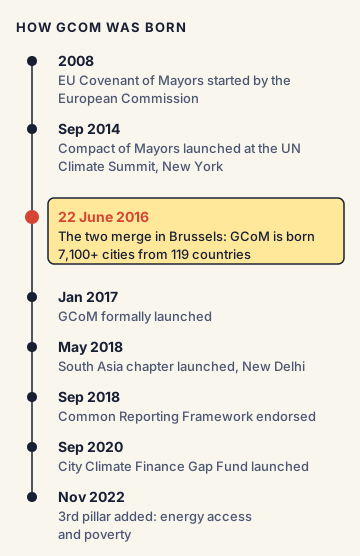
- EU Covenant of Mayors (2008): Started by the European Commission to help European towns meet the European Union's 2020 climate and energy targets (including a 20% cut in emissions). Signing cities promised to go beyond these targets.
- Compact of Mayors (2014): Launched in September 2014 at the UN Climate Summit in New York by UN Secretary-General Ban Ki-moon and Michael Bloomberg (then the UN Secretary-General's Special Envoy for Cities and Climate Change), along with three big city networks: C40, ICLEI and UCLG.
The two merged on 22 June 2016 in Brussels, creating an alliance of over 7,100 cities from 119 countries at that time. The new body was formally launched in January 2017. The 2026 Impact Report marks ten years since the merger.
How does a city take part?
Joining is a step-by-step journey:
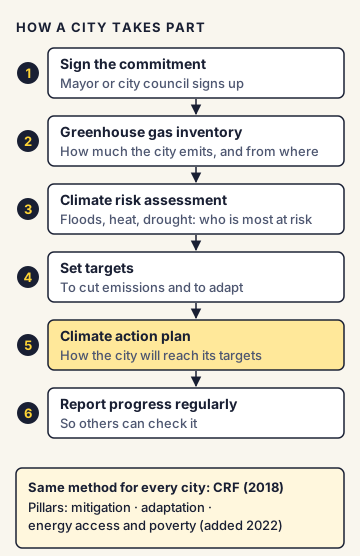
- The mayor or city council formally signs the GCoM commitment.
- The city prepares a greenhouse gas inventory: an account of how much the city emits and from where (transport, buildings, waste and so on).
- It carries out a climate risk and vulnerability assessment: a study of which hazards (floods, heat, drought, sea-level rise) threaten it and who is most at risk.
- It sets targets to cut emissions and to adapt.
- It adopts a climate action plan that explains how it will reach those targets.
- It reports progress regularly, so others can check it.
How is progress measured?
In September 2018, the GCoM Board endorsed a Common Reporting Framework (CRF). This gives every member city in the world the same method to count emissions and report risks. Without it, one city might count airport emissions and another might not, and their numbers could never be compared. The CRF stands on three pillars:
- Mitigation: cutting greenhouse gas emissions.
- Adaptation: preparing for climate impacts like heat and floods.
- Energy access and poverty: making sure people have clean, affordable and reliable energy. This pillar was added to the framework in November 2022, mainly because many cities in Africa and Asia still have homes without proper electricity.
How is it organised?
GCoM works through a global secretariat and a network of regional and national chapters (for example, Europe, Latin America, Sub-Saharan Africa and South Asia). City networks such as ICLEI, C40 and UCLG act as partners and help cities with technical work. Each chapter adjusts the common rules to local conditions.
How does it help cities get money?
Most cities, especially in poor countries, cannot easily borrow money for climate projects. Often they do not even have a well-prepared project to show a bank. So GCoM works with finance partners:
- The City Climate Finance Gap Fund, launched on 23 September 2020 by Germany and Luxembourg with the World Bank, the European Investment Bank and GCoM, gives early-stage technical help so that a city's rough idea becomes a bankable project. One fund is run by the World Bank and one by the European Investment Bank.
- The Cities Climate Finance Leadership Alliance (CCFLA) tracks how much climate money flows to cities and pushes for more.
India's position and Indian examples
GCoM's South Asia chapter was launched in New Delhi in May 2018, with ICLEI South Asia as its technical coordinator and support from the European Union. Surat and Gangtok committed at the launch. Many Indian cities have since joined, including Mumbai (which joined in February 2020), Kochi, Dharamshala, Bhavnagar, Jamnagar and Junagadh. Ahmedabad's mayor has served on the GCoM global board. India also has its own city climate tools:
- ClimateSmart Cities Assessment Framework (CSCAF): launched in 2019 by the Ministry of Housing and Urban Affairs to rate Indian cities on climate action across areas like energy, green cover, mobility, water and waste.
- Heat Action Plans: Ahmedabad made South Asia's first heat action plan in 2013, after a deadly heatwave in 2010. Many Indian cities and states now have one.
Commonly confused concepts
- GCoM vs C40: C40 is a smaller network of nearly 100 of the world's largest cities (founded in 2005). GCoM is a much bigger alliance of about 14,000 cities and towns of all sizes, and C40 is one of its partners.
- GCoM vs ICLEI: ICLEI (Local Governments for Sustainability, founded in 1990) is a membership network that gives cities technical help on many sustainability issues. GCoM is a climate pledge alliance. ICLEI helps cities meet their GCoM commitments.
- GCoM vs UNFCCC: The UNFCCC is a legally binding treaty between countries. GCoM is a voluntary alliance of cities and is not a treaty. City pledges are not part of the formal UN negotiations.
- City targets vs NDCs: A Nationally Determined Contribution (NDC) is a country's official climate pledge under the Paris Agreement. City targets under GCoM are separate and voluntary, though a city's actions help its country meet its NDC.
Issues, criticism and the way forward
- Money gap: Cities in developing economies receive about US$6 billion a year against a need of about US$147 billion a year by 2030. Very little of the money reaches adaptation.
- Weak powers: In many countries, including India, cities do not control electricity, public transport or land use. State or national governments do. So a mayor may make a promise that the city cannot fully deliver.
- Pledges vs action: Signing up is easy; delivery is hard. Many members are still at the early stages (inventory or risk study) and have not finished an action plan.
- Data and capacity: Small towns often lack trained staff and reliable data to count emissions or study risks.
- Way forward: Experts suggest giving cities direct access to climate funds, building more "bankable" projects, including city voices in national climate plans (NDCs), and strengthening local data. GCoM says its next phase will focus on finance, data, innovation and partnerships.
Concepts to Know
- Greenhouse gas inventory: A list showing how much greenhouse gas an area releases and from which sources, like a family writing down where every rupee of its monthly budget goes.
- CO2 equivalent (CO2e): A common unit that converts all greenhouse gases (like methane) into the amount of carbon dioxide that would cause the same warming. It lets us add different gases together.
- Gigatonne: One billion tonnes.
- Mitigation: Actions that cut the gases causing climate change, like using solar power instead of coal.
- Adaptation: Actions that protect people from climate effects that are already happening, like building better drains or giving early heatwave alerts.
- Net zero: A state where the greenhouse gases a place releases are balanced by the amount it removes from the air, so the total added is zero.
- Global South: A term for developing countries, mostly in Asia, Africa and Latin America.
- EU Covenant of Mayors: launched 2008 by the European Commission
- Compact of Mayors: launched September 2014 at the UN Climate Summit (Ban Ki-moon, Michael Bloomberg, C40, ICLEI, UCLG)
- Merger into GCoM: 22 June 2016, Brussels (over 7,100 cities, 119 countries); formal launch January 2017
- Common Reporting Framework endorsed September 2018; three pillars: mitigation, adaptation, energy access and poverty (pillar added November 2022)
- GCoM South Asia chapter: launched May 2018, New Delhi; technical coordinator ICLEI South Asia
- City Climate Finance Gap Fund: launched 23 September 2020 (Germany, Luxembourg, World Bank, EIB, GCoM)
- As of November 2026: about 14,000 members, about one in seven people worldwide
- IPCC: urban areas produced about 67–72% of global CO2 and methane emissions in 2020
● Tracked since November 11, 2026 · last seen November 11, 2026 · updates as the daily brief publishes