Forward Guidance
How Central Banks Signal Their Next Move
Forward guidance is when a central bank tells the public, in advance, what it is likely to do with interest rates in the future. Instead of only announcing today's rate, it gives a hint about tomorrow's. For example, it may say "rates will stay low for a long time" or "we will keep raising rates until inflation comes down". People, banks and markets then plan their borrowing, saving and investing using this hint. In India, the simplest form of forward guidance is the MPC's stance.
Why does it exist?
A central bank directly controls only a very short-term rate, like the overnight repo rate. But home loans, company bonds and fixed deposits depend on what people expect rates to be over many years. If the central bank can shape those expectations, its policy works faster and more strongly. Think of a cricket captain telling the team the plan for the next five overs.
Everyone can prepare, and there are fewer surprises. Guidance also reduces sudden shocks in markets, because big changes are hinted at before they happen.
Where did it come from?
For most of the 20th century, central banks were secretive. Many believed surprise made policy more powerful. This changed from the 1990s, as central banks became more open. A few key steps:
- December 2003: The US Federal Reserve said low rates could be kept "for a considerable period". This is often cited as an early example of modern forward guidance.
- 2008 to 2012: After the global financial crisis, rates in rich countries were already near zero and could not be cut further. Words became a main policy tool. The Federal Reserve gave date-based guidance and, in December 2012, threshold-based guidance: it said rates would stay near zero at least as long as US unemployment stayed above 6.5% and inflation expectations stayed under control.
- January 2012: The Federal Reserve began publishing the "dot plot", a chart showing where each policymaker expects interest rates to be in coming years.
- July 2013: The European Central Bank gave its first explicit forward guidance, saying its rates would stay at present or lower levels "for an extended period of time".
How does it work? The main types
- Qualitative (open-ended) guidance: A general hint without a date or number. "Rates will remain low for as long as necessary."
- Time-based (calendar) guidance: Linked to a time period. "Policy will stay accommodative at least during the current financial year and into the next."
- State-based (threshold or outcome-based) guidance: Linked to economic conditions. "We will not raise rates until unemployment falls below 6.5%" or "until recovery is secure".
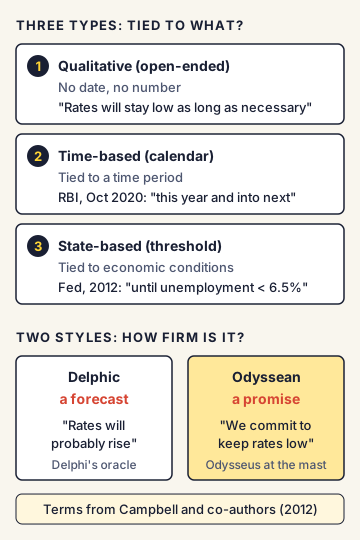
Economists also separate two styles. Delphic guidance is a forecast: "based on what we see, rates will probably rise". Odyssean guidance is a promise: "we commit to keeping rates low, even if inflation rises a little". The names come from a 2012 paper by Campbell and co-authors. "Delphic" refers to the ancient Greek oracle at Delphi, which made predictions; "Odyssean" refers to Odysseus, who tied himself to his ship's mast to keep a promise.
India's position: how the RBI gives guidance
- The stance: With every decision, the MPC announces a stance. The main words used are:
- Accommodative: ready to cut rates or keep them low to support growth.
- Neutral: free to move either way, depending on data.
- Withdrawal of accommodation: focused on taking back earlier easy-money support, to control inflation.
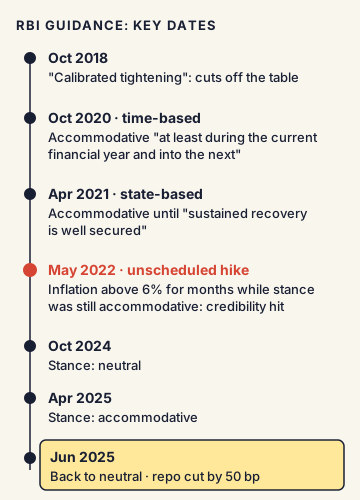
- Calibrated tightening: used by the RBI in October 2018, meaning rate cuts are off the table and hikes may come step by step.
- Time-based guidance in COVID: In October 2020, the MPC said it would keep an accommodative stance "as long as necessary, at least during the current financial year and into the next financial year". In April 2021, it shifted to state-based wording: accommodative until the "prospects of sustained recovery are well secured".
- Recent stance changes: The stance moved to neutral in October 2024, to accommodative in April 2025, and back to neutral in June 2025, when the RBI also cut the repo rate by 50 basis points and said it had "very limited space" left to support growth.
- Other communication tools (legal requirements under the RBI Act):
- Minutes of each MPC meeting, with every member's vote and written statement, are published on the 14th day after the meeting (Section 45ZL). Each member must write a statement explaining their vote (Section 45ZI).
- The Monetary Policy Report is published once every six months. It explains the sources of inflation and gives inflation forecasts for 6 to 18 months ahead (Section 45ZM).
- The Governor's statement and post-policy press conference, along with the RBI's projections of GDP growth and CPI inflation.
Commonly confused concepts
- Stance vs policy rate: The policy rate (repo rate) is today's decision. The stance is a hint about the direction of future decisions. The RBI can, for example, hike the rate while keeping a neutral stance, which signals it is not committing to more hikes.
- Forward guidance vs forecast: A forecast says where inflation or growth is likely to go. Forward guidance says what the central bank is likely to do about it.
- Neutral stance vs neutral rate: A neutral stance is a communication signal. The neutral rate of interest is an economic idea: the rate at which policy neither speeds up nor slows down the economy. They are different things, though both use the word "neutral".
- Withdrawal of accommodation vs tightening: "Withdrawal of accommodation" means removing easy support that was given earlier (for example during COVID). "Tightening" means actively making money costlier beyond a normal level. In practice both can involve rate hikes, but the words signal different intentions.
Issues, criticism and the way forward
- Credibility risk: Guidance works only if people believe it. If a central bank promises one thing and then does another, people stop trusting its words. The RBI faced criticism in 2022, when inflation had stayed above 6% for months while the stance was still accommodative, and it then made an unscheduled rate hike in May 2022.
- Flexibility vs commitment: Strong promises (Odyssean guidance) can trap a central bank if conditions change suddenly, for example after an oil shock. Many central banks now prefer "data-dependent" language that keeps their hands free. Critics say this gives too little guidance at all.
- Confusing words: Terms like "calibrated tightening" or "withdrawal of accommodation" are hard for ordinary people to understand. Some experts suggest that the RBI explain its stance in plainer language, or publish a projected path for rates, as some central banks do.
- Mixed signals: If the vote is split, or if the Governor's comments differ from the written stance, markets can read the guidance in different ways.
Concepts to Know
- Expectations: What people believe will happen in the future. In monetary policy, expected interest rates and expected inflation shape today's decisions on loans, savings and prices.
- Accommodative policy: A policy of low interest rates and plenty of money in the system, meant to support growth.
- Data-dependent: A central bank decides each meeting based on the latest numbers on inflation and growth, rather than following a fixed plan.
- Dot plot: A chart published by the US Federal Reserve where each dot shows one policymaker's view of where interest rates should be at the end of coming years.
- Basis point: One-hundredth of a percentage point. 25 basis points = 0.25%.
- Forward guidance types: qualitative (open-ended), time-based (calendar), state-based (threshold); styles: Delphic (forecast) vs Odyssean (commitment), terms from Campbell et al. (2012)
- US Fed: "considerable period" language (December 2003); dot plot first published January 2012; 6.5% unemployment threshold (December 2012)
- ECB: first explicit forward guidance in July 2013
- RBI time-based guidance: October 2020; shifted to state-based guidance: April 2021
- RBI stance: neutral (October 2024) → accommodative (April 2025) → neutral (June 2025)
- RBI Act: Section 45ZI (members' written statements), Section 45ZL (minutes on the 14th day), Section 45ZM (Monetary Policy Report every six months, with 6 to 18 month inflation forecasts)
● Tracked since October 07, 2026 · last seen October 07, 2026 · updates as the daily brief publishes