Foreign Exchange Risk Reserve (FERR)
A Foreign Exchange Risk Reserve (FERR) is a cash deposit that a central bank asks banks to keep when they sell foreign currency for the future against the home currency. The bank earns nothing on this deposit. Because the money is locked up, the bank's cost goes up, and it passes that cost to the customer. So buying dollars in advance becomes more costly, and fewer people rush to buy dollars when the home currency is falling.
Why does it exist?
When a currency starts falling, people expect it to fall more. Importers rush to lock in dollars early, and speculators bet on a further fall. This extra demand for dollars pushes the currency down even faster, like a crowd running to a ration shop on rumours of a shortage. A central bank can sell dollars from its reserves to calm the market, but reserves are limited.
A risk reserve attacks the problem from the demand side: it makes dollar buying through forward contracts costlier, without spending reserves.
Where did it come from?
The best-known example is China. In August 2015, the People's Bank of China (PBoC), China's central bank, announced a 20% foreign exchange risk reserve on banks' forward sales of foreign currency. It took effect on 15 October 2015, soon after China devalued the yuan in August 2015. China later used the ratio like a switch:
- Suspended it in September 2017.
- Brought it back at 20% in August 2018, when the yuan was falling.
- Cut it to zero from 12 October 2020, when the yuan was rising fast.
- Raised it again to 20% in September 2022.
- Cut it to zero from 2 March 2026, to slow down a rising yuan.
India brought in its own FERR in October 2026, during a period of heavy pressure on the rupee.
How does it work in India?
Think of it as a "security deposit" the bank must leave with the RBI for each covered deal.
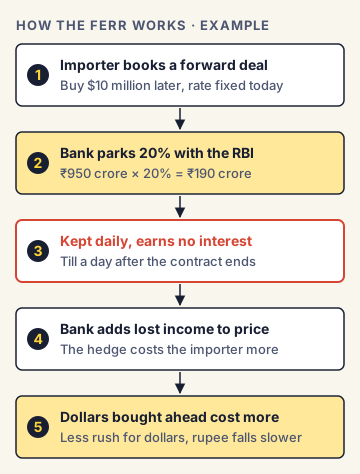
- A customer, such as an importer, books a contract with an authorised dealer bank to buy dollars at a fixed rate on a future date.
- If the deal meets the conditions, the bank must deposit 20% of the rupee value of the notional amount in its current account with the RBI.
- The bank keeps this amount every day, from the working day after the contract is made until a day after the contract ends.
- The money earns no interest, so the bank includes this cost in the price it charges the customer.
A simple example
Suppose an importer books a contract to buy $10 million, and $1 equals about ₹95. The rupee value is ₹950 crore. The bank must park 20% of this, about ₹190 crore, with the RBI for the life of the contract. ₹190 crore of the bank's money is stuck there and cannot be lent out to earn interest. That lost income is the "cost" the bank passes on.
Which customer contracts are covered?
All of these conditions must be met:
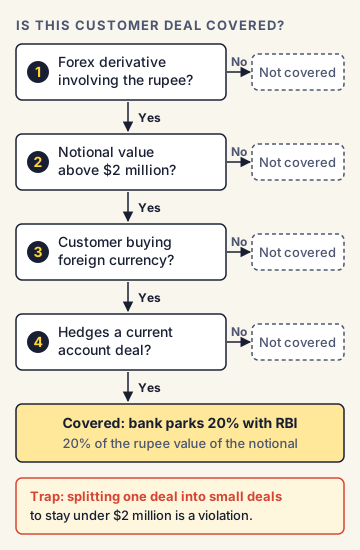
- The contract is a foreign exchange derivative that involves the Indian rupee (INR).
- Its notional value is above $2 million (or the equal amount in another currency). Splitting one deal into many smaller deals with one or more banks to stay under $2 million is treated as a violation.
- The customer is buying foreign currency against the rupee.
- The contract hedges a current account transaction (for example, payment for imports of goods or services).
What is left out?
- Contracts where the customer sells foreign currency (for example, an exporter selling future dollar earnings).
- Contracts that do not involve the rupee (say, dollar against euro).
- Hedges of capital account transactions (such as repaying a foreign loan or making a foreign investment).
- Hedges of interest on external commercial borrowings (ECBs), coupons on Indian debt held by non-residents and dividends to non-resident investors. Under FEMA these payments count as current account items, but they come from capital account deals, so the RBI has kept them out.
- Banks' market-making and proprietary (own trading) positions. For banks, the reserve covers only their hedges of their own assets and liabilities that involve buying foreign currency against the rupee, with no minimum size.
How is it different from the CRR?
Both are cash kept with the RBI that earns no interest. But they are separate:
- The CRR is a share of a bank's deposits (its Net Demand and Time Liabilities). It is a general monetary tool that controls how much money banks can lend.
- The FERR is a share of specific currency contracts. It targets only dollar demand through derivatives.
- A bank's daily balance with the RBI must cover the CRR, the FERR and any other cash reserve, all together.
India's wider toolkit on the rupee
The FERR is one of several steps the RBI took in October 2026:
- Banned the rebooking of rupee derivative contracts once they are cancelled, while still allowing roll-over on maturity.
- Cut the limit for hedging without showing an underlying exposure from $100 million to $5 million (both with banks and on stock exchanges).
- Required customers to give an undertaking that the same exposure has not been hedged with another bank.
- Limited rupee non-deliverable derivatives offered to non-residents to hedging only.
- Opened a special window to supply dollars to the three state-run oil companies (IOC, HPCL and BPCL), so their large dollar buying moves away from the open market.
Commonly confused concepts
- FERR vs Cash Reserve Ratio (CRR): CRR is linked to a bank's deposits and controls overall money supply. FERR is linked to specific foreign exchange contracts and controls dollar demand.
- FERR vs forex reserves: Forex reserves are the dollars, gold and other foreign assets held by the RBI. The FERR is rupee cash that commercial banks deposit with the RBI. It is not part of India's forex reserves.
- FERR vs Liquidity Coverage Ratio (LCR): LCR asks banks to hold enough safe, easily sold assets to survive 30 days of stress. FERR money is locked and cannot be counted towards the LCR.
- Current account vs capital account transaction: Paying for imports is current account. Repaying a foreign loan or buying a foreign company is capital account. The FERR covers only current account hedges (with the exceptions above).
- Forward contract vs spot deal: A spot deal settles now (usually in two working days). A forward contract fixes the rate today for a future date. The FERR targets forward-type derivatives, not spot purchases.
Issues, criticism and the way forward
- Higher cost for genuine importers: Importers of oil, electronics, machinery and fertiliser have real dollar bills to pay. A costlier hedge raises their costs, and some of this may reach consumers as higher prices.
- Less hedging, more risk: If hedging becomes too costly, some firms may leave their dollar bills unhedged. If the rupee then falls sharply, they can face large losses.
- Short-term relief only: Analysts point out that the FERR treats the symptom (rush for dollars), not the causes, such as a high crude oil bill, a wide current account deficit and foreign investment outflows.
- Market depth: Tight rules can push some activity to offshore markets such as the non-deliverable forward (NDF) market, where the RBI has less control.
- The way forward: Experts generally suggest using such tools for a short period, clearly explaining when they will be withdrawn, and pairing them with lasting fixes: boosting exports, attracting stable long-term foreign investment and reducing oil import dependence. China's practice of switching the ratio on and off as conditions change is often cited as an example of using it as a temporary tool.
Concepts to Know
- Foreign exchange derivative: A contract whose value depends on an exchange rate, such as a forward, a swap or an option. Firms use it to fix or limit the rate they will pay or receive in the future.
- Hedging: Protecting yourself from a future price change. An importer who fixes today the rate at which it will buy dollars in three months is hedging.
- Notional value: The face amount of the contract. In a contract to buy $10 million, the notional value is $10 million, even though no money changes hands on day one.
- Authorised dealer (AD): A bank or institution that the RBI has allowed to deal in foreign exchange under FEMA.
- Speculation: Buying or selling only to profit from a price change, without any real trade or payment behind it.
- Liquidity Coverage Ratio (LCR): A global banking rule (Basel III) that asks banks to hold enough high-quality liquid assets, such as cash and government bonds, to meet 30 days of cash outflows in a crisis.
- External Commercial Borrowing (ECB): A loan that an Indian company takes from a foreign lender.
- India's FERR: 20% of the INR equivalent of the notional amount, kept in cash with the RBI daily, earning no interest
- Customer contracts: covered only above $2 million notional, rupee-linked, customer buying foreign currency, hedging a current account transaction
- RBI directions: 10 October 2026 (A.P. (DIR Series) Circular Nos. 25 and 26) and 12 October 2026 (Circular No. 27, banks' own hedges); FAQs on 15 October 2026
- Separate from CRR; not counted as HQLA under the LCR; daily reporting by 5 pm on the next working day
- Same package: hedging limit without proof of exposure cut from $100 million to $5 million; no rebooking of cancelled rupee contracts
- China's PBoC: 20% risk reserve from 15 October 2015; suspended 2017; back in 2018; zero from 12 October 2020; 20% from September 2022; zero from 2 March 2026
● Tracked since October 15, 2026 · last seen October 15, 2026 · updates as the daily brief publishes