Food vs Fuel Debate
Biofuels and Food Security
The food vs fuel debate is about one simple question: should crops and land be used to feed people and animals, or to make fuel for vehicles? When crops like sugarcane, maize or rice are turned into ethanol, less of them is left for food, and their prices can rise. Supporters of biofuels say they cut oil imports and help farmers. Critics say they can make food costlier, use scarce water and push up prices for the poor.
Why does this debate arise?
Land, water and crops are limited. Imagine a family farm that grows maize. It can sell the maize to a poultry farm (as feed), to a food company, or to an ethanol distillery. If the distillery pays more, the maize goes there. This is good for the farmer, but poultry farms and food companies now have to pay more, and the cost reaches the consumer.
Fuel demand is huge and keeps growing, so even a small share of fuel coming from crops can use a very large amount of food.
Where did the debate come from?
The debate became global during the 2007-08 world food price crisis, when prices of wheat, rice and maize shot up and caused protests in many poor countries. At that time, the United States was turning a fast-growing share of its maize into ethanol, and the European Union was promoting biodiesel. Estimates of how much biofuels caused the price spike varied widely.
An International Food Policy Research Institute (IFPRI) estimate put it at about 30% of the rise in grain prices. A leaked World Bank draft gave a much higher figure, but the final World Bank analysis said the effect was smaller than first thought, and also blamed high oil prices and speculation by financial investors. Since then, most countries have tried to put "food security safeguards" into their biofuel policies.
How does it play out in India?
India's ethanol programme first relied mainly on molasses, a by-product of sugar making, which does not hurt food supply. To reach E20, India allowed more feedstocks:
- Sugarcane juice and B-heavy molasses: These take sugar away directly, so in years of low sugar output, the government restricts them (as in December 2023, and again for 2026-27).
- Surplus rice from the Food Corporation of India (FCI): Rice from government stocks was sold to distilleries. In July 2023, these sales were stopped because of food price concerns, and later restored when stocks were comfortable.
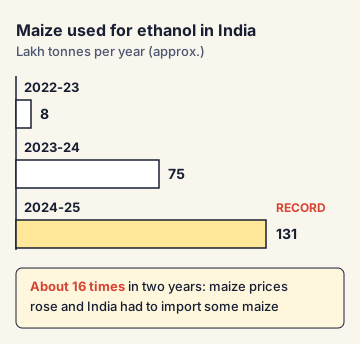
- Maize: It became the biggest single feedstock. Maize use for ethanol rose from about 8 lakh tonnes in 2022-23 to a record of about 131 lakh tonnes in 2024-25. This pushed up maize prices and hurt poultry and starch industries, which use maize as feed and raw material, and India had to import some maize.
What safeguards does India use?
The National Policy on Biofuels, 2018 allows surplus food grains to be used for ethanol only with the approval of the National Biofuel Coordination Committee (NBCC), chaired by the Minister of Petroleum and Natural Gas. The government also uses yearly tender rules (which feedstocks are allowed), feedstock-wise prices and incentives, and rules on FCI rice sales to move ethanol production away from food when supplies are tight.
What about water?
Sugarcane and rice are very thirsty crops. A NITI Aayog and Petroleum Ministry expert committee estimated that one litre of ethanol from sugar needs about 2,860 litres of water. It recommended incentives to source ethanol from less water-intensive crops like maize and from second-generation sources. Other studies give different numbers, because they count irrigation and processing in different ways, but all agree that the water cost is large.
What are the alternatives?
The answer most experts give is second-generation (2G) ethanol, made from things people do not eat:
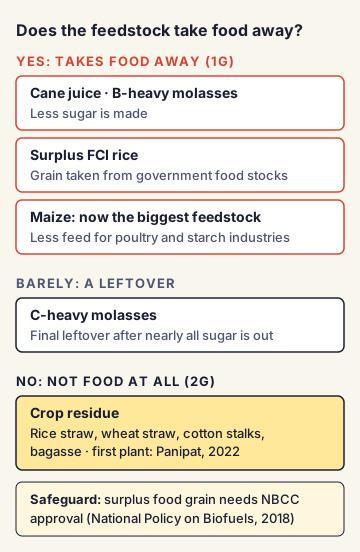
- Crop residue such as rice straw (which is otherwise burnt in fields, causing air pollution in north India), wheat straw, cotton stalks and bagasse (crushed cane fibre).
- India's first 2G ethanol plant, at Panipat (Haryana) by Indian Oil Corporation, was dedicated to the nation on 10 August 2022, which is World Biofuel Day.
- The PM JI-VAN Yojana (2019) gives financial support to set up 2G ethanol projects.
- Other options include compressed biogas from waste (the SATAT scheme), electric vehicles, and better fuel efficiency.
Commonly confused concepts
- First-generation (1G) vs second-generation (2G) biofuels: 1G biofuels come from food crops (cane, maize, rice). 2G biofuels come from non-food plant waste. Third-generation biofuels come from algae.
- B-heavy vs C-heavy molasses: In a sugar mill, sugar is taken out of cane juice in stages. B-heavy molasses comes from an earlier stage and still has a lot of sugar in it, so using it for ethanol means making less sugar. C-heavy molasses is the final leftover after nearly all sugar is taken out, so using it for ethanol barely affects sugar output.
- Ethanol vs biodiesel: Ethanol is an alcohol mixed into petrol. Biodiesel is made from vegetable oils or animal fats and mixed into diesel.
- Food security vs energy security: Food security means everyone can get enough affordable, nutritious food. Energy security means a country can get enough energy at affordable prices. Biofuels help the second but can strain the first.
Issues, criticism and the way forward
- Price pressure: Diverting cane, rice and maize can raise prices of sugar, poultry feed, eggs and meat, which hurts poorer consumers the most.
- Policy swings: Frequent changes in allowed feedstocks and prices make it hard for distilleries to plan investments. Mills that built cane-juice ethanol capacity now face idle plants in bad years.
- Water stress: Pushing water-hungry crops in drought-prone areas like Marathwada can drain groundwater.
- Farmer gains: Supporters point out that ethanol demand has given farmers better and more stable prices for maize and cane, and helped mills pay cane dues faster.
- Way forward: a stable multi-year feedstock policy with clear food-security triggers; more 2G ethanol from crop residue; better maize yields (through improved seeds and irrigation) so that both feed and fuel needs are met; and a careful look at targets beyond E20 based on food and water budgets.
Concepts to Know
- Feedstock: The raw material used to make a product. For ethanol, it means cane, molasses, grains or crop waste.
- Distillery: A factory that ferments sugars or starch with yeast and then separates the alcohol by heating, to make ethanol.
- Fermentation: A natural process in which yeast eats sugar and turns it into alcohol and carbon dioxide.
- Bagasse: The dry, crushed fibre left after juice is squeezed out of sugarcane.
- Food Corporation of India (FCI): The central body that buys food grains from farmers, stores them and supplies them for the public distribution system.
- 2007-08 world food price crisis made food vs fuel a global debate; IFPRI estimated biofuels caused about 30% of the grain price rise
- National Policy on Biofuels, 2018: surplus food grains for ethanol only with National Biofuel Coordination Committee (NBCC) approval
- Maize used for ethanol: about 8 lakh tonnes (2022-23), about 75 lakh tonnes (2023-24), about 131 lakh tonnes (2024-25)
- FCI rice sales to distilleries halted in July 2023, later restored
- NITI Aayog and Petroleum Ministry expert committee: about 2,860 litres of water per litre of sugar-based ethanol
- Panipat 2G ethanol plant dedicated on 10 August 2022 (World Biofuel Day); PM JI-VAN Yojana launched in 2019
● Tracked since April 27, 2026 · last seen October 18, 2026 · updates as the daily brief publishes