Sugar Sector Regulation in India
Sugarcane (Control) Order, FRP and Minimum Selling Price
India's sugar sector is one of the most closely controlled parts of the economy. The government decides the minimum price that sugar mills must pay farmers for sugarcane, the lowest price at which mills can sell sugar, how much sugar can be exported, and even how much cane or sugar can be turned into ethanol. The aim is to protect two groups at the same time: about five crore cane farmers [Unverified] and crores of consumers who buy sugar every day.
Why is sugar so tightly controlled?
Sugar is an "essential commodity" for ordinary households, so a sharp rise in its price hurts the poor. At the same time, sugarcane farmers are a huge group who depend on mills to buy their crop. Sugarcane cannot be stored. Once cut, it must be crushed within a day or two, or it dries and loses sugar.
So a farmer cannot wait for a better price or sell far away. He must sell to the nearest mill. This gives mills strong bargaining power, so the government steps in to protect farmers. The government also manages supply to keep sugar prices stable for consumers.
What is the legal basis?
- Essential Commodities Act, 1955: lets the Centre control the production, supply, price and trade of essential goods. Sugar is one of them.
- Sugarcane (Control) Order, 1966: issued under this Act. It controls the price of sugarcane and the rules of buying it.
- Sugar Price (Control) Order, 2018: introduced the minimum selling price of sugar.
Fair and Remunerative Price (FRP): what mills must pay farmers
The FRP is the minimum price that every sugar mill in India must pay farmers for sugarcane.
- It is fixed by the Centre. The Cabinet Committee on Economic Affairs (CCEA) approves it, based on recommendations of the Commission for Agricultural Costs and Prices (CACP) and after talking to states and industry.
- It replaced the older Statutory Minimum Price (SMP) when the Sugarcane (Control) Order was amended on 22 October 2009.
- The FRP is linked to a basic recovery rate, which is the amount of sugar got from cane. If a mill's recovery is higher, farmers get a premium. If lower, the price is cut, but only down to a floor.
- For the 2026-27 sugar season, the FRP is ₹365 per quintal at a basic recovery of 10.25%. That is 2.81% more than ₹355 in 2025-26. Farmers get ₹3.56 more per quintal for every 0.1 percentage point of recovery above 10.25%. For mills with recovery below 9.5%, there is no further cut: farmers get ₹338.30 per quintal.
The Order lists factors for fixing the FRP. These include the cost of growing cane, returns from other crops, fair prices of sugar for consumers, the sugar recovery rate, money mills earn from by-products (molasses, bagasse and press mud), and a reasonable margin for farmers for risk and profit.
How quickly must mills pay?
Under the Sugarcane (Control) Order, 1966, a mill must pay the farmer within 14 days of getting the cane. If it pays late, it must pay interest at 15% a year for the delay. In practice, unpaid dues to farmers (called cane arrears) are a long-running problem, especially when sugar prices are low.
State Advised Price (SAP): states can pay more
Some states, such as Uttar Pradesh, Punjab and Haryana, announce their own higher cane price, called the State Advised Price. Mills in those states must pay the SAP, which is above the FRP. In U.P. Cooperative Cane Unions Federations v. West U.P. Sugar Mills Association (2004), the Supreme Court held that states can fix an SAP, as long as it is higher than the Centre's minimum price.
Minimum Selling Price (MSP) of sugar: a floor for mills
When sugar prices crashed in 2018, mills could not pay farmers. So the government introduced a Minimum Selling Price of sugar from 7 June 2018 under the Sugar Price (Control) Order, 2018. Mills cannot sell sugar below this price. It was ₹29 per kg at first and was raised to ₹31 per kg from 14 February 2019.
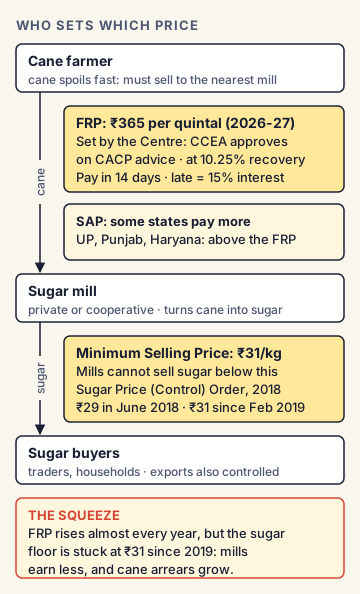
As of October 2026, it has stayed at ₹31 per kg, even though the cane FRP has gone up many times. Mills have been asking for it to be raised to around ₹40 per kg.
The road to partial decontrol
Earlier, mills had to give part of their sugar (called levy sugar) to the government at a low price for the Public Distribution System (ration shops). They could also sell their remaining sugar only in fixed monthly quantities set by the government (the regulated release mechanism). In 2012, a committee led by C. Rangarajan recommended removing these controls.
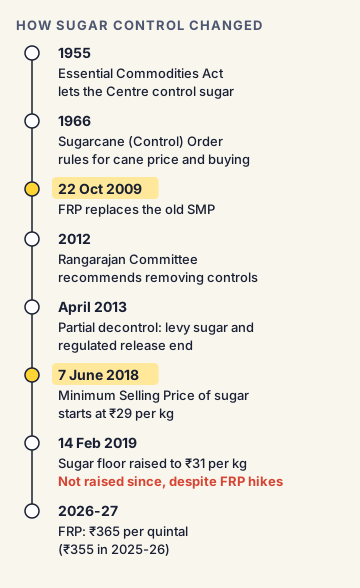
In April 2013, the government partly decontrolled the sector: it ended levy sugar and the regulated release mechanism. States now buy sugar for ration shops from the open market. However, cane pricing (FRP) stayed under control.
Other tools the government uses
- Export controls: The government decides how much sugar can be exported each season, based on stocks.
- Stock limits and monthly sale quotas: used at times to stop hoarding and keep prices steady.
- Ethanol diversion controls: deciding whether mills can use cane juice and B-heavy molasses for ethanol. In December 2023, the government first banned cane juice use for ethanol and then, about a week later, allowed it with a cap of 17 lakh tonnes of sugar diversion for ESY 2023-24. The cap was removed from 1 November 2024.
India's position and Indian examples
India is the world's second-largest sugar producer after Brazil and the largest consumer. Uttar Pradesh, Maharashtra and Karnataka produce most of India's sugar. Maharashtra and Karnataka have many cooperative mills owned by farmers. The sugar season runs from 1 October to 30 September.
Commonly confused concepts
- FRP vs MSP (Minimum Support Price): Both are set by the Centre on CACP advice. But MSP is a price at which the government may buy crops like wheat and rice. FRP is a price that private and cooperative mills must legally pay; the government does not buy sugarcane itself.
- FRP vs SAP: FRP is fixed by the Centre and applies all over India. SAP is fixed by some states and is higher.
- FRP vs SMP: SMP was the old Statutory Minimum Price, replaced by FRP in October 2009.
- Minimum Support Price vs Minimum Selling Price of sugar: The first protects farmers selling crops. The second (₹31 per kg) protects sugar mills by setting a floor on the price at which they sell sugar.
- Sugar season vs Ethanol Supply Year: Sugar season is October to September. ESY is November to October.
Issues, criticism and the way forward
- Price squeeze on mills: Cane prices (FRP) rise almost every year, but the sugar selling price floor has not changed since 2019. This hurts mills' profits and leads to late payments to farmers.
- Cane arrears: Delays in paying farmers are common, despite the 14-day rule.
- Water stress: Sugarcane is a very thirsty crop. Growing it in dry regions like Marathwada worsens water shortages.
- Policy swings: Frequent changes in export and ethanol rules make it hard for mills to plan and invest.
- Sugar vs ethanol balance: In bad crop years, the government must choose between keeping sugar prices low and keeping ethanol supply high.
- Way forward: The Rangarajan Committee had suggested linking cane price to the value of sugar and by-products (a revenue-sharing formula, about 70% of the value to farmers [Unverified]). Experts also suggest a regular review of the sugar minimum selling price, drip irrigation for cane, better cane varieties, and stable, rule-based policies on exports and ethanol.
Concepts to Know
- Recovery rate: The share of sugar got from crushing cane. A 10.25% recovery means 100 kg of cane gives 10.25 kg of sugar.
- Quintal: A unit of weight equal to 100 kg.
- Bagasse: The dry, fibrous material left after juice is squeezed out of cane. It is burned in mills to make electricity.
- Press mud: A soft waste left after cleaning cane juice. It can be used as manure or to make compressed biogas.
- Cane arrears: Money that mills owe farmers for cane but have not yet paid.
- Cabinet Committee on Economic Affairs (CCEA): A committee of senior Union ministers, chaired by the Prime Minister, that takes big economic decisions such as approving crop prices.
- Commission for Agricultural Costs and Prices (CACP): An expert body under the Ministry of Agriculture, set up in 1965, that recommends crop prices to the government.
- Essential Commodities Act, 1955; Sugarcane (Control) Order, 1966; Sugar Price (Control) Order, 2018
- FRP replaced SMP through an amendment to the Sugarcane (Control) Order on 22 October 2009
- FRP 2026-27: ₹365 per quintal at 10.25% recovery (2025-26: ₹355); premium ₹3.56 per quintal per 0.1% extra recovery; ₹338.30 per quintal floor for recovery below 9.5%
- Payment within 14 days of cane delivery; 15% yearly interest on delay
- SAP upheld in U.P. Cooperative Cane Unions Federations v. West U.P. Sugar Mills Association (2004)
- Minimum Selling Price of sugar: introduced 7 June 2018 at ₹29/kg; ₹31/kg from 14 February 2019
- Rangarajan Committee (2012) led to partial decontrol in April 2013: levy sugar and regulated release ended
- Sugar season: October to September
- India: 2nd largest sugar producer (after Brazil), largest consumer
● Tracked since October 05, 2026 · last seen October 05, 2026 · updates as the daily brief publishes