Food Adulteration
Common Adulterants, Health Risks and Detection
Food adulteration means making food worse on purpose or by carelessness, while still selling it as pure. It can mean adding something cheap (water in milk, starch in paneer), adding something harmful (a textile dye in turmeric), or taking out something valuable (removing cream from milk). The substance added is called an adulterant. Adulteration cheats the buyer of money, and in many cases it also harms health.
Why does adulteration happen?
The main reason is profit. Milk, ghee, spices and edible oils are costly, and a small amount of a cheap filler can raise a seller's margin a lot. Demand also jumps in the festival season, when more sweets, ghee and paneer are bought than dairies can honestly supply. Weak checking, and the fact that most buyers cannot test food, make cheating easy.
Where did the fight against it begin?
India's first national law on the subject was the Prevention of Food Adulteration Act, 1954. In 2006, it was replaced by the Food Safety and Standards Act, 2006, which now defines an "adulterant" as any material that is or could be used to make food unsafe, sub-standard, misbranded or containing extraneous matter. The general criminal law (earlier IPC Sections 272 and 273, now Bharatiya Nyaya Sanhita Sections 274 and 275) also treats adulteration of food for sale as an offence.
What are the main types of adulteration?
- Intentional adulteration: done on purpose for profit, like mixing water, starch, chalk powder, cheap oils or colours.
- Incidental adulteration: happens through carelessness, like pesticide residues, insect parts, dust, or hair getting into food.
- Metallic contamination: harmful metals like lead, arsenic or mercury entering food from polluted water, soil, or poor-quality containers.
- Packaging and handling hazards: chemicals leaking from bad packaging, or unsafe ripening methods.
Common adulterants and how they harm you
Here are the cases that appear most often in news and exams:
- Milk: water (reduces nutrition), starch, urea, detergent (to make fake froth and look thick), and hydrogen peroxide or neutralisers (to stop milk from going sour). Detergent and urea can damage the stomach and kidneys.
- Paneer and khoya: starch, and analogue paneer made from vegetable fats and milk powder instead of milk. Analogue paneer is legal only if it is clearly labelled as non-dairy; selling it as real paneer is cheating.
- Ghee and butter: vanaspati (hydrogenated vegetable fat), cheaper animal fats, or mashed potato and starch.
- Turmeric: metanil yellow (a textile dye banned in food, linked to nerve and liver damage) and lead chromate (adds a bright yellow colour; lead harms the brain, especially in children).
- Chilli powder: brick powder, and Sudan dyes (red industrial dyes that the IARC, the WHO's cancer agency, lists as possible causes of cancer).
- Sweets: non-permitted colours, and "silver" leaf made from aluminium instead of silver.
- Fruits: ripening with calcium carbide. When it touches moisture it gives off acetylene gas, and the industrial-grade chemical can carry traces of arsenic and phosphorus. It is banned under Regulation 2.3.5 of the Food Safety and Standards (Prohibition and Restrictions on Sales) Regulations, 2011. Ethylene gas, up to 100 ppm, is the permitted ripening agent.
How can adulteration be detected?
There are two levels:
- Simple home tests: FSSAI's DART booklet (Detect Adulteration with Rapid Test) lists dozens of easy tests. For example, a few drops of iodine turn a paneer or ghee sample blue if starch is present. Chilli powder sprinkled on water leaves coloured streaks if it has a water-soluble dye. Turmeric shows a lasting pink or violet colour with a few drops of hydrochloric acid if metanil yellow is present.
- Laboratory testing: official samples taken by Food Safety Officers go to notified food laboratories, which give a legal report used for penalties or prosecution.
India's position and Indian examples
FSSAI's National Milk Safety and Quality Survey (May to October 2018) tested 6,432 milk samples from all states and union territories. Only 12 samples were found adulterated in a way that made them unsafe (hydrogen peroxide, detergent, urea and a neutraliser). A bigger problem was contamination: 368 samples (5.7%) had aflatoxin M1 above the safe limit, and 77 had antibiotic residues above limits.
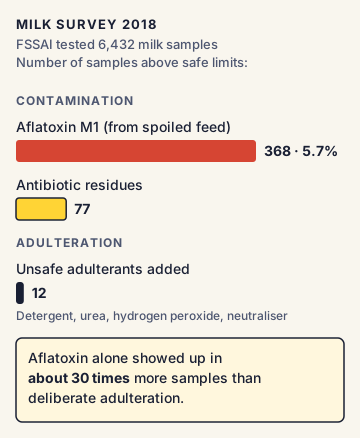
Aflatoxin M1 enters milk when cattle eat feed spoiled by fungus. So the survey showed that unsafe milk is often a problem of contamination and poor feed, not only deliberate cheating. States also run special drives before festivals like Diwali, when seizures of khoya, paneer and sweets rise sharply.
Commonly confused concepts
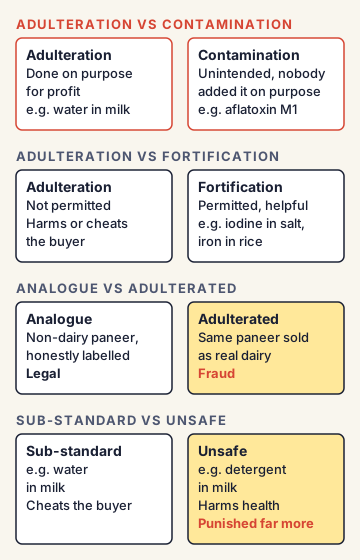
- Adulteration vs contamination: Adulteration is usually a deliberate addition or removal. Contamination is the unintended presence of something harmful, like aflatoxin, pesticides or heavy metals.
- Adulteration vs fortification: Fortification is the permitted and helpful addition of vitamins and minerals (like iodine in salt or iron in rice), following FSSAI standards. Adulteration is unpermitted and harmful or cheating.
- Analogue vs adulterated product: An analogue (like non-dairy paneer) is legal if honestly labelled. It becomes a fraud when it is sold as the real dairy product.
- Sub-standard vs unsafe: Watered milk may be sub-standard (cheats the buyer). Milk with detergent is unsafe (harms health). The law punishes unsafe food far more severely.
Issues, criticism and the way forward
- Health burden: Long-term intake of adulterants like lead, dyes and urea can cause organ damage and cancer, and hurts children the most.
- Consumer awareness is low: Most buyers do not know simple tests or how to complain.
- Gaps in testing: Too few labs, slow reports and a small number of officers make it hard to catch offenders in time.
- Informal supply chains: Loose milk, open spices and roadside sweets pass through many hands, making it hard to trace who adulterated the food.
- Way forward: Experts recommend year-round random sampling (not just festival drives), more mobile testing vans and rapid kits, traceability of dairy supply chains, clear labelling of analogue products in shops and restaurant menus, and strong, quick penalties for repeat offenders.
Concepts to Know
- Adulterant: The substance used to adulterate food, for example starch in paneer or dye in turmeric.
- Aflatoxin: A poison made by certain fungi (moulds) that grow on badly stored grain and cattle feed. Aflatoxin M1 is the form that appears in milk when cows eat such feed. It can damage the liver.
- Vanaspati: Vegetable oil that has been hardened by adding hydrogen, which makes it solid like ghee. It is much cheaper than ghee.
- IARC: The International Agency for Research on Cancer, a part of the World Health Organization that classifies substances by how likely they are to cause cancer.
- ppm (parts per million): A way to measure very small amounts. 100 ppm means 100 parts of a gas in one million parts of air.
- First national law: Prevention of Food Adulteration Act, 1954; replaced by the Food Safety and Standards Act, 2006
- Criminal law: IPC Sections 272 and 273, now BNS Sections 274 and 275 (up to 6 months); the FSS Act prevails for the same act (Ram Nath, 2024)
- Calcium carbide for ripening banned under Regulation 2.3.5, FSS (Prohibition and Restrictions on Sales) Regulations, 2011; ethylene allowed up to 100 ppm
- DART: FSSAI's booklet of household tests for adulteration
- National Milk Safety and Quality Survey 2018: 6,432 samples; 12 adulterated; 368 (5.7%) with aflatoxin M1 above limits; 77 with antibiotic residues
- Iodine test: blue colour shows starch in paneer, khoya or ghee
- Metanil yellow (turmeric) and Sudan dyes (chilli) are non-permitted industrial dyes
● Tracked since April 07, 2026 · last seen November 08, 2026 · updates as the daily brief publishes