Fleet Support Ships and Replenishment at Sea
A fleet support ship is a large naval ship that works like a moving petrol pump and supply store for warships. It carries fuel, fresh water, food, ammunition and spare parts. It meets warships in the middle of the ocean and passes these supplies to them while both ships keep sailing. This process is called replenishment at sea. It lets a navy keep its warships far from home for weeks or months without returning to port.
Why does a navy need these ships?
A warship burns a lot of fuel and its crew needs food every day. Without a supply ship, it would have to sail back to a port every few days. That wastes time, makes its movements easy to predict and limits how far it can go. Think of a long road trip with no petrol pumps on the way. You could only drive half your tank's distance and then turn back. A fleet support ship removes this limit.
What do the terms "reach" and "endurance" mean?
- Reach is how far from home a navy can operate.
- Endurance is how long it can stay there.
- A navy that can operate far out in the open ocean for long periods is called a blue-water navy. Supply ships are one of the main things that make a navy blue-water.
Where did the idea come from?
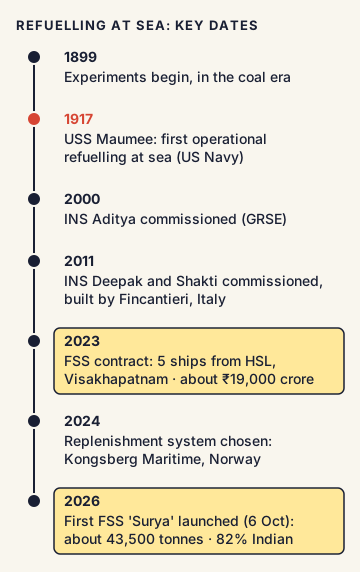
Early navies used coal, and shifting coal between moving ships was slow and dangerous. Experiments began around 1899. Once ships switched to oil, fuel could be pumped through hoses. The United States Navy carried out the first operational refuelling at sea in 1917, when the oiler USS Maumee refuelled destroyers crossing the Atlantic during the First World War.
In the Second World War, this skill let US aircraft-carrier groups stay at sea in the Pacific for very long periods. Since then, every major navy has built supply ships.
How does replenishment at sea work?
There are three main methods:
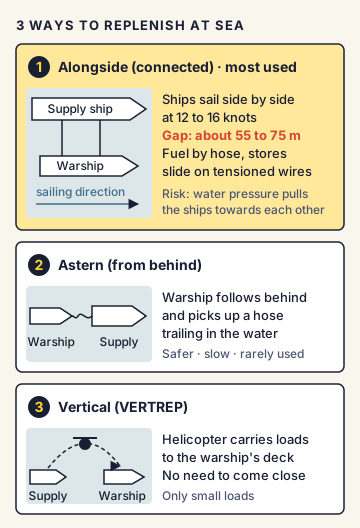
- Alongside (connected) replenishment: The supply ship and the warship sail side by side, in the same direction and at the same speed, usually about 12 to 16 knots. They keep a gap of roughly 60 to 80 yards (about 55 to 75 metres). A thin line is fired across from the supply ship. It is used to pull heavier ropes, cables and fuel hoses across. Fuel is then pumped, and boxes of stores slide across on tensioned wires.
- Astern refuelling: The warship follows directly behind the supply ship and picks up a hose that trails in the water. It is safer from collision but slow, so it is rarely used now.
- Vertical replenishment (VERTREP): A helicopter carries loads from the supply ship to the deck of the warship. There is no need to come close, but a helicopter can lift only small loads.
The alongside method needs great skill. Two large ships moving close together create water pressure between them that can pull them towards each other. Both captains must hold their course and speed very precisely.
Fleet tanker vs fleet support ship
A fleet tanker (also called an oiler) mainly carries fuel. A fleet support ship or replenishment ship carries fuel plus food, water, ammunition and spares, so it can meet almost all of a warship's needs in one visit. Some also have repair workshops, hospitals and a deck for a helicopter.
India's earlier supply ships
Before this new class, the Indian Navy's main replenishment ships were:
- INS Jyoti: a Komandarm Fedko-class replenishment oiler built in Russia, serving with the Eastern Naval Command.
- INS Aditya: built by Garden Reach Shipbuilders and Engineers (GRSE), Kolkata, and commissioned on 3 April 2000. It is a longer version of the Deepak-class design, with a workshop and four replenishment stations.
- INS Deepak and INS Shakti (Deepak class): about 27,500 tonnes each, built by Fincantieri of Italy and commissioned in 2011. This was the first time India chose a foreign company to build a surface ship of this kind for its navy.
These ships were few, and some are old. With more warships and an aircraft carrier group now operating, the Navy needed bigger and more modern supply ships.
The new Fleet Support Ship (FSS) programme: key facts
- Contract: signed on 25 August 2023 with Hindustan Shipyard Limited, Visakhapatnam, for five ships, worth about ₹19,000 crore.
- Size: about 43,500 to 45,000 tonnes displacement, about 230 metres long. These will be among the largest ships of the Indian Navy.
- Design: an Indian design. A Turkish design partner was planned at first but was dropped in 2023, and the design work was done in India.
- Equipment: the replenishment-at-sea system was selected from Kongsberg Maritime of Norway in 2024. The ships can carry one helicopter.
- Indigenous content: about 80% or more; the first ship has about 82%.
- Timeline: the first ship was due for delivery about four years after the contract, with the rest following at intervals of roughly a year.
Why does this matter for India's strategy?
The Indian Ocean is large, and India wants to be the first responder in the region. Supply ships let Indian warships stay on anti-piracy patrol in the Gulf of Aden, escort merchant ships near the Strait of Hormuz, or carry relief to a disaster-hit island country. During humanitarian missions, a supply ship can also carry water and food for people on land. A strong supply fleet is also needed to support aircraft-carrier groups far from home.
The industrial angle
Building a ship this large in India supports steel makers, engine and pump suppliers, electronics firms and many small and medium enterprises. HSL is a Defence Public Sector Undertaking (DPSU) under the Ministry of Defence. Its new slipway and crane mean it can now take on large ships for both the Navy and the commercial market.
Commonly confused concepts
- Launching vs commissioning: Launching is when the empty hull first goes into the water. Commissioning is when the finished ship formally joins the Navy and gets the prefix "INS" (Indian Naval Ship). There is usually a gap of a year or more between the two.
- Keel laying vs steel cutting: Steel cutting is when the first steel plate is cut for the ship. Keel laying is the formal start of joining the ship's main structure on the slipway.
- Displacement vs deadweight tonnage: Displacement is the total weight of the ship (equal to the weight of water it pushes aside). Deadweight is how much cargo, fuel and stores it can carry.
- Fleet support ship vs logistics agreements: A supply ship gives the Navy its own floating supply base. Logistics agreements such as LEMOA (with the US) let Indian ships refuel at a partner's bases. Both extend reach, but in different ways.
Issues, criticism and the way forward
- Delays: Large Indian shipbuilding projects have often run late. A long gap between ordering and delivery leaves the Navy short of supply ships.
- Imported parts: Even with high Indian content, some key systems, such as engines and the replenishment rigs, still come from foreign firms.
- Vulnerability: Supply ships are big and lightly armed, so they need protection from warships during conflict.
- Way forward: Experts suggest building more such ships in series, raising Indian content in engines and pumps, and growing shipyard capacity so delivery timelines stay short.
Concepts to Know
- Knot: A unit of speed at sea. One knot is one nautical mile per hour, about 1.85 kilometres per hour.
- Nautical mile: A distance used at sea, equal to 1.852 kilometres.
- Hull: The main body or shell of a ship, the part that sits in the water.
- Slipway: A sloping platform near the water on which a ship is built. When the hull is ready, it slides down the slipway into the sea.
- Indigenous content: The share of a product's value (parts, materials, services) that comes from within the country.
- Defence Public Sector Undertaking (DPSU): A company owned by the government that makes defence equipment, such as HSL, Mazagon Dock or GRSE.
- First operational refuelling at sea: US Navy, 1917 (USS Maumee)
- Three methods: alongside (connected), astern, vertical (helicopter)
- FSS contract: 25 August 2023, HSL Visakhapatnam, 5 ships, about ₹19,000 crore
- FSS-1 'Surya': launched 6 October 2026, about 43,500 tonnes, about 82% indigenous content
- Earlier ships: INS Deepak and INS Shakti (Fincantieri, Italy, 2011), INS Aditya (GRSE, 2000), INS Jyoti (built in Russia)
● Tracked since October 06, 2026 · last seen October 06, 2026 · updates as the daily brief publishes