Flag Code of India, 2002
The Flag Code of India, 2002 is a set of rules that tells citizens, governments and organisations how to use, show and respect the national flag, the Tiranga. It explains how the flag should be hoisted, where it can be flown, what must never be done with it, and how it is shown at government buildings, on vehicles and at events.
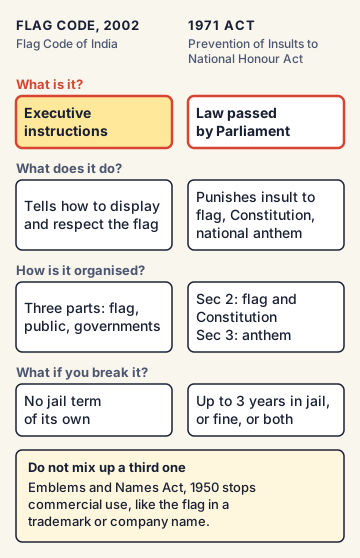
It is an executive set of instructions of the Union government, not a law made by Parliament. The law that punishes insult to the flag is a separate one: the Prevention of Insults to National Honour Act, 1971.
Why does it exist?
The national flag stands for the whole nation: its freedom struggle, its unity and its people. Rules are needed so that the flag is treated with dignity everywhere in the same way. Before 2002, ordinary citizens were not allowed to fly the flag freely on any day; only government offices could, on fixed occasions. People wanted the right to show the flag as a sign of pride. The 2002 Code opened up flag use to citizens while keeping rules of respect.
Where did it come from?
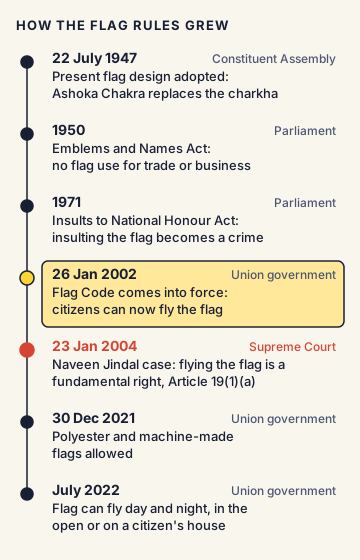
- 22 July 1947: The Constituent Assembly adopted the present design of the national flag, with Dr Rajendra Prasad in the chair. It became the flag of the Union of India on 15 August 1947. The design grew out of the earlier Swaraj flag, which was based on a design proposed by Pingali Venkayya. In 1947 the spinning wheel (charkha) at the centre was replaced with the Ashoka Chakra.
- 1950: The Emblems and Names (Prevention of Improper Use) Act, 1950 stopped the use of the flag and other national symbols for trade and business purposes.
- 1971: Parliament passed the Prevention of Insults to National Honour Act, 1971.
- Earlier, flag use was guided by scattered executive instructions. In 2002, these were brought together into one Flag Code, which came into force on 26 January 2002.
- 23 January 2004: In Union of India v. Naveen Jindal, the Supreme Court held that the right to fly the national flag freely, with respect and dignity, is a fundamental right under Article 19(1)(a) (freedom of speech and expression). The right is not absolute. It can be limited by reasonable restrictions under Article 19(2), and the Flag Code's rules of respect must be followed.
- 30 December 2021: An amendment allowed flags to be made of machine-made and polyester cloth, besides hand-spun and hand-woven khadi.
- July 2022: Another amendment allowed the flag to be flown day and night when it is displayed in the open or on a citizen's house. Earlier, it could be flown only from sunrise to sunset. This came alongside the Har Ghar Tiranga campaign of 2022.
How is the Code organised?
It has three parts:
- Part I: a general description of the national flag (colours, shape, size).
- Part II: rules for display by members of the public, private organisations and educational institutions.
- Part III: rules for display by Union and state governments and their bodies.
Key facts about the flag (from the Code)
- Shape: rectangular, with a width-to-length ratio of 2:3 (often written as 3:2 length to width).
- Colours: three equal horizontal bands: saffron at the top, white in the middle, green at the bottom.
- Centre: the Ashoka Chakra in navy blue, with 24 spokes, printed or painted on the white band.
- Cloth: hand-spun and hand-woven or machine-made, of cotton, polyester, wool, silk or khadi bunting (after the 2021 amendment).
- The Karnataka Khadi Gramodyoga Samyukta Sangha at Bengeri, Hubballi (Karnataka), set up in 1957, is widely reported as the only unit certified by the Bureau of Indian Standards (BIS) to make khadi national flags.
Key rules of respect
- The flag must be given a place of honour and be clearly seen. A damaged or dishevelled flag must not be displayed.
- It must not touch the ground or water.
- It must not be flown upside down (saffron must be at the top).
- No other flag may be placed higher than or above the national flag, or side by side with it as an equal.
- It must not be used as drapery, as a costume below the waist, or printed on cushions, napkins or underwear.
- No lettering may be written on it.
- It may be flown at half-mast only on government orders, as a sign of mourning.
- A damaged flag should be destroyed privately, preferably by burning or another dignified method.
The 1971 Act: the law behind the Code
The Prevention of Insults to National Honour Act, 1971 makes it a crime to insult national symbols.
- Section 2: Whoever, in a public place or in public view, burns, mutilates, defaces, destroys, tramples upon or shows disrespect to the national flag or the Constitution, by words or acts, can be jailed for up to three years, or fined, or both. Criticism of the Constitution or the flag, or lawful steps to amend the Constitution or change the flag, are not offences.
- Section 3: Intentionally stopping the singing of the national anthem or disturbing a gathering singing it is punishable with up to three years in jail, or fine, or both.
- Section 3A: a higher minimum punishment for repeat offenders.
- In 2026, Parliament passed an amendment that extends similar protection to the national song, Vande Mataram.
Can a state have its own flag?
This is the question in today's news, and UPSC loves it.
- The Constitution has no article that allows a state flag, and no article that forbids one. It is silent.
- The national flag is the only flag of the Union. The Flag Code says no flag may be flown higher than or equal to it.
- Jammu and Kashmir was the only state with an official flag, because its own Constitution (under Article 370) provided for it. When its special status ended in August 2019, that flag lost legal standing.
- Karnataka unveiled a proposed state flag (the Nada Dhwaja, yellow-white-red with the Gandaberunda emblem) in March 2018 and sent it to the Centre. The Ministry of Home Affairs said there is no provision for a separate flag for a state, and the proposal was later dropped.
- Tamil Nadu proposed one in 1970; it too was not adopted.
- Some states use unofficial cultural flags (like Karnataka's red-yellow Kannada flag) at festivals, but these have no legal status.
Article 51A(a): the citizen's duty
The first Fundamental Duty asks every citizen to abide by the Constitution and respect its ideals and institutions, the national flag and the national anthem. This duty was added by the 42nd Amendment Act, 1976. Duties are not directly enforceable in court, but courts use them to interpret laws.
Commonly confused concepts
- Flag Code vs Prevention of Insults Act: The Flag Code is executive instructions (rules of how to display). The 1971 Act is a law passed by Parliament (punishment for insult).
- Flag Code vs Emblems and Names Act, 1950: The 1950 Act stops commercial misuse of national names and symbols (for example, using the flag in a trademark or company name). The Flag Code deals with how to display the flag.
- National Flag Day vs Armed Forces Flag Day: 22 July marks the adoption of the national flag in 1947. Armed Forces Flag Day (7 December) is for raising funds for soldiers' welfare.
- Hoisting vs unfurling: On Independence Day (15 August), the Prime Minister hoists the flag (pulls it up from the bottom of the pole). On Republic Day (26 January), the President unfurls it (the flag is already tied at the top and is opened).
- State emblem vs national flag: The State Emblem (the Lion Capital of Sarnath) is a separate national symbol, protected by the State Emblem of India (Prohibition of Improper Use) Act, 2005.
Issues, criticism and the way forward
- Is the Code law? Because the Flag Code is executive instructions, some argue it cannot be enforced in the same way as a law. Courts have said it must still be followed as a guide to respectful use.
- Polyester vs khadi: Khadi weavers and the Hubballi unit said the 2021 change hurt their livelihoods and the link between the flag and khadi from the freedom movement. Supporters said cheaper flags make it easier for every household to fly one.
- Free speech balance: Some argue that punishing "disrespect" may limit protest. The 1971 Act therefore excludes criticism and lawful change from its scope.
- State flags and identity: Supporters of state flags say they express regional pride, like US states or Swiss cantons. Others argue a single flag better expresses national unity. A clear national policy on symbolic regional flags, consistent with the Flag Code, could settle such demands.
Concepts to Know
- Executive instructions: Rules issued by the government without a law passed by Parliament. They guide officials and the public but are not an Act.
- Fundamental right: A basic right in Part III of the Constitution that courts can enforce. Article 19(1)(a) gives freedom of speech and expression.
- Reasonable restrictions (Article 19(2)): Limits the state can place on free speech for reasons like sovereignty, public order, decency or contempt of court.
- Half-mast: Flying the flag halfway down the pole as a mark of mourning.
- Canton: The upper corner of a flag nearest the pole.
- Flag design adopted by the Constituent Assembly: 22 July 1947
- Flag Code of India came into force: 26 January 2002; three parts
- Union of India v. Naveen Jindal (23 January 2004): flying the flag with respect is a fundamental right under Article 19(1)(a), subject to Article 19(2)
- Flag ratio 2:3; Ashoka Chakra navy blue, 24 spokes
- December 2021: polyester and machine-made flags allowed; July 2022: flag can fly day and night in the open or on houses
- Prevention of Insults to National Honour Act, 1971: Section 2 (flag and Constitution) and Section 3 (national anthem), up to 3 years' jail or fine or both
- Article 51A(a): duty to respect the flag (42nd Amendment, 1976)
- No constitutional provision for state flags; J&K's flag ended in 2019; Karnataka proposal 2018 not approved
● Tracked since November 03, 2026 · last seen November 03, 2026 · updates as the daily brief publishes