Extreme Weather Events and Climate Change
An extreme weather event is weather that is much more severe than what is normal for a place and season: a very hot heatwave, very heavy rain, a strong cyclone, a long drought or a sudden flood. Such events have always happened. What has changed is that, as the Earth warms because of human activity, many of them are now happening more often, more strongly and at unusual times. Understanding this link helps a country plan for disasters instead of only reacting to them.
Why does it matter?
Extreme weather kills people, destroys crops and houses, and pushes poor families into debt. In India, where many people depend on farming and work outdoors, even a few days of extreme heat or rain can hurt incomes and food supply. If governments treat each event as a one-time "natural disaster", they keep spending on relief again and again. If they understand the pattern, they can invest in early warning, better buildings and climate-resilient farming.
What counts as "extreme"?
Scientists usually call an event extreme when it is rare for that place, for example in the top 10% or top 1% of all values ever recorded. Weather offices also set fixed thresholds. India's IMD uses these for rain measured over 24 hours:
- Heavy rain: 64.5 mm to 115.5 mm
- Very heavy rain: 115.6 mm to 204.4 mm
- Extremely heavy rain: 204.5 mm or more
IMD also has separate rules for heatwaves (based on how far the day's maximum temperature is above normal, or above fixed levels like 45°C in the plains) and cold waves (based on how far the night's minimum temperature falls below normal).
Weather vs climate
Weather is what happens over hours or days: today's rain, tomorrow's heat. Climate is the average pattern of weather over a long period, usually 30 years. One hot day is weather. A steady rise in the number of hot days over decades is a change in climate. Climate change does not "cause" one single storm by itself, but it changes the odds, like loading a dice so that sixes come up more often.
How does warming make weather more extreme?
There are a few simple reasons:
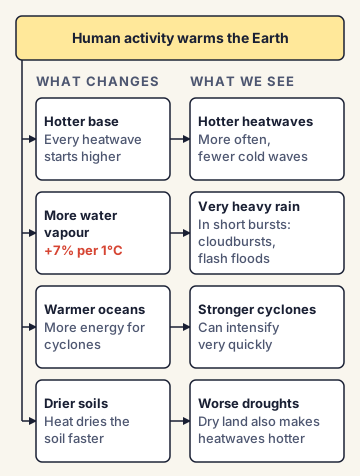
- Hotter base: If the average temperature rises, every heatwave starts from a higher level. So heatwaves become hotter and more frequent, and cold waves become rarer.
- More water vapour: Warmer air can hold more moisture, about 7% more for every 1°C of warming (a rule from physics called the Clausius-Clapeyron relation). When this extra moisture falls, rain comes down in short, very heavy bursts. This is why we see more cloudbursts and flash floods, even in years with normal total rain.
- Warmer oceans: Cyclones draw their energy from warm sea water. Warmer seas can make cyclones stronger and help them intensify very quickly.
- Drier soils: Higher heat dries soil faster, which worsens droughts and makes heatwaves even hotter, because dry land heats up more.
Where did this understanding come from?
The Intergovernmental Panel on Climate Change (IPCC), a UN body set up in 1988, reviews the world's climate science. Its Sixth Assessment Report (Working Group I, August 2021) said it is "unequivocal" (beyond doubt) that human influence has warmed the planet. It also gave clear numbers on heat extremes. A heatwave that happened about once in 50 years in the pre-industrial climate (1850–1900) now happens about 4.8 times in 50 years at today's 1°C of warming.
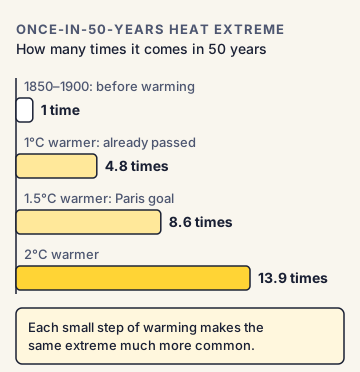
At 1.5°C of warming it would happen about 8.6 times, and at 2°C about 13.9 times. A new science called extreme event attribution grew in the 2000s and 2010s. It uses computer models to compare "today's world" with "a world without human warming" and says how much more likely an event became. The group World Weather Attribution, founded in 2014 by scientists including Friederike Otto and Geert Jan van Oldenborgh, now publishes such studies within days of a disaster.
How warm is the world now?
The World Meteorological Organization (WMO) confirmed that 2024 was the warmest year on record, about 1.55°C above the 1850–1900 average. It was likely the first calendar year above 1.5°C. This does not by itself mean the Paris Agreement's 1.5°C goal has failed, because that goal is measured over about 20 years, not one year. WMO estimated long-term warming at about 1.3°C as of 2024.
India's position and Indian examples
India is one of the countries most exposed to extreme weather because of its long coastline, the monsoon, the Himalaya and a large population that depends on farming.
- Heatwaves: Cities and states prepare Heat Action Plans. Ahmedabad made the first one in South Asia in 2013.
- Floods and cloudbursts: The Himalayan states face cloudbursts, landslides and glacial lake outburst floods.
- Cyclones: Better early warning has sharply cut cyclone deaths along the Odisha and Andhra coasts compared with the 1999 Odisha super cyclone.
- Law and institutions: The Disaster Management Act, 2005 set up the National Disaster Management Authority (NDMA), chaired by the Prime Minister, along with state and district authorities and response funds.
- Climate policy: The National Action Plan on Climate Change (2008) has eight national missions, and states have their own State Action Plans on Climate Change.
- Global framework: India follows the Sendai Framework for Disaster Risk Reduction 2015–2030 (adopted in Sendai, Japan, in March 2015), which has seven targets and four priorities for action. India also leads the Coalition for Disaster Resilient Infrastructure (CDRI), launched in 2019.
Commonly confused concepts
- Weather vs climate: Weather is short-term (hours to days); climate is the long-term average (around 30 years).
- Hazard vs disaster: A hazard is the event itself (a cyclone or heavy rain). It becomes a disaster only when it causes serious loss of lives or property that a community cannot handle on its own. A cyclone over an empty sea is a hazard, not a disaster.
- Mitigation vs adaptation: Mitigation means cutting greenhouse gas emissions to slow warming. Adaptation means adjusting to the changes that are already coming, such as building cyclone shelters or growing heat-tolerant crops.
- Heatwave vs heat stress: A heatwave is defined by air temperature. Heat stress depends also on humidity, which stops sweat from cooling the body. A 38°C humid day on the coast can be more dangerous than a 42°C dry day.
- Attribution vs prediction: Attribution looks back and says how much climate change made a past event more likely. Prediction (forecasting) looks forward to warn about a coming event.
Issues, criticism and the way forward
- Data gaps: India has no single official database of all extreme events and their losses. Deaths from heat, lightning and cold are often under-counted, and reports like this one rely partly on media reports.
- Relief over prevention: Spending has long focused on relief after disasters. The 15th Finance Commission began setting aside separate mitigation funds, which experts say should grow.
- Not all events are "notified" disasters: Heatwaves and lightning are not on the central list of notified disasters for which national relief funds are used, though states can use part of their funds for local disasters.
- Farmers bear heavy losses: Crop damage hits small farmers hardest. Experts call for faster crop insurance payouts and climate-resilient seeds and practices.
- Early warning to the last mile: Warnings must reach people in local languages and in time. The UN's "Early Warnings for All" initiative aims to cover everyone by 2027.
- Way forward: Experts suggest a national loss and damage database, stronger heat and flood action plans at the district level, climate-proof infrastructure, and deeper emission cuts worldwide, because adaptation alone cannot keep up with unlimited warming.
Concepts to Know
- Pre-industrial level: The average global temperature of 1850–1900, before large-scale burning of coal and oil. It is used as the starting line to measure warming.
- IPCC (Intergovernmental Panel on Climate Change): A UN body that collects and reviews scientific research on climate change and publishes big reports every few years. It does not do its own experiments.
- WMO (World Meteorological Organization): The UN agency for weather, climate and water, based in Geneva.
- Cloudburst: Very intense rain over a small area in a short time. IMD uses about 100 mm or more in an hour.
- Paris Agreement (2015): A global climate deal to keep warming well below 2°C and try to limit it to 1.5°C above pre-industrial levels.
- Greenhouse gases: Gases like carbon dioxide and methane that trap heat in the atmosphere, like a blanket around the Earth.
- IMD 24-hour rain: heavy 64.5–115.5 mm, very heavy 115.6–204.4 mm, extremely heavy ≥204.5 mm
- Warmer air holds about 7% more water vapour per 1°C (Clausius-Clapeyron relation)
- IPCC AR6 WG1 (August 2021): a once-in-50-year heat extreme now occurs 4.8 times per 50 years at 1°C, 8.6 at 1.5°C, 13.9 at 2°C
- WMO: 2024 warmest year on record, about 1.55°C above 1850–1900; long-term warming about 1.3°C
- IPCC set up in 1988; World Weather Attribution founded 2014
- Disaster Management Act, 2005; NAPCC, 2008 (8 missions); Sendai Framework 2015–2030 (7 targets, 4 priorities); CDRI launched 2019
- First Heat Action Plan in South Asia: Ahmedabad, 2013
● Tracked since November 04, 2026 · last seen November 04, 2026 · updates as the daily brief publishes