Export Diversification
Why Countries Spread Their Trade Risk
Export diversification means a country selling more kinds of products to more countries, instead of depending on a few products or a few buyers. It is like the old advice: do not put all your eggs in one basket. If one basket falls, you lose everything. If the eggs are spread across many baskets, one fall hurts much less. Countries diversify exports so that a shock in one product or one market does not crash their whole economy.
Why does it matter?
Exports bring in foreign currency, jobs and growth. But if most of a country's exports go to one buyer, that buyer gains great power over it. A sudden tariff, a recession, a ban or a change in tastes in that one market can wipe out orders overnight. The same is true for products. A country that mainly sells one commodity, like oil or copper, suffers badly when world prices of that commodity fall. Diversification makes export earnings steadier, protects jobs, and gives the country more freedom in its foreign policy.
The two types of diversification
Students should learn both:
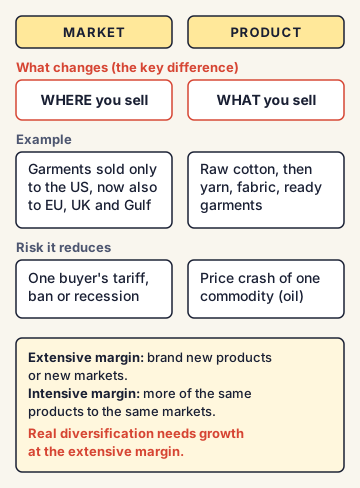
- Market (geographic) diversification: selling the same products to more countries. Example: an Indian garment exporter who sold only to the US starts selling to the European Union, the UK and the Gulf.
- Product diversification: selling new or more varied products. Example: a country moving from exporting raw cotton to exporting yarn, fabric, readymade garments and technical textiles.
Economists also split product diversification into two kinds. The extensive margin means adding brand new products or new markets. The intensive margin means selling more of the products you already export to markets you already serve. Real diversification needs growth at the extensive margin.
Where did the idea come from?
In 1950, two economists, Raúl Prebisch and Hans Singer, separately argued that prices of primary goods (raw materials and farm crops) tend to fall over the long run compared with prices of manufactured goods. This is called the Prebisch-Singer hypothesis. It meant that poor countries exporting only raw materials would keep losing out. So they needed to diversify into manufacturing and higher-value goods.
The idea strongly influenced development thinking in Latin America, Asia and Africa. Later, oil shocks in the 1970s and 1980s, and commodity price crashes, showed again how risky it is to depend on a single export. Gulf countries, for example, now run long-term plans like Saudi Arabia's Vision 2030 (launched 2016) to reduce dependence on oil.
How is it measured?
The most common tool is a concentration index based on the Herfindahl-Hirschman Index (HHI). You take each product's (or each market's) share in a country's total exports, square each share, and add them up.
- If a country exports only one product, the index is 1 (fully concentrated).
- The closer the index is to 0, the more diversified the exports.
UNCTAD publishes a normalised version of this index for every country, worked out over product groups. The same method can be applied to destination markets to see how much a country depends on a few buyers.
A simple example: if 90% of a shop's sales come from one customer, the shop is in danger if that customer leaves. If no customer gives more than 10%, losing one customer is manageable.
How does a country diversify?
There is no single tool. Governments usually combine several:
- Trade agreements that cut tariffs in new markets, so exporters can compete there.
- Export promotion: trade fairs, buyer-seller meets, branding and market information.
- Cheaper trade finance and export insurance, so small firms can take the risk of new buyers.
- Better quality and standards, so goods meet the rules of richer markets (for example, EU safety and labelling rules).
- Better logistics: ports, roads, warehouses and faster customs.
- Industrial policy that helps new sectors grow, such as electronics or green goods.
India's export picture
India's merchandise exports were about US$437 billion in 2024-25. The United States is India's largest export market, taking roughly 18% to 20% of India's goods exports (about US$86.5 billion in 2024-25). Some sectors depend on the US even more. For gems and jewellery, the US took about 31% of India's exports in 2024-25. Textiles and garments also rely heavily on US buyers.
This is why US tariff changes hit these labour-heavy sectors hard. India's top markets also include the UAE, the Netherlands, the UK and China. India's share of world merchandise exports is still under 2%, so there is plenty of room to grow in new markets.
India's main policy tools for diversification
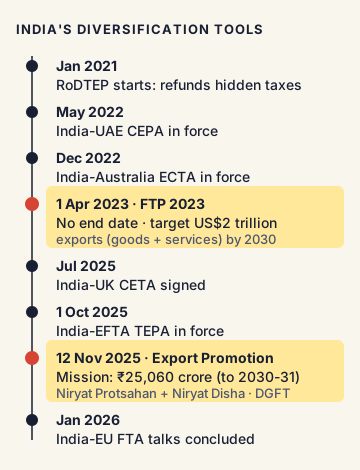
- Foreign Trade Policy (FTP) 2023: announced on 31 March 2023 and in force from 1 April 2023. Unlike earlier five-year policies, it has no end date and is updated when needed. It targets US$2 trillion of exports (goods plus services) by 2030. It also pushes trade settlement in rupees, e-commerce exports, and "Towns of Export Excellence".
- Export Promotion Mission: announced in the Union Budget 2025-26 and approved by the Cabinet on 12 November 2025, with an outlay of ₹25,060 crore for 2025-26 to 2030-31. It has two parts: Niryat Protsahan (cheaper trade finance for small exporters) and Niryat Disha (non-money support like quality compliance, branding, trade fairs, warehousing and market information). The Directorate General of Foreign Trade (DGFT) runs it. Sectors hit by US tariffs, like textiles, leather, gems and jewellery and marine products, get priority.
- RoDTEP (Remission of Duties and Taxes on Export Products): from 1 January 2021, it refunds hidden taxes that exporters pay but cannot otherwise claim back, so Indian goods are not "exporting taxes".
- Districts as Export Hubs: each district identifies products with export potential and gets support to sell them abroad.
- Trade agreements with new partners: for example, the India-UAE CEPA (in force from May 2022), the India-Australia ECTA (in force from December 2022), the India-EFTA TEPA (in force from 1 October 2025), the India-UK CETA (signed July 2025), the India-Oman CEPA (signed December 2025) and the India-EU FTA (talks concluded in January 2026).
Commonly confused concepts
- Export diversification vs import substitution: Diversification means selling more types of goods to more places. Import substitution means making at home what you used to buy from abroad, often behind high tariffs. India followed import substitution for decades before the 1991 reforms.
- Market diversification vs product diversification: Market diversification changes where you sell. Product diversification changes what you sell. A country can be strong in one and weak in the other.
- Export diversification vs economic diversification: Economic diversification is broader. It covers the whole economy's spread across farming, industry and services, not only exports.
- Concentration index vs trade deficit: A concentration index measures how spread out exports are. A trade deficit means a country imports more than it exports. They measure completely different things.
- Extensive margin vs intensive margin: Extensive = new products or new markets. Intensive = more of the same products to the same markets.
Issues, criticism and the way forward
- Big markets are hard to replace: The US is a very large, rich consumer market. No single new market can quickly absorb what Indian exporters sell there. Diversification takes years.
- Small firms struggle most: Many textile and jewellery exporters are small businesses. They lack money and staff to find buyers in new countries or meet new standards.
- Standards and non-tariff barriers: Markets like the EU have strict rules on safety, chemicals, labour and carbon (for example, the EU's carbon border tax, CBAM). These can block entry even after tariffs fall in a trade agreement.
- FTA use is low: Studies have found that Indian exporters often do not use the tariff benefits of FTAs, because of complex rules of origin and paperwork.
- Too much diversification is not the goal: Some experts point out that specialisation also brings efficiency. The aim is not to stop selling to the US, but to reduce the risk of depending on it.
- Way forward: Experts suggest moving up the value chain (from raw diamonds to branded jewellery, from yarn to technical textiles), using FTAs better, cheaper credit and insurance for small exporters, stronger logistics, and growing services and digital exports alongside goods.
Concepts to Know
- Tariff: A tax a country charges on goods coming in from another country. A 100% tariff doubles the price of the imported good at the border.
- Merchandise exports: Exports of physical goods (like clothes or machines), as opposed to services (like IT or tourism).
- Commodity: A basic raw good, such as crude oil, copper, wheat or cotton, that is mostly the same whoever produces it.
- Value chain / moving up the value chain: All the steps in making a product. Moving up means doing the steps that earn more money, like design, branding and finished products, instead of only selling raw material.
- UNCTAD (United Nations Conference on Trade and Development): A UN body set up in 1964 that studies trade and development and publishes trade data for all countries.
- FTA / CEPA / ECTA / TEPA: Different names for trade agreements in which countries cut tariffs on each other's goods. CEPA and TEPA usually also cover services and investment.
- Rules of origin: Rules that decide which country a product "comes from", so that only goods truly made in a partner country get the lower FTA tariff.
- Trade finance: Short-term loans and guarantees that help exporters make and ship goods before the foreign buyer pays.
- Two types: market (geographic) diversification and product diversification
- Prebisch-Singer hypothesis (1950): prices of primary goods tend to fall over time against manufactured goods
- Measured by an HHI-based concentration index: 1 = fully concentrated, near 0 = well diversified; UNCTAD publishes it
- India's merchandise exports in 2024-25: about US$437 billion; US share roughly 18% to 20% (about US$86.5 billion)
- US share of India's gems and jewellery exports in 2024-25: about 31%
- FTP 2023: effective 1 April 2023, no end date, target US$2 trillion exports by 2030
- Export Promotion Mission: ₹25,060 crore for 2025-26 to 2030-31; sub-schemes Niryat Protsahan and Niryat Disha; run by DGFT
- RoDTEP: in place from 1 January 2021
- India-EFTA TEPA in force from 1 October 2025; India-EU FTA talks concluded January 2026
● Tracked since October 17, 2026 · last seen October 17, 2026 · updates as the daily brief publishes