Export Credit Guarantee Corporation of India (ECGC)
India's Export Credit Insurer
Updated 14 Oct 2026: Added ECGC's new Shipbuilding Project Credit Risk Insurance Policy (SbPCP), launched in October 2026 for shipyards building ships for foreign buyers.
The Export Credit Guarantee Corporation, now called ECGC Ltd., is a government-owned company that protects Indian exporters if a foreign buyer does not pay. It sells a special kind of insurance called export credit insurance. If the buyer goes bankrupt, delays payment for too long, or cannot pay because of war or government action in his country, ECGC pays the exporter most of the lost money. It also protects banks that give loans to exporters.
Why does an exporter need it?
Most exports are sold "on credit". The exporter ships the goods today, but the foreign buyer pays 60, 90 or 180 days later. During this time, many things can go wrong far away from India. The buyer's company may shut down. A war may break out. That country may suddenly stop its people from sending dollars abroad.
A small Indian exporter cannot check every buyer in every country, and one unpaid order can wipe out a year's profit. Think of ECGC like a guarantor who stands behind a loan: because it is there, the exporter dares to sell to new buyers and new countries.
Why do banks care?
Banks lend money to exporters before and after shipment. These loans are called pre-shipment credit (money to buy raw material and make the goods) and post-shipment credit (money given against the bill while the exporter waits for payment). If the foreign buyer does not pay, the exporter may not be able to repay the bank. ECGC cover reduces this risk, so banks lend more easily and at lower interest rates.
Where did it come from?
The Government of India set up the Export Risks Insurance Corporation (ERIC) on 30 July 1957, at a time when India badly needed foreign exchange. Its history moved in steps:
- 1957: Export Risks Insurance Corporation (ERIC) set up.
- 1964: Renamed Export Credit and Guarantee Corporation Ltd., as its work grew to include guarantees to banks.
- 1983: Renamed Export Credit Guarantee Corporation of India Ltd.
- 8 August 2014: Renamed ECGC Ltd., the name it uses today.
Who owns and controls it?
ECGC is fully owned by the Government of India. It works under the administrative control of the Ministry of Commerce and Industry and has its head office in Mumbai. Because it is an insurance company, it is also regulated by the Insurance Regulatory and Development Authority of India (IRDAI), under the general insurance category. Its authorised capital is ₹10,000 crore.
In September 2021, the Union Cabinet approved a capital infusion of ₹4,400 crore over five years (from 2021-22) and its listing on the stock exchange through an initial public offering (IPO). More capital lets ECGC take on bigger risks and support more exports.
What risks does it cover?
ECGC divides the risks into two groups:
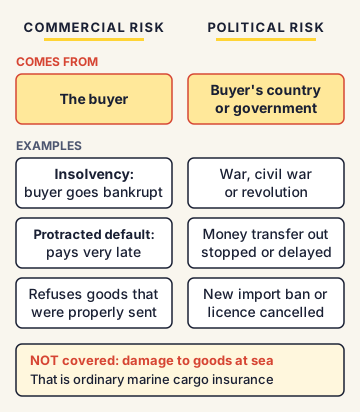
- Commercial risks (problems with the buyer): the buyer becomes insolvent (bankrupt); the buyer fails to pay for a long time, called protracted default; or the buyer refuses to accept goods that were properly shipped.
- Political risks (problems with the buyer's country): war, civil war or revolution; new import bans; the foreign government stopping or delaying the transfer of money out of the country; or cancellation of a valid import licence.
ECGC does not cover risks the exporter can control or insure elsewhere. For example, damage to goods at sea is covered by ordinary marine cargo insurance, not by ECGC.
How does it work?
Here is the simple flow for an exporter:
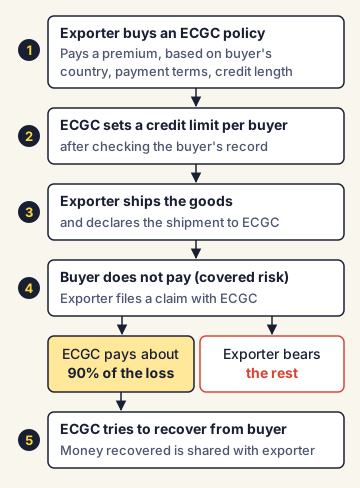
- The exporter buys a policy from ECGC and pays a premium (the fee for insurance). The premium depends on the buyer's country, the payment terms and the length of credit.
- ECGC sets a credit limit for each foreign buyer, after checking the buyer's record.
- The exporter ships the goods and declares the shipment to ECGC.
- If the buyer does not pay because of a covered risk, the exporter files a claim. ECGC pays a fixed share of the loss, usually around 90%. The exporter bears the rest, so he still has a reason to choose buyers carefully.
- After paying, ECGC tries to recover the money from the buyer. Anything recovered is shared with the exporter.
Main types of cover
ECGC sells different products for different users:
- Whole Turnover Policies for exporters: all shipments are covered under one policy. Examples are the Shipment Comprehensive Risk Policy (for exporters with yearly exports above ₹5 crore, usually 90% cover) and the Small Exporters Policy (for turnover up to ₹5 crore, with 95% cover for commercial risks and 100% for political risks).
- Stand Alone Policies for single buyers or single shipments.
- Export Credit Insurance for Banks (ECIB): protects banks against losses on export loans if the exporter cannot repay because of insolvency or protracted default. From 1 October 2025, ECGC offers an enhanced 90% cover to eligible banks on export credit loans up to ₹50 crore, without extra cost.
- Medium and long-term covers for big project exports, like building a power plant or a highway abroad.
- Shipbuilding Project Credit Risk Insurance Policy (SbPCP): protects Indian shipyards that build ships for foreign buyers if the buyer fails to pay. A ship takes years to build, so one unpaid order can sink a shipyard. The Ministry of Ports, Shipping and Waterways launched it on 13 October 2026, under the Shipbuilding Development Scheme (approved by the Union Cabinet in September 2025, with an outlay of ₹19,989 crore). The Centre pays part of the premium and supports the insurer when claims come. For ships ordered by Indian buyers, the matching policy is the Business Credit Shield Policy Shipbuilders (BCSPS) of The New India Assurance Company Ltd.
NIRVIK and NEIA
Two related ideas often appear in exams:
- NIRVIK (Niryat Rin Vikas Yojana) is an Export Credit Insurance Scheme announced in 2019. It proposed raising the cover for banks' export loans up to 90% of principal and interest, for both pre-shipment and post-shipment credit, to make credit cheaper for small exporters.
- NEIA (National Export Insurance Account) Trust was set up in 2006. It supports big project exports of strategic and national importance, which are too large or risky for ECGC's own books. In 2021, the government approved continuing NEIA with a ₹1,650 crore grant-in-aid over five years (2021-22 to 2025-26).
India's position and Indian examples
ECGC is India's main export credit agency, a type of body most trading nations have. It is a key tool in emergencies. A clear example is the RELIEF intervention launched on 19 March 2026 under the Export Promotion Mission, when shipping in the Gulf and West Asia was disrupted. It has three parts:
- Component I: up to 100% risk cover for shipments made between 14 February and 15 March 2026.
- Component II: up to 95% cover for shipments from 16 March 2026, under Stand Alone or Whole Turnover Policies taken on or after that date, with premiums held at pre-disruption levels.
- Component III: reimburses MSME exporters without ECGC cover for up to 50% of the extra freight and insurance cost, capped at ₹50 lakh per exporter.
The Export Promotion Mission, approved by the Union Cabinet in November 2025 with an outlay of ₹25,060 crore for 2025-26 to 2030-31, is the umbrella. It has two sub-schemes: Niryat Protsahan (cheaper trade finance for MSMEs) and Niryat Disha (non-financial support like quality, branding, logistics and trade fairs).
Commonly confused concepts
- ECGC vs EXIM Bank: ECGC is an insurer: it pays when a buyer fails to pay. The Export-Import Bank of India (EXIM Bank, set up in 1982 under the Export-Import Bank of India Act, 1981) is a lender: it gives loans and lines of credit for exports and for foreign buyers of Indian goods.
- Export credit insurance vs marine cargo insurance: Credit insurance covers the risk of not getting paid. Marine insurance covers physical loss or damage to the goods during the journey.
- ECGC vs RoDTEP: RoDTEP refunds taxes already paid, so it lowers cost. ECGC reduces risk. One makes exports cheaper; the other makes them safer.
- Commercial risk vs political risk: Commercial risk comes from the buyer (bankruptcy, delay). Political risk comes from the buyer's government or country (war, money transfer bans).
WTO angle
Government-backed export insurance can become a hidden subsidy if it is sold too cheaply. Under the WTO Agreement on Subsidies and Countervailing Measures (SCM Agreement), Annex I, item (j), government export credit guarantee or insurance programmes count as prohibited export subsidies if their premiums are too low to cover the programme's long-term operating costs and losses. So ECGC must, over time, charge premiums that cover its claims and costs. Short emergency support like RELIEF is funded separately through a government scheme.
Issues, criticism and the way forward
- Low reach: Many small exporters do not buy ECGC cover, either because they do not know about it or find the premium and paperwork heavy. Simpler digital policies and awareness drives are suggested.
- Claim delays: Exporters often complain that claims take a long time to settle, which hurts their cash flow.
- Capital limits: An insurer can only take risks in proportion to its capital. This is why the government approved the ₹4,400 crore infusion and a stock market listing, which has been delayed.
- Rising claims in crises: Wars and sanctions raise claims sharply. ECGC must balance supporting exporters with staying financially healthy, so that its premiums remain WTO-compliant.
- Way forward: Experts suggest faster claim settlement, better buyer-risk data, more products for MSMEs and e-commerce exporters, and closer coordination with banks and EXIM Bank.
Concepts to Know
- Export credit: When an exporter sends goods first and the foreign buyer pays later. The "credit" is the time the buyer gets to pay.
- Premium: The fee paid to an insurance company to buy cover. Higher risk means a higher premium.
- Insolvency: When a person or company does not have enough money to pay its debts, and is legally declared unable to pay.
- Protracted default: When a buyer does not pay for a long time after the due date, even if he is not formally bankrupt.
- Export credit agency (ECA): A government-backed body in a country that insures or finances exports. ECGC is India's ECA.
- Initial public offering (IPO): When a company sells its shares to the public for the first time and gets listed on a stock exchange.
- Grant-in-aid: Money the government gives to a body for a purpose, which does not have to be paid back.
- Reefer container: A refrigerated shipping container used for goods like fruit, fish or medicines.
- Set up on 30 July 1957 as Export Risks Insurance Corporation (ERIC); renamed in 1964 and 1983; called ECGC Ltd. since 8 August 2014
- Fully owned by the Government of India; under the Ministry of Commerce and Industry; head office in Mumbai; regulated by IRDAI
- Authorised capital: ₹10,000 crore; Cabinet approved ₹4,400 crore infusion over 5 years and an IPO (September 2021)
- Covers commercial risks (insolvency, protracted default, non-acceptance) and political risks (war, transfer delays, import bans)
- Small Exporters Policy: turnover up to ₹5 crore; 95% commercial and 100% political risk cover
- ECIB: enhanced 90% cover for eligible bank export loans up to ₹50 crore from 1 October 2025
- SbPCP (13 October 2026): ECGC's credit risk cover for export shipbuilding contracts, under the Shipbuilding Development Scheme; New India Assurance's BCSPS covers domestic orders
- NIRVIK (2019): up to 90% cover of principal and interest on export credit
- NEIA Trust (2006): supports strategic project exports; ₹1,650 crore grant-in-aid approved for 2021-22 to 2025-26
- WTO SCM Agreement, Annex I item (j): underpriced export credit insurance is a prohibited export subsidy
- 14 Oct 2026Added ECGC's new Shipbuilding Project Credit Risk Insurance Policy (SbPCP), launched in October 2026 for shipyards building ships for foreign buyers.
● Tracked since March 02, 2026 · last seen October 13, 2026 · updates as the daily brief publishes