Executive Magistrates under the BNSS, 2023
An Executive Magistrate is a government officer, usually from the revenue or administrative side (like a District Collector, SDM or Tehsildar), who is given special powers to keep public peace and order. Unlike a judge, an Executive Magistrate does not hold trials or decide whether someone is guilty. Their job is mainly preventive: to stop trouble before it happens. Their powers come from the Bharatiya Nagarik Suraksha Sanhita (BNSS), 2023, and earlier came from the Code of Criminal Procedure (CrPC), 1973.
Why do we need Executive Magistrates?
Think of a big festival procession, a land dispute that may turn violent, or a rumour that could spark a riot. Courts move slowly, so someone on the ground needs the power to act within hours. Executive Magistrates fill this gap. They can ban gatherings, order a crowd to leave, take a promise (bond) from troublemakers to keep the peace, and order a dangerous structure removed. In short, they are the government's "peacekeepers with legal power" at the district level.
Where did the idea come from?
Under British rule, the District Collector was both the chief administrator and a magistrate who could try criminal cases. This mixed executive and judicial power in one person. After independence, Article 50 of the Constitution (a Directive Principle of State Policy) asked the State to separate the judiciary from the executive in public services. The Law Commission's 41st Report (1969) recommended a clear split.
The new CrPC, 1973 (in force from 1 April 1974) did this. Trials went to Judicial Magistrates under the High Court, while preventive and order-keeping work stayed with Executive Magistrates under the State Government. The BNSS, 2023 kept the same structure.
What does the BNSS say about criminal courts?
Section 6 of the BNSS lists four classes of criminal courts in every State (other than High Courts):
- Courts of Session
- Judicial Magistrates of the first class
- Judicial Magistrates of the second class
- Executive Magistrates
The BNSS dropped the posts of Metropolitan Magistrate and Assistant Sessions Judge that existed under the CrPC.
Who are the Executive Magistrates? (Section 14)
Section 14 of the BNSS (earlier Section 20 of the CrPC) sets out the structure:
- The State Government can appoint as many Executive Magistrates in each district as it thinks fit, and must make one of them the District Magistrate (DM).
- It can make any Executive Magistrate an Additional District Magistrate (ADM) with such DM powers as it directs.
- It can put an Executive Magistrate in charge of a sub-division; that officer is called the Sub-Divisional Magistrate (SDM). The State can let the DM make this choice.
- If the DM post falls vacant, the officer who temporarily takes over the district uses the DM's powers until the State decides.
- The State can also give a Commissioner of Police all or any powers of an Executive Magistrate under any law. This is how the "police commissionerate system" in big cities works.
What is a Special Executive Magistrate? (Section 15)
Section 15 of the BNSS (earlier Section 21 of the CrPC) says the State Government may appoint, for any term it thinks fit, Special Executive Magistrates for particular areas or for particular functions. It can choose either Executive Magistrates or any police officer not below the rank of Superintendent of Police or equivalent. The State then gives them only the powers it thinks fit, out of those an Executive Magistrate can have.
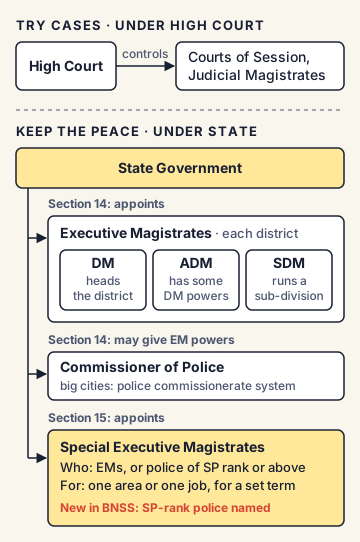
For example, a State may appoint SEMs for a by-election, a large religious gathering, or a communally sensitive area. The express mention of SP-rank police officers is new in the BNSS; under the CrPC, some States did this through their own amendments or orders.
What powers can Executive Magistrates use?
These are the main powers, all preventive or administrative:
- Security for keeping the peace (Section 126, earlier CrPC 107): If a person is likely to disturb public peace, the Magistrate can ask them to show cause why they should not sign a bond (a written promise backed by money) to keep the peace for up to one year.
- Security for good behaviour (Sections 127 to 129, earlier CrPC 108 to 110): Bonds can be demanded from people spreading certain harmful material (Section 127) and from suspicious persons trying to hide their presence to commit crimes (Section 128), for up to one year. From habitual offenders, such as repeated thieves or robbers, the bond can be for up to three years (Section 129).
- Dispersing unlawful assemblies (Section 148, earlier CrPC 129): An Executive Magistrate or the officer in charge of a police station can order an unlawful assembly to disperse, and use force if it does not.
- Removing public nuisances (Section 152, earlier CrPC 133): Orders to remove obstructions, dangerous buildings or harmful trades from public places.
- Urgent prohibitory orders (Section 163, earlier CrPC 144): Orders banning gatherings or activities in an emergency.
- Land and water disputes likely to cause violence (Section 164, earlier CrPC 145): Deciding who stays in possession for now, to prevent a fight, until a civil court decides who the real owner is.
- Inquiry into deaths (Section 196, earlier CrPC 176): Inquiring into the cause of certain deaths, such as suicides or suspicious deaths. But deaths, disappearances or rape in police or judicial custody must be inquired into by a Judicial Magistrate.
What can they NOT do?
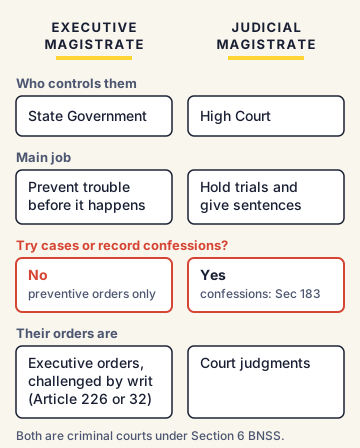
Executive Magistrates cannot try criminal cases or sentence anyone for a crime. They cannot record confessions; only a Judicial Magistrate can do that (Section 183 BNSS, earlier CrPC 164). Their orders are executive orders, not court judgments. So citizens can challenge them before the High Court (Article 226) or the Supreme Court (Article 32). In Gulam Abbas v. State of Uttar Pradesh (1981), the Supreme Court held that an order under Section 144 CrPC is an executive order, not a judicial one, and is open to challenge if it affects fundamental rights.
What have the courts said about police as magistrates?
- In P. Sathish v. State (2023), a special bench of the Madras High Court struck down two Tamil Nadu government orders of 2013 and 2014. These had given Deputy Commissioners of Police the powers of Executive Magistrates under Sections 107 to 110 CrPC. The court said this put investigation, prosecution and decision in the hands of the police alone. It held that this violated Articles 14, 21 and 50, and that breach of such bonds must be dealt with by a Judicial Magistrate.
- In Devadassan v. Second Class Executive Magistrate, Ramanathapuram (2022), the Supreme Court held that an Executive Magistrate's order to detain a person who broke a good-behaviour bond (under Section 122 CrPC) was valid.
These rulings show the courts are still drawing the line on how far Executive Magistrates, especially police officers acting as SEMs, can go.
Commonly confused concepts
- Executive Magistrate vs Judicial Magistrate: An Executive Magistrate is an administrative officer under the State Government who prevents breaches of peace. A Judicial Magistrate is a judge under the control of the High Court who holds trials and gives sentences.
- Executive Magistrate vs Special Executive Magistrate: An Executive Magistrate is appointed under Section 14 and has general powers in a district. An SEM is appointed under Section 15 only for a particular area or job, for a set term, with only the powers the State chooses to give.
- SEM vs Special Judicial Magistrate: A Special Judicial Magistrate is appointed by the High Court (at the State's request) to try certain cases. An SEM does not try cases at all.
- District Magistrate vs District Judge: The DM (usually the Collector) heads district administration and law and order. The District Judge is the highest judicial officer in the district and heads the district courts.
Issues, criticism and the way forward
- Blurring of separation of powers: Giving magistrate powers to police officers lets the same body arrest, accuse and decide. Critics see this as going against the spirit of Article 50.
- Misuse of preventive powers: Bonds under Sections 126 to 129 and prohibitory orders can be used to silence protests or harass people without a trial.
- Lack of legal training: Executive Magistrates are administrators, not trained judges, yet they decide matters that affect personal liberty.
- Lack of reasons and record: Courts have repeatedly asked that orders give clear reasons, so they can be reviewed.
- Way forward: Experts suggest clear State guidelines on when SEMs may be appointed and for how long, written and reasoned orders, quick review by Judicial Magistrates or the High Court, and training in law and human rights for every officer given these powers.
Concepts to Know
- Bharatiya Nagarik Suraksha Sanhita (BNSS), 2023: The new law that sets out how crimes are investigated and tried in India. It replaced the CrPC, 1973 from 1 July 2024. It has 531 sections.
- Preventive power: A power used to stop a crime or disorder before it happens, not to punish someone after it happens.
- Bond: A written promise, often backed by a sum of money, that a person will keep the peace or behave well. If the person breaks the promise, they can lose the money or be detained.
- Surety: Another person who promises to pay if the person who signed the bond breaks it.
- Directive Principles of State Policy: Guidelines in Part IV of the Constitution that the government should follow while making laws. Courts cannot enforce them directly.
- Writ jurisdiction: The power of the High Courts (Article 226) and the Supreme Court (Article 32) to issue orders to protect people's rights against wrong government action.
- Section 6 BNSS: four classes of criminal courts, including Executive Magistrates
- Section 14 BNSS (old CrPC 20): Executive Magistrates, DM, ADM, SDM; Commissioner of Police can be given their powers
- Section 15 BNSS (old CrPC 21): Special Executive Magistrates for particular areas or functions; Executive Magistrates or police officers of SP rank or above
- Sections 126 to 129 BNSS (old CrPC 107 to 110): security bonds; up to 1 year, up to 3 years for habitual offenders
- Section 163 BNSS (old CrPC 144): urgent prohibitory orders; Section 164 BNSS (old CrPC 145): property disputes
- Article 50: separation of judiciary from executive; given effect by the CrPC, 1973 (in force 1 April 1974)
- BNSS passed December 2023, assent 25 December 2023, in force 1 July 2024
● Tracked since October 22, 2026 · last seen October 22, 2026 · updates as the daily brief publishes