Ex Post Facto Environmental Clearance
The Vanashakti Case and After
An ex post facto environmental clearance (also called a post-facto or retrospective clearance) is an approval given to a project after it has already started building or running without the required environmental clearance. "Ex post facto" is Latin for "after the fact". It is like getting a driving licence after you have already been caught driving for two years. The law normally says clearance must come first, so this kind of approval is a big legal and ethical debate in India.
Why is it such a big issue?
The whole point of EIA is to study harm before it happens. If a mine has already cut a forest, a later study can only describe the damage, not prevent it. Critics say post-facto approval rewards those who break the rules. On the other side, the government and industry say some violations are minor or technical. They argue that shutting down a running factory with thousands of workers may hurt the public more than letting it pay a penalty and fix the harm.
How did the courts first see it?
For years, the Supreme Court took a firm line against it:
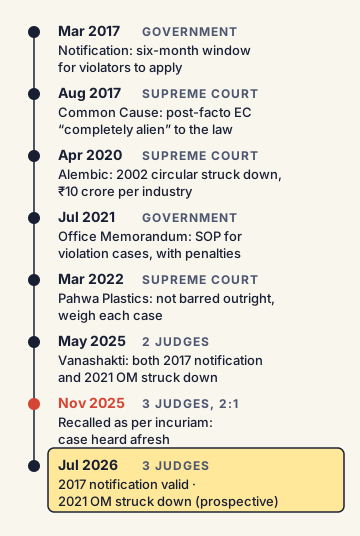
- Common Cause v. Union of India (2 August 2017): In a case on illegal iron and manganese mining in Odisha, the Court said the idea of an ex post facto or retrospective EC is "completely alien to environmental jurisprudence".
- Alembic Pharmaceuticals v. Rohit Prajapati (1 April 2020): The Court struck down a 2002 ministry circular that allowed such clearances. It still did not close the industries, but ordered each to pay ₹10 crore as compensation.
Later, the Court softened this view:
- Electrosteel Steels v. Union of India (2021) and Pahwa Plastics v. Dastak NGO (March 2022): The Court said the Environment (Protection) Act does not forbid post-facto clearance outright. It said such clearance should not be given routinely, but each case must be weighed, including jobs and the economy.
- D. Swamy v. Karnataka State Pollution Control Board (September 2022) followed the same softer view.
What did the government do?
The MoEFCC created two windows for violators:
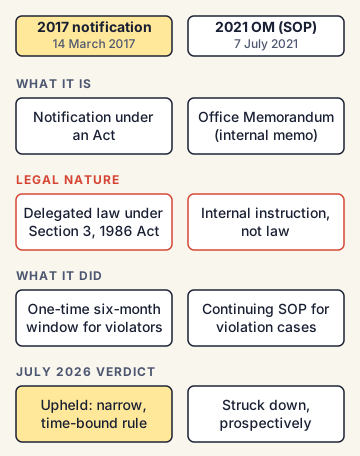
- Notification of 14 March 2017: It gave a six-month window for projects running without EC to apply. Such "violation cases" had to submit a remediation plan (to repair damage) and a Natural and Community Resource Augmentation Plan (to add back to nature and to local communities as much as was lost).
- Office Memorandum of 7 July 2021: It set a Standard Operating Procedure (SOP) to deal with violation cases on a continuing basis, with penalties.
The Vanashakti story: three rulings in 14 months
- Vanashakti v. Union of India (16 May 2025): A two-judge bench struck down both the 2017 notification and the 2021 OM. It said post-facto clearances violate the right to a clean, pollution-free environment under Article 21 (right to life) and go against the precautionary principle. It barred the Centre from granting such clearances in future.
- Review and recall (18 November 2025): In a review petition filed by the Confederation of Real Estate Developers' Associations of India (CREDAI), a three-judge bench recalled the May 2025 judgment by a 2:1 majority (Chief Justice B.R. Gavai and Justice K. Vinod Chandran in the majority; Justice Ujjal Bhuyan dissenting). The majority said the May ruling was per incuriam, meaning it had missed earlier binding judgments of benches of the same size. The matter was sent for a fresh hearing.
- Fresh hearing (29 July 2026): A three-judge bench of Chief Justice Surya Kant, Justice Joymalya Bagchi (who wrote the judgment) and Justice V.M. Pancholi decided:
- Prior EC remains the rule under the EIA Notification, 2006.
- The 2017 notification is valid. It was a narrow, time-bound rule made under Section 3 of the 1986 Act.
- The 2021 OM is struck down. A post-facto regime cannot be created by an internal memo; it needs a proper statutory notification with safeguards.
- The quashing of the OM works prospectively (only for the future). Clearances already granted stay unless challenged one by one. Pending, rejected or returned proposals may be decided according to law.
- Any exception to prior EC must pass two tests: a clear and fair basis linked to the Act's purpose (Article 14, equality), and proportionality (the public benefit must outweigh the harm).
How does a "rule with an exception" work here?
Think of a school rule: "No entry after the bell." The principal may allow late entry only for a few clear reasons, like a medical emergency, written down in advance for everyone. That is very different from a teacher letting anyone in after a quiet word. The July 2026 ruling says post-facto EC can be the written, narrow exception, not the quiet word.
Commonly confused concepts
- Recall vs review vs overrule: A review (Article 137) is a request to the same court to correct a clear error in its own judgment. A recall cancels the judgment so the case is heard again. Overruling is when a bigger or later bench declares an earlier judgment wrong law.
- Per incuriam vs obiter dicta: Per incuriam means a judgment given in ignorance of a binding law or ruling, so it loses its value as a precedent. Obiter dicta are passing remarks of judges that are not binding.
- Notification vs office memorandum: A notification made under an Act is delegated law. An OM is an internal instruction and cannot create a new legal regime. This difference decided the fate of the 2017 and 2021 instruments.
- Ex post facto clearance vs ex post facto law (Article 20(1)): Article 20(1) stops the State from punishing a person for an act that was not a crime when done. It is about criminal law, not environmental approvals.
Issues, criticism and the way forward
- Fait accompli problem: Critics say post-facto approvals encourage a "build first, seek approval later" habit, because a finished project is rarely demolished.
- Polluter pays: Supporters say penalties and repair plans make the violator pay for the damage, while saving jobs and investment already made.
- Legal uncertainty: Three different rulings in about 14 months confused industry, regulators and citizens alike. Projects faced the risk of closure, then relief, then a new framework.
- Fairness to honest applicants: Firms that waited for clearance lost time and money, while violators kept running.
- Way forward: Experts suggest a single, clear statutory rule for rare exceptions, penalties large enough to deter, independent damage assessment, strict time limits, and strong monitoring so that prior clearance stays the normal path.
Concepts to Know
- Article 21: The fundamental right to life and personal liberty. Courts have read it to include the right to a clean and healthy environment.
- Review petition: A request under Article 137 asking the Supreme Court to re-examine its own judgment, usually for a clear mistake.
- Prospective effect: A ruling that applies only from now on, not to things already done in the past.
- Proportionality: A test courts use to check that the government's action is not more harmful than needed for its goal.
- Delegated legislation: Rules made by the government using powers given to it by a law passed by Parliament.
- Common Cause v. Union of India: 2 August 2017 (retrospective EC "completely alien to environmental jurisprudence")
- Alembic Pharmaceuticals v. Rohit Prajapati: 1 April 2020 (₹10 crore compensation per industry)
- Pahwa Plastics v. Dastak NGO: March 2022 (post-facto EC not barred outright)
- MoEFCC notification: 14 March 2017 (six-month window); Office Memorandum (SOP): 7 July 2021
- Vanashakti v. Union of India: 16 May 2025, two-judge bench, struck down both instruments
- Recall: 18 November 2025, three-judge bench, 2:1 (Justice Ujjal Bhuyan dissenting), review sought by CREDAI
- Fresh ruling: 29 July 2026, CJI Surya Kant, Justices Joymalya Bagchi and V.M. Pancholi; 2017 notification upheld, 2021 OM quashed prospectively
- Power used: Section 3, Environment (Protection) Act, 1986
● Tracked since October 04, 2026 · last seen October 04, 2026 · updates as the daily brief publishes