European Climate Law
The EU's Legally Binding Path to Climate Neutrality
The European Climate Law is the law that makes the European Union's climate goals legally binding. Its central rule is that the EU as a whole must reach climate neutrality by 2050. This means that by 2050, the greenhouse gases the EU still releases must be balanced by the gases it removes from the air, so the net result is zero.
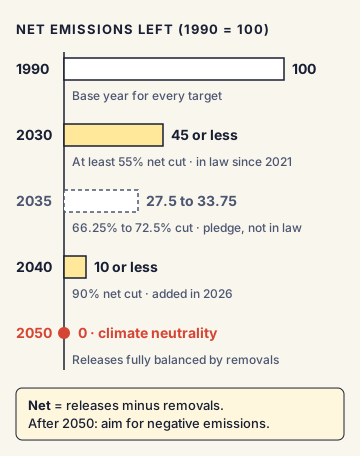
The law also sets binding steps on the way: a 55% net cut by 2030 and a 90% net cut by 2040, both compared with 1990 levels. Its official name is Regulation (EU) 2021/1119.
Why does the EU need a climate law?
Before this law, the 2050 net-zero goal was only a political promise. A promise can be dropped when governments change or when the economy is under pressure. By putting the goal into law, the EU made it binding on all its institutions and all 27 member states. Think of it like the difference between telling your family "I will save money" and signing a fixed deposit agreement with a bank. The second one is much harder to break.
Where did it come from?
The story has a few clear steps:
- December 2019: the European Commission (the EU's executive arm) presented the European Green Deal, a plan to make Europe the first climate-neutral continent by 2050.
- March 2020: the Commission proposed the European Climate Law to make that goal binding.
- 30 June 2021: the law was adopted. It entered into force on 29 July 2021.
- July 2021: the Commission proposed the "Fit for 55" package, a set of laws to actually deliver the 55% cut by 2030.
- July 2025: the Commission proposed adding a 2040 target of a 90% net cut.
- December 2025: the European Parliament and the Council reached a provisional deal on the 2040 target.
- 5 March 2026: the Council formally adopted the amendment. It was published in the EU's Official Journal on 18 March 2026 as Regulation (EU) 2026/667.
How does "net" reduction work?
A net cut counts both sides: the gases released and the gases removed. Removals happen when forests, soils or machines take carbon dioxide out of the air. Suppose the EU released 100 units in 1990. A 90% net cut by 2040 means that releases minus removals must come to no more than 10 units in 2040.
For the 2030 target, the law caps how much removals can count: at most 225 million tonnes of CO2 equivalent. This cap stops countries from relying too much on forests instead of actually cutting pollution.
What does the 2040 target include?
The 2040 amendment keeps the 90% figure but adds some flexibilities:
- International carbon credits: from 2036, the EU can count a limited amount of high-quality carbon credits bought from projects in other countries. The cap is 5% of the EU's 1990 net emissions. These credits must follow Article 6.4 of the Paris Agreement plus extra quality rules, and cannot be used by companies to meet their obligations under the EU Emissions Trading System.
- Permanent removals: rules to let companies use domestic permanent removals (for example, capturing carbon from burning plants and storing it underground, or pulling it straight from the air) are to be added when the ETS law is revised in 2026.
- Regular review: the Commission will check progress every two years. It will look at science, technology, removals and competitiveness, and the review could lead to changes in the path.
- ETS2 delay: the new emissions trading system for buildings and road transport fuels (ETS2) was pushed back by one year, to start on 1 January 2028.
Who checks the EU's climate path?
The law created the European Scientific Advisory Board on Climate Change. It has 15 independent senior scientists, appointed for four-year terms (renewable once). It gives independent advice on targets and checks whether EU policies match the science. Its chair, Ottmar Edenhofer, was first elected in May 2022, and the board began its second term (2026 to 2030) in 2026.
The Commission must also assess the progress of the EU and each member state every five years, in line with the Paris Agreement's Global Stocktake cycle. After 2050, the law says the EU should aim for negative emissions, meaning it removes more than it releases.
How does it connect to the EU's climate pledge?
Under the Paris Agreement, every country must submit a climate plan called a Nationally Determined Contribution (NDC). The EU and its member states submit one joint NDC. On 5 November 2025, the EU submitted its 2035 target: a 66.25% to 72.5% net cut compared with 1990. This range was worked out from the straight-line path between its 2030 target and its 2040 target.
India's position and Indian links
India does not have a single climate law like this. India's targets, such as net zero by 2070 and the goals in its NDC, are policy commitments under the Paris Agreement. They are delivered through laws like the Energy Conservation Act, 2001 (amended in 2022 to allow a domestic carbon market) and the Carbon Credit Trading Scheme, 2023.
The EU's climate law matters to India mainly through trade. The EU's tough domestic targets are the reason for the Carbon Border Adjustment Mechanism (CBAM), a charge on the carbon in imports such as steel and aluminium, which affects Indian exporters.
Commonly confused concepts
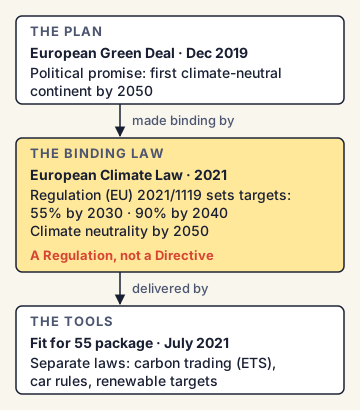
- European Climate Law vs European Green Deal: the Green Deal (2019) is the overall political plan. The Climate Law (2021) is the binding law that fixes the targets.
- European Climate Law vs Fit for 55: the Climate Law sets the goal (55% by 2030). Fit for 55 is the package of separate laws (carbon trading, car rules, renewable targets and more) that tries to achieve it.
- Climate neutrality vs carbon neutrality: climate neutrality covers all greenhouse gases (carbon dioxide, methane, nitrous oxide and others). Carbon neutrality covers only carbon dioxide.
- Net cut vs gross cut: a gross cut counts only lower releases. A net cut also subtracts removals by forests and technology.
- Regulation vs Directive (EU law): a Regulation applies directly in all member states as it is. A Directive sets a goal that each member state must write into its own national law. The European Climate Law is a Regulation.
Issues, criticism and the way forward
- Weaker in practice? Critics, including the EU's own scientific advisory board, warn that counting international credits could reduce real cuts at home and put the 2050 goal at risk.
- Rollbacks: environmental groups point to delays such as ETS2 and the planned postponement of methane rules as signs of backsliding. The EU says its 90% target shows its ambition remains.
- Competitiveness: industry groups and some member states worry that strict targets raise energy costs and push factories out of Europe. This pressure shaped the flexibilities in the 2040 target.
- Fairness to poorer countries: some independent analysts rate the EU's 2035 NDC as not matching its fair share or the 1.5°C goal, given the EU's large past emissions.
- Way forward: experts call for strong safeguards on carbon credits, real growth in permanent removals, and support for households hit by higher fuel prices under ETS2.
Concepts to Know
- Climate neutrality (net zero): a state where the greenhouse gases released are fully balanced by the gases removed from the air, so the net total is zero.
- CO2 equivalent (CO2e): a common unit that converts all greenhouse gases into the amount of carbon dioxide that would cause the same warming.
- Carbon credit: a certificate showing that one tonne of CO2e was cut or removed somewhere. A buyer can count it against its own target.
- Emissions Trading System (ETS): a market where the government sets a total limit on emissions and issues permits. Companies must hold a permit for every tonne they release, and can buy or sell spare permits.
- Council of the EU vs European Parliament: the Council is made up of ministers from the 27 member governments. The Parliament is elected directly by EU citizens. Most EU laws need the approval of both.
- Official name: Regulation (EU) 2021/1119; adopted 30 June 2021; in force 29 July 2021.
- Binding goals: climate neutrality by 2050; at least 55% net cut by 2030; 90% net cut by 2040 (all vs 1990).
- 2030 cap on removals counted: 225 million tonnes CO2e.
- 2040 amendment: Regulation (EU) 2026/667; Council adoption 5 March 2026.
- International credits for 2040: from 2036, up to 5% of 1990 net emissions.
- ETS2 (buildings and road transport) start: 1 January 2028.
- Scientific Advisory Board: 15 members, four-year terms.
- EU 2035 NDC (submitted 5 November 2025): 66.25% to 72.5% net cut vs 1990.
● Tracked since November 10, 2026 · last seen November 10, 2026 · updates as the daily brief publishes