Emissions Gap Report (UNEP)
Measuring How Far the World Is From Its Climate Goals
The Emissions Gap Report is a yearly scientific report published by the United Nations Environment Programme (UNEP). It compares two numbers: how much greenhouse gas the world is likely to release in the coming years, and how much it should release to keep warming within safe limits. The difference between the two is called the emissions gap. A bigger gap means the world is further away from its climate goals.
Why does it exist?
Under the Paris Agreement, each country decides its own climate promise. Nobody forces a country to promise more. So someone must add up all these promises and check whether, together, they are enough. Think of a family saving for a house. Each member promises to save some money every month. Someone must add these up and see if the total will be enough by the target date. The Emissions Gap Report does this job for the whole planet's climate promises.
Where did it come from?
UNEP started the series in 2010, one year after the Copenhagen climate summit (2009). At Copenhagen, countries made their first voluntary pledges to cut emissions, and scientists wanted to check whether those pledges added up. The report has come out every year since. The 2019 report was the tenth edition, and the 2026 report is the 17th. It is usually released a few weeks before each year's UN climate summit, the COP (Conference of the Parties), so that negotiators have fresh numbers.
Who makes it?
UNEP prepares it with the UNEP Copenhagen Climate Centre and a large team of independent scientists and modelling groups from around the world. UNEP itself was set up in 1972 after the Stockholm Conference on the Human Environment, and its headquarters is in Nairobi, Kenya.
How does it work?
The report follows three simple steps.
- Where are we now? It measures total world emissions in the latest year, in billion tonnes of CO2-equivalent (GtCO2e).
- Where are we heading? It projects emissions in 2030 and 2035 under different cases: only the policies already in force (current policies), countries' promises that do not depend on outside help (unconditional NDCs), and promises that depend on getting money or technology from others (conditional NDCs).
- Where should we be? It uses climate models to find the emissions level that would keep warming "well below 2°C" or at 1.5°C. The difference between step 2 and step 3 is the gap.
The report also turns these numbers into a likely temperature by 2100, which is easy for everyone to understand.
Two kinds of gaps
Students should know both.
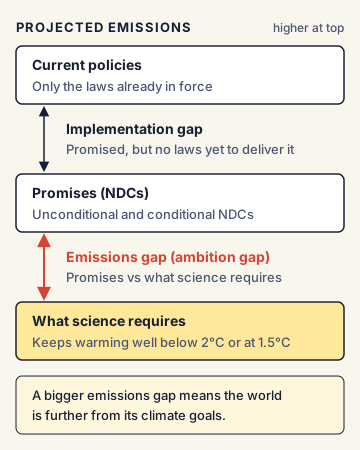
- Emissions gap (ambition gap): the difference between what countries have promised and what science requires.
- Implementation gap: the difference between what countries have promised and what their actual current policies will deliver. A country may promise a big cut but not pass the laws needed to achieve it.
What have recent editions said?
Each report has a short, sharp title.
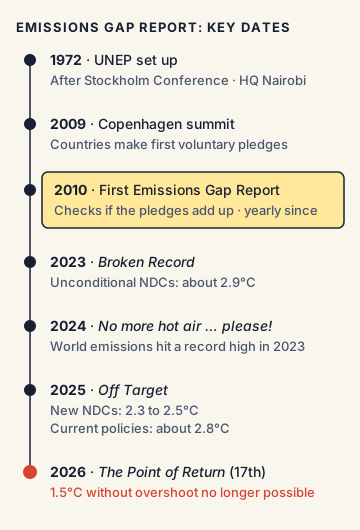
- 2023, Broken Record: fully meeting unconditional promises would still lead to about 2.9°C of warming this century.
- 2024, No more hot air … please!: world emissions reached a new record high in 2023.
- 2025, Off Target: fully meeting the new NDCs would lead to 2.3 to 2.5°C of warming; current policies alone would lead to about 2.8°C. The report said warming would go above 1.5°C, at least for some time.
- 2026, The Point of Return: 1.5°C without overshoot is no longer possible; emissions must fall 18% by 2030, 45% by 2035 and 69% by 2040 (from 2025 levels) to keep the overshoot as small as possible.
India's position and Indian examples
India is the world's third-largest emitter in total, but its emissions per person are far below the world average. India argues that rich countries, which caused most past emissions, should cut faster and give money and technology to developing countries. This is the principle of Common But Differentiated Responsibilities and Respective Capabilities (CBDR-RC). India's 2022 NDC promised to cut its emissions intensity (emissions per unit of GDP) by 45% by 2030 from 2005 levels and to reach 50% of power capacity from non-fossil sources by 2030.
Its 2035 NDC, submitted to the UNFCCC on 24 April 2026, raises these to a 47% intensity cut and about 60% non-fossil capacity by 2035, plus an extra forest carbon sink of 3.5 to 4.0 billion tonnes of CO2-equivalent. India's long-term goal is net zero by 2070, announced at COP26 in Glasgow (2021).
Commonly confused concepts
- Emissions Gap Report vs IPCC Assessment Reports: The IPCC (Intergovernmental Panel on Climate Change) reviews all climate science and publishes big Assessment Reports roughly every 6 to 7 years. The Emissions Gap Report is yearly and focuses only on the gap between pledges and targets.
- Emissions Gap Report vs Adaptation Gap Report: Both are by UNEP. The Adaptation Gap Report looks at the gap in preparing for climate impacts (money and plans for adaptation), not at cutting emissions.
- Emissions Gap Report vs Production Gap Report: The Production Gap Report (led by the Stockholm Environment Institute with UNEP and partners) compares how much coal, oil and gas governments plan to produce with what climate goals allow.
- Emissions Gap Report vs Global Stocktake: The Global Stocktake is an official five-yearly review under the Paris Agreement itself (first finished at COP28 in 2023). The Emissions Gap Report is an independent scientific report and has no legal role in the treaty.
- Unconditional vs conditional NDC: Unconditional means the country will do it on its own. Conditional means it will do more only if it gets international finance or technology.
Issues, criticism and the way forward
- Promises are not action: Year after year the report shows a large implementation gap. Experts say countries must turn pledges into laws, budgets and projects.
- Fairness: Developing countries point out that the report's "required" cuts are global. They ask who should cut how much, given that rich countries used most of the past carbon budget.
- Finance: Many developing-country pledges are conditional. Their delivery depends on climate finance. At COP29 in Baku (2024), countries set a new goal of at least USD 300 billion a year by 2035 for developing countries, which many called too low.
- Dependence on carbon removal: The pathways now rely more on removing CO2 from the air later this century. Critics warn this may become an excuse to delay cuts today.
- The way forward: UNEP repeatedly asks for faster growth in solar and wind power, an end to deforestation, cuts in methane, and stronger NDCs every five years.
Concepts to Know
- Greenhouse gases: Gases such as carbon dioxide (CO2), methane and nitrous oxide that trap heat in the atmosphere, like a blanket around the Earth.
- CO2-equivalent (CO2e): A common unit that converts all greenhouse gases into the amount of CO2 that would cause the same warming. It lets us add different gases together.
- Gigatonne (Gt): One billion tonnes.
- NDC (Nationally Determined Contribution): A country's own climate action plan under the Paris Agreement, updated every five years.
- LULUCF (Land Use, Land-Use Change and Forestry): Emissions or removals of CO2 from land, for example when forests are cut or burnt (emissions) or when new forests grow (removals).
- Emissions intensity: The amount of emissions released for each unit of GDP (economic output). It can fall even when total emissions rise, if the economy grows faster than emissions.
- Net zero: When a country's remaining emissions are balanced by an equal amount of removals, so the net addition to the air is zero.
- Published by UNEP every year since 2010; 2026 edition is the 17th, titled The Point of Return
- Usually released before the annual COP
- UNEP: set up in 1972 after the Stockholm Conference; headquarters Nairobi
- 2025 report (Off Target): NDCs lead to 2.3 to 2.5°C; current policies about 2.8°C
- 2023 report (Broken Record): about 2.9°C under unconditional NDCs
- India: 45% emissions-intensity cut by 2030 (2022 NDC); 47% by 2035 and about 60% non-fossil capacity (2035 NDC, submitted 24 April 2026); net zero by 2070
● Tracked since October 21, 2026 · last seen October 21, 2026 · updates as the daily brief publishes