Emergency Provisions of the Constitution of Pakistan (Articles 232 to 237)
Pakistan's Constitution of 1973 has a special part, Part X (Emergency Provisions), that lets the federal government take extra powers during a crisis. It covers three kinds of emergency: a security emergency (Article 232), a breakdown of government in a province (Article 234), and a financial emergency (Article 235). During these emergencies, the federal government can take over the work of a province, and Pakistan's Parliament can make laws on provincial subjects. These provisions look very similar to India's own emergency articles, which is why they matter for UPSC.
Why do these provisions exist?
Pakistan is a federation of provinces (Punjab, Sindh, Khyber Pakhtunkhwa and Balochistan), each with its own elected government. Normally, the Centre cannot interfere in subjects given to provinces. But what if a province faces a war, a violent uprising, or a government that cannot or will not function? The emergency provisions act like an emergency brake in a bus.
They let the federal government step in, keep order and restore normal rule. The risk, as with any emergency brake, is misuse: pulling it when there is no real emergency.
Where did they come from?
Pakistan's present Constitution was adopted on 10 April 1973 and came into force on 14 August 1973. Like India's Constitution, it borrowed its emergency ideas from the Government of India Act, 1935, which gave the British Governor-General and Governors power to take over a province when its government failed. Over time, the provisions were changed several times:
- 1975 (Third Amendment): changed how long an emergency could continue.
- 1985 (Revival of the Constitution Order): after military rule, renamed Parliament as "Majlis-e-Shoora (Parliament)" in these articles.
- 2010 (18th Amendment): a major reform that gave more power to the provinces. It added a check on emergencies on the ground of internal disturbance, and on Governor's rule (explained below). The same amendment renamed the North-West Frontier Province as Khyber Pakhtunkhwa.
Article 232: Proclamation of emergency
The President can declare an emergency if he is satisfied that a grave emergency exists in which the security of Pakistan, or any part of it, is threatened by:
- war or external aggression, or
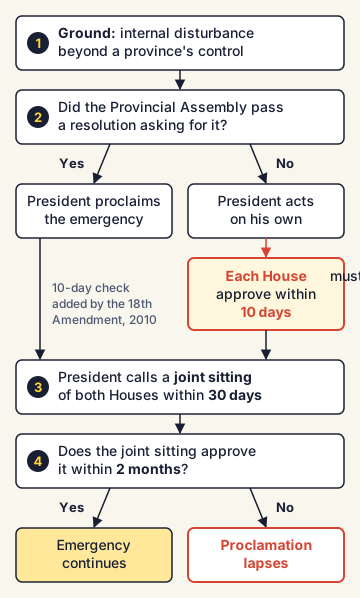
- internal disturbance beyond the power of a provincial government to control.
The 18th Amendment added a safeguard for the "internal disturbance" ground. The Provincial Assembly of that province must first pass a resolution asking for it. If the President acts on his own without such a resolution, the proclamation must be placed before both Houses of Parliament (the National Assembly and the Senate), and each House must approve it within ten days.
During an Article 232 emergency:
- Parliament can make laws for a province even on subjects that normally belong only to the provinces.
- The federal government can give directions to a province and take over its functions.
- Parliament may extend the term of the National Assembly by up to one year at a time, but not beyond six months after the emergency ends (Article 232(6)).
- The President must call a joint sitting of both Houses within 30 days. The proclamation lapses after two months unless the joint sitting approves it.
Article 233: Fundamental rights during an emergency
While an emergency is in force, some fundamental rights stop limiting the state. These are the rights in Articles 15 (movement), 16 (assembly), 17 (association), 18 (trade and profession), 19 (speech) and 24 (property). The President may also suspend the right to go to court to enforce specified fundamental rights. Such orders must also be placed before Parliament.
Article 234: Failure of constitutional machinery in a province
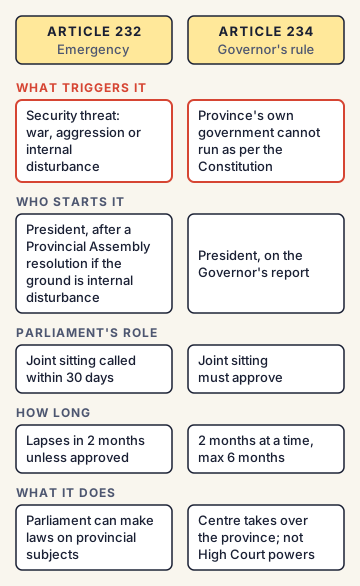
This is often called Governor's rule. If the President, on receiving a report from the Governor of a province, is satisfied that the provincial government cannot be run according to the Constitution, he may issue a proclamation. Under it:
- The President can take over all or any functions of the provincial government, or direct the Governor to do so on his behalf.
- He can declare that the powers of the Provincial Assembly will be used by or under the authority of Parliament.
- If each House of Parliament passes a resolution asking for this, the President must issue it.
- He cannot take over the powers of the High Court.
The 18th Amendment removed the words "or otherwise" after "report from the Governor", so the President now needs the Governor's report. An Article 234 proclamation must be approved by a joint sitting of Parliament. It lasts two months at a time and can be extended by two months at a time, up to a maximum of six months in total.
Articles 235 to 237: Financial emergency, revocation and indemnity
- Article 235 (financial emergency): If the economic life, financial stability or credit of Pakistan is threatened, the President may declare a financial emergency after consulting the Governors. The Centre can then direct provinces on spending, including cuts in salaries.
- Article 236: A proclamation can be changed or revoked by a later proclamation. Courts cannot question the validity of a proclamation or order made under this Part.
- Article 237: Parliament can pass laws to indemnify (protect from legal action) officials for acts done to keep or restore order.
How have these powers been used?
- Governor's rule (Article 234) has been imposed in every province at different times. In the province now called Khyber Pakhtunkhwa, it was imposed in February 1975 (after the killing of a former provincial Governor) and in February 1994. It was imposed in Punjab in 2009 and in Balochistan in January 2013 (for 60 days, after deadly bombings in Quetta).
- May 1998: An emergency was declared on 28 May 1998, citing a threat of external aggression, on the day of Pakistan's nuclear tests. The right to go to court to enforce fundamental rights was suspended.
- November 2007: The then army chief, who was also President, declared an emergency outside the Constitution through a Provisional Constitution Order. In July 2009, Pakistan's Supreme Court held the steps taken under it unconstitutional. This was not an Article 232 emergency.
Comparison with India
India's Constitution has a near-mirror set of provisions, because both come from the Government of India Act, 1935.
| Type | Pakistan | India |
|---|---|---|
| Security emergency | Article 232 (war, external aggression, internal disturbance) | Article 352 (war, external aggression, armed rebellion) |
| Breakdown of government in a state or province | Article 234 (Governor's rule) | Article 356 (President's Rule) |
| Financial emergency | Article 235 | Article 360 |
| Maximum length of state takeover | 6 months in total | Up to 3 years, in 6-month steps (with extra conditions after 1 year) |
| Approval | Joint sitting of Parliament | Each House of Parliament separately, within 2 months |
A key difference: India's 44th Amendment (1978) replaced the words "internal disturbance" in Article 352 with "armed rebellion", because the vague phrase "internal disturbance" was used for the 1975 Emergency. Pakistan's Article 232 still uses "internal disturbance", but since 2010 it needs a provincial resolution or quick parliamentary approval.
Commonly confused concepts
- Article 232 vs Article 234 (Pakistan): Article 232 is about security threats (war, aggression, internal disturbance) and affects the whole country or a part. Article 234 is about the provincial government failing to work according to the Constitution. In KP in October 2026, both were invoked together.
- Governor's rule vs martial law: Governor's rule is a constitutional step, approved by Parliament and limited in time. Martial law is rule by the army that sets aside the Constitution.
- Pakistan's Governor vs Chief Minister: The Governor is appointed by the President (on the Prime Minister's advice) and represents the federation. The Chief Minister is the elected head of the provincial government. Under Governor's rule, power moves from the Chief Minister to the Governor.
- Joint sitting vs each House separately: A joint sitting means both Houses vote together as one body. "Each House separately" means both must approve on their own.
Issues, criticism and the way forward
- Misuse against opponents: Critics argue that emergency powers have often been used when the Centre and a province are run by rival political groups, which weakens provincial autonomy. Supporters of such steps argue that the federation has a duty to protect citizens when a province cannot handle terrorism.
- Federalism after the 18th Amendment: The 2010 reform aimed to protect provinces. Using emergency powers against an elected provincial government tests how strong those safeguards really are.
- Limited court review: Article 236 bars courts from questioning a proclamation, so the main check is Parliament.
- Security vs democracy: Terrorism in KP has risen sharply in recent years. The debate is whether central control improves security or deepens public anger.
- Way forward: Experts point to the need for clear, fact-based grounds before an emergency, strong and quick parliamentary review, and cooperation between the federation and the provinces on counter-terrorism rather than confrontation.
Concepts to Know
- Proclamation: A formal official announcement, signed by the head of state, that brings a legal step into force.
- Federation: A country where power is shared between a central government and regional governments (provinces or states), each with its own powers.
- Majlis-e-Shoora: The official name of Pakistan's Parliament. It has two Houses: the National Assembly (lower House) and the Senate (upper House).
- 18th Amendment (Pakistan, 2010): A major constitutional change that moved many powers from the Centre to the provinces and restored a parliamentary form of government.
- Indemnity: Legal protection from being sued or punished for an action.
- Government of India Act, 1935: A British law that set up a federal structure for India. Both the Indian and Pakistani Constitutions borrowed many provisions from it.
- Pakistan Constitution: adopted 10 April 1973, in force 14 August 1973; emergency provisions in Part X, Articles 232 to 237.
- Article 232: grave emergency on war, external aggression or internal disturbance beyond a province's control.
- Internal-disturbance emergency (after the 18th Amendment, 2010): needs a Provincial Assembly resolution, or approval by each House within 10 days if the President acts alone.
- Article 232: joint sitting within 30 days; lapses in two months without approval; National Assembly term can be extended by up to one year.
- Article 233: suspends rights in Articles 15, 16, 17, 18, 19 and 24.
- Article 234: Governor's rule on the Governor's report; joint sitting approval; two months at a time; maximum six months; High Court powers cannot be taken over.
- Article 235: financial emergency after consulting Governors.
- Article 236: courts cannot question a proclamation.
- Previous uses: Governor's rule in KP (1975, 1994), Punjab (2009), Balochistan (January 2013); national emergency 28 May 1998.
● Tracked since October 11, 2026 · last seen October 11, 2026 · updates as the daily brief publishes