Electrolysers
How Water Is Split to Make Green Hydrogen
An electrolyser is a machine that uses electricity to split water (H2O) into hydrogen gas and oxygen gas. This process is called electrolysis. When the electricity comes from renewable sources like solar or wind, the hydrogen made is called green hydrogen, because almost no carbon dioxide is released. The electrolyser is the heart of any green hydrogen plant, in the same way that an engine is the heart of a car.
Why does it matter?
Hydrogen is already used in huge amounts, mainly in oil refineries and fertiliser factories. Today most of it is made from natural gas or coal, which releases a lot of carbon dioxide (CO2). To make clean hydrogen at scale, a country needs two things: cheap renewable electricity and good, cheap electrolysers. If electrolysers stay costly or must be imported, green hydrogen stays costly too. That is why they are central to India's plans.
Where did it come from?
Electrolysis is an old idea. In 1800, two English scientists, William Nicholson and Anthony Carlisle, split water into hydrogen and oxygen using an electric battery. By the early 1900s, large electrolysers were working in places with cheap hydropower, such as Norway, to make hydrogen for fertilisers. Later, cheap natural gas took over, and electrolysis became a small niche. Interest came back after about 2015, when solar and wind power became much cheaper and countries began looking for ways to cut emissions in heavy industry.
How does an electrolyser work?
Think of it as a box with two metal plates, called electrodes, sitting in water that can carry electricity.
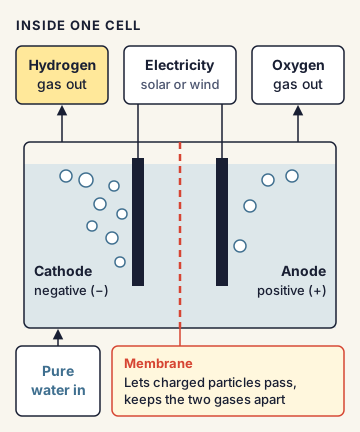
- Electricity enters the box. One electrode becomes negative (the cathode) and the other becomes positive (the anode).
- At the cathode, hydrogen gas bubbles out.
- At the anode, oxygen gas bubbles out.
- A thin wall, called a membrane or separator, sits between the two sides. It lets charged particles pass but keeps the two gases apart, so they do not mix.
- The hydrogen is then cleaned, dried and pressed into tanks or pipes.
Many such small units, called cells, are joined together into a stack. The size of an electrolyser is measured by how much electricity it can use, in kilowatts (kW) or megawatts (MW). So "3,000 MW of electrolyser manufacturing" means factories able to make machines that together can use 3,000 MW of power.
The four main types
UPSC can ask how these differ:
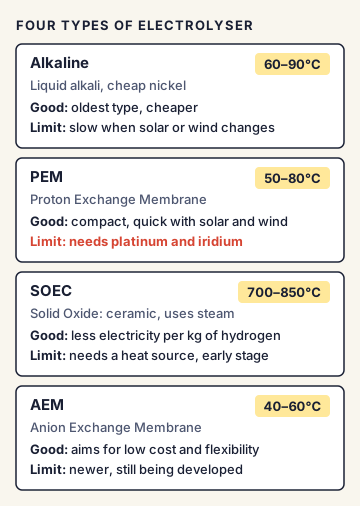
- Alkaline electrolyser: the oldest and most mature type. It uses a liquid alkaline solution, usually potassium hydroxide, and cheap metals like nickel. It runs at about 60–90°C. It is cheaper, but it does not adjust as quickly when solar or wind power goes up and down.
- PEM (Proton Exchange Membrane) electrolyser: uses a solid plastic-like membrane instead of a liquid. It runs at about 50–80°C, is compact, and reacts quickly to changing power, which suits solar and wind. But it needs costly, rare metals such as platinum and iridium.
- SOEC (Solid Oxide Electrolyser Cell): uses a ceramic material and works with steam at very high heat, about 700–850°C. It needs less electricity per kg of hydrogen, but it needs a heat source and is still at an early stage.
- AEM (Anion Exchange Membrane) electrolyser: a newer type that tries to mix the low cost of alkaline with the flexibility of PEM. It runs at about 40–60°C and is still being developed.
How much power and water does it need?
In practice, an electrolyser system needs roughly 50–55 kilowatt-hours (kWh) of electricity to make 1 kg of hydrogen. One kg of hydrogen holds about 33 kWh of usable energy, so a good part of the electricity is lost as heat. This is why electricity is the biggest cost. Chemistry says about 9 litres of water are needed for each kg of hydrogen.
Real plants need more, roughly 20–30 litres per kg, because the water must be made very pure and some is used for cooling. Electrolysers cannot use ordinary tap or sea water directly. The water must be demineralised (all salts removed), and in dry coastal areas this may mean desalination (removing salt from sea water).
India's position and Indian examples
- National Green Hydrogen Mission (2023): India's main programme, run by the Ministry of New and Renewable Energy (MNRE). Its biggest part is the SIGHT programme (Strategic Interventions for Green Hydrogen Transition), with ₹17,490 crore.
- SIGHT Component I supports electrolyser manufacturing in India. The incentive is paid per kW of electrolysers made and sold, starting at ₹4,440 per kW in the first year and falling each year over five years to ₹1,480 per kW.
- Auctions: The Solar Energy Corporation of India (SECI) ran the bidding. The first tranche of about 1,500 MW a year was awarded in January 2024, and a second tranche of about 1,500 MW in 2024, which together make up the 3,000 MW mentioned in the news. Winners must commission factories within about 30 months of the award.
- Green Hydrogen Standard (August 2023): MNRE defined green hydrogen as hydrogen whose emissions from water treatment, electrolysis, gas cleaning, drying and compression are not more than 2 kg of CO2 equivalent per kg of hydrogen, averaged over the last 12 months. Both electrolysis and biomass-based routes can qualify. The Bureau of Energy Efficiency (BEE) accredits the agencies that check and certify this.
- Cheaper power: The government has waived Inter-State Transmission System (ISTS) charges for eligible green hydrogen projects, so plants can take solar and wind power from other states more cheaply.
The global picture
As of the end of 2025, the International Energy Agency (IEA) estimated world electrolyser manufacturing capacity at about 58 GW a year, with China holding about 60%. But actual output was under 5 GW, so most factories sat idle. This shows two things for India: the world can make many electrolysers, but demand for green hydrogen is still weak, and depending on one country for machines is a supply risk.
Commonly confused concepts
- Electrolyser vs fuel cell: An electrolyser uses electricity to make hydrogen from water. A fuel cell does the reverse: it uses hydrogen to make electricity, giving out only water. A hydrogen bus runs on a fuel cell, not an electrolyser.
- Electrolysis vs steam methane reforming (SMR): Electrolysis splits water. SMR takes hydrogen out of natural gas (methane) using steam, and releases CO2. Most hydrogen today comes from SMR, and it is called grey hydrogen.
- Green vs blue vs grey hydrogen: Grey is from fossil fuels with CO2 released. Blue is also from fossil fuels, but the CO2 is captured and stored. Green is from water using renewable power.
- MW of electrolysers vs tonnes of hydrogen: MW measures the machine's power size. Tonnes per year measures how much hydrogen is actually produced. A simple calculation: a 1 MW electrolyser running all 8,760 hours of a year uses 8,760 MWh, which at about 55 kWh per kg makes roughly 160 tonnes of hydrogen. If it runs only when the sun shines, it makes far less.
Issues, criticism and the way forward
- High cost: Electrolysers are still costly, and costly electricity makes the hydrogen costlier. The IEA expects green hydrogen to stay more expensive than grey hydrogen in the near future.
- Running only part of the day: Solar power is available only in daytime. If an electrolyser runs only 6–8 hours a day, each kg of hydrogen carries more of the machine's cost. Round-the-clock renewable power or storage helps, but adds cost.
- Rare metals and supply chains: PEM electrolysers need iridium and platinum, which are rare and mined in only a few countries. Manufacturing is concentrated in China.
- Water stress: Many sunny parts of India, such as Rajasthan and Gujarat, are also water-scarce. Plants need clear plans for water sourcing, treatment and desalination.
- Weak demand: Factories are built, but buyers are few because green hydrogen is costly. Experts suggest demand-side rules such as a production or consumption obligation, and carbon pricing on grey hydrogen.
- Way forward: Experts suggest lowering renewable power costs, research on electrolysers that use less rare metal, scaling up Indian manufacturing with performance-linked incentives, and starting with industries that already use hydrogen, like refineries and fertilisers.
Concepts to Know
- Electrode: A metal plate through which electricity enters or leaves a liquid or material. The negative one is the cathode; the positive one is the anode.
- Membrane: A very thin sheet that lets some particles pass and blocks others, like a very fine filter.
- Kilowatt-hour (kWh): A unit of electrical energy. It is the "unit" shown on your electricity bill. A 1,000-watt heater running for one hour uses 1 kWh.
- Demineralised water: Water from which salts and minerals have been removed, so that it does not damage the machine.
- Desalination: Removing salt from sea water to make it usable.
- CO2 equivalent: A common measure that converts all greenhouse gases into the amount of CO2 that would cause the same warming.
- Carbon pricing: Making polluters pay for each tonne of CO2 they release, through a tax or a trading system, so that clean options become relatively cheaper.
- Electrolysis first shown in 1800 by William Nicholson and Anthony Carlisle
- Four main types: Alkaline (most mature, nickel, ~60–90°C), PEM (platinum and iridium, flexible), SOEC (steam, ~700–850°C), AEM (emerging)
- Electricity use: roughly 50–55 kWh per kg of hydrogen; water: about 9 litres per kg by chemistry, about 20–30 litres per kg in practice
- SIGHT programme: ₹17,490 crore; electrolyser incentive starts at ₹4,440 per kW and falls over five years
- SECI tranches: about 1,500 MW (January 2024) and about 1,500 MW (2024), total 3,000 MW per annum
- Green Hydrogen Standard (August 2023): not more than 2 kg CO2 equivalent per kg hydrogen, 12-month average; BEE accredits verifiers
- As of end-2025 (IEA): global electrolyser manufacturing capacity about 58 GW a year, China about 60%
● Tracked since November 06, 2026 · last seen November 06, 2026 · updates as the daily brief publishes