Early Warnings for All (EW4All) Initiative
Early Warnings for All (EW4All) is a United Nations plan to make sure every person on Earth is protected by an early warning system by the end of 2027. An early warning system tells people, before a disaster strikes, that a cyclone, flood, heatwave or other danger is coming and what they should do. It was announced by the UN Secretary-General on 23 March 2022. It is led jointly by the World Meteorological Organization (WMO) and the UN Office for Disaster Risk Reduction (UNDRR).
Why do early warnings matter so much?
A warning cannot stop a cyclone. But it can stop a cyclone from killing people. If a fisherman knows two days in advance that a storm is coming, he stays home. If a village knows a flood is coming, families move to a shelter with their papers and cattle. The Global Commission on Adaptation's 2019 report Adapt Now found that just 24 hours' warning of a coming storm or heatwave can cut the damage by 30%.
It also estimated that spending US$800 million on such systems in developing countries could avoid losses of US$3 billion to US$16 billion a year. Few climate actions give so much benefit for so little money.
Why was a global plan needed?
In 2022, the WMO reported that about half of all countries did not have proper early warning systems. Coverage was worst in the poorest places: least developed countries (LDCs), small island developing states (SIDS) and much of Africa. These are exactly the places hit hardest by climate change. As the world warms, extreme weather like heavy rain, strong cyclones and heatwaves is becoming more frequent. So the gap was becoming deadlier every year.
Where did it come from?
The idea builds on earlier global efforts:
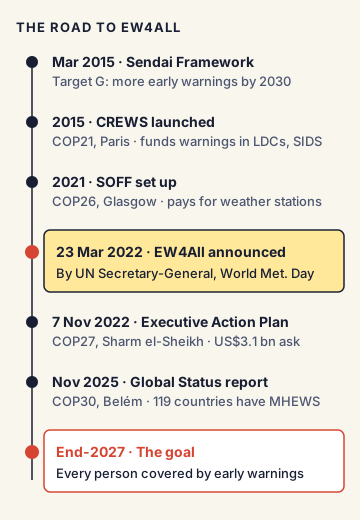
- Sendai Framework for Disaster Risk Reduction (2015–2030): adopted in March 2015 in Sendai, Japan. Its Target G asks countries to greatly increase people's access to multi-hazard early warning systems and disaster risk information by 2030.
- CREWS (Climate Risk Early Warning Systems) initiative: launched at COP21 in Paris in 2015 to fund warning systems in LDCs and SIDS.
- SOFF (Systematic Observations Financing Facility): set up at COP26 in Glasgow in 2021 to pay for weather observations (like weather stations) in poor countries.
On 23 March 2022 (World Meteorological Day), the UN Secretary-General asked the WMO to lead a plan to cover everyone within five years. The Executive Action Plan for EW4All was unveiled at COP27 in Sharm el-Sheikh, Egypt, on 7 November 2022. It asked for an initial investment of about US$3.1 billion between 2023 and 2027, which works out to about 50 US cents per person per year.
How does an early warning system work? The four pillars
A full warning system is like a chain. If even one link breaks, people are not saved. EW4All organises the work into four pillars, each led by a different agency:
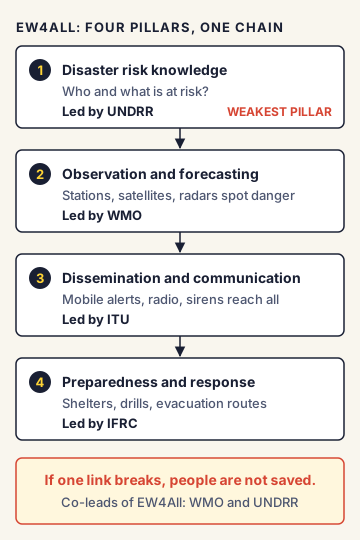
- Disaster risk knowledge (led by UNDRR): knowing which hazards threaten an area and which people, homes and assets are most at risk.
- Detection, observation, monitoring, analysis and forecasting (led by WMO): weather stations, satellites, radars and forecasters who spot a danger and predict where and when it will hit.
- Warning dissemination and communication (led by the International Telecommunication Union, ITU): getting the warning to every person on time, through mobile alerts, radio, TV, sirens and loudspeakers, in a language they understand.
- Preparedness and response capabilities (led by the International Federation of Red Cross and Red Crescent Societies, IFRC): making sure people know what to do when they get the warning: evacuation routes, shelters, drills and local volunteers.
A simple example: a forecast that a cyclone will hit the coast (pillar 2) is useless if fishermen never receive the message (pillar 3), or if they receive it but have no safe shelter to go to (pillar 4).
What is a "multi-hazard" early warning system (MHEWS)?
It is one system that warns about many kinds of dangers (cyclones, floods, heatwaves, landslides, tsunamis) instead of separate systems for each. It saves money and avoids confusion, because people learn one way of receiving and acting on alerts.
How far has the world come?
Progress is tracked through the yearly Global Status of Multi-Hazard Early Warning Systems report by WMO and UNDRR. The 2025 edition, released at COP30 in Belém in November 2025, found that 119 countries (about 60% of all countries) now report having a multi-hazard early warning system, a record high. But big gaps remain. Only 43% of small island developing states reported having one.
Risk knowledge (pillar 1) is the weakest pillar: fewer than one-third of countries report having the ability to properly understand their disaster risks.
India's position and Indian examples
India is often cited as a success story for early warnings:
- Odisha cyclones: The 1999 Odisha super cyclone killed about 10,000 people. When Cyclone Phailin hit in 2013, early warnings and the evacuation of nearly a million people kept deaths to a few dozen. Since then, the India Meteorological Department (IMD) has kept improving its cyclone forecasts.
- SACHET: India's Integrated Alert System, built by the Centre for Development of Telematics (C-DOT) and used by the National Disaster Management Authority (NDMA). It follows the Common Alerting Protocol (CAP), a global standard recommended by the ITU, and sends location-based SMS alerts in many Indian languages across all states and Union Territories.
- Cell broadcast: In May 2026, India launched a nationwide cell broadcast system that sends an alert to every mobile phone in a chosen area at the same time, even if networks are crowded. The government said this supports the EW4All goal.
- Heat Action Plans: Cities like Ahmedabad (since 2013) give advance heatwave warnings and steps to protect people.
- India also leads the Coalition for Disaster Resilient Infrastructure (CDRI), launched in 2019, which helps countries build infrastructure that can survive disasters.
Commonly confused concepts
- EW4All vs Sendai Framework: The Sendai Framework (2015–2030) is the wide global plan to reduce all disaster risk, with seven targets. EW4All (2022–2027) is a narrower, faster campaign focused on just one of those targets, Target G (early warnings).
- EW4All vs CREWS vs SOFF: EW4All is the overall goal and plan. CREWS and SOFF are funding windows that pay for parts of it (warning systems and weather observations).
- Early warning (adaptation) vs Loss and Damage: Early warnings help prevent harm before a disaster, so they count as adaptation. Loss and damage support helps people recover after harm that could not be avoided.
- WMO vs UNDRR: WMO is the UN's specialised agency for weather, climate and water, based in Geneva. UNDRR is the UN office for disaster risk reduction (also in Geneva), which looks after the Sendai Framework.
Issues, criticism and the way forward
- Funding gap: The US$3.1 billion plan has not been fully funded, and poor countries struggle to pay for weather stations, radars and trained forecasters.
- The "last mile": A warning often fails to reach the poorest: people without phones, women in remote homes, migrants who do not speak the local language, or people with disabilities.
- Warnings without action: People may get a warning but have no shelter, no transport or no money to leave. Some ignore alerts because of past false alarms.
- Weak risk knowledge: Many countries do not have good maps of who is at risk, which is why pillar 1 lags.
- Way forward: Experts suggest stable funding through CREWS, SOFF and climate funds; "impact-based" forecasts that tell people what a storm will do (for example, which roads will flood), not just wind speeds; mobile cell broadcast alerts; community volunteers; and anticipatory finance, which releases money to families a few days before a forecast disaster.
Concepts to Know
- Early warning system: A set of tools and people that detect a coming hazard, warn the public in time, and help them act to stay safe.
- Hazard vs disaster: A hazard is a natural event like a cyclone. It becomes a disaster only when it seriously harms people and property who are not prepared.
- Least developed countries (LDCs): A UN list of the world's poorest and most vulnerable countries, such as Bangladesh and Ethiopia.
- Small island developing states (SIDS): Small island nations like Tuvalu and Fiji that face rising seas and strong storms.
- Cell broadcast: A mobile technology that sends one message to all phones in a chosen area at once, unlike SMS, which is sent number by number.
- Anticipatory finance: Money released before a forecast disaster strikes, so families can prepare, instead of waiting until after the damage.
- EW4All announced: 23 March 2022 (World Meteorological Day) by the UN Secretary-General
- Goal: everyone on Earth protected by early warning systems by end-2027
- Executive Action Plan: unveiled 7 November 2022 at COP27, Sharm el-Sheikh, Egypt; US$3.1 billion for 2023–2027 (about 50 US cents per person per year)
- Co-leads: WMO and UNDRR, supported by ITU and IFRC
- Four pillars: risk knowledge (UNDRR), observation and forecasting (WMO), dissemination and communication (ITU), preparedness and response (IFRC)
- Linked to Sendai Framework (2015–2030) Target G
- Global Status of MHEWS 2025: 119 countries (about 60%) report MHEWS; only 43% of SIDS; risk knowledge is the weakest pillar
- Global Commission on Adaptation (2019): 24 hours' warning can cut damage by 30%
- India: SACHET (C-DOT, NDMA, Common Alerting Protocol); nationwide cell broadcast launched May 2026; CDRI launched 2019
● Tracked since November 11, 2026 · last seen November 11, 2026 · updates as the daily brief publishes